Day 866

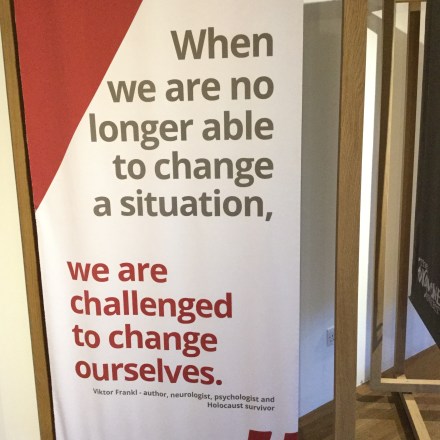
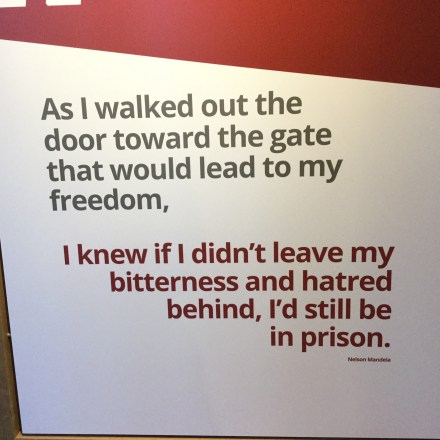
Having a couple of daylight hours still left after work is a luxury. This evening I was lucky. I walked aimlessly along the Southbank and ‘The F-word’ exhibition caught my eye. F for Forgiveness. Bold posters with simple, human messages from ordinary people from all over the world, telling stories that transform, offering a dynamic and challenging exploration of forgiveness through real life situations.

There is nothing ordinary about forgiveness. Forgiving others. Forgiving myself. I constantly struggle with it.

One mother said “When I was told that my son had been killed in action, the first words that came out of my mouth were ’Do not take revenge in the name of my son.’ It was a totally instinctive response.”

When Saagar passed away, one of the strongest feelings that came up for me was – no one should have to loose anyone they love to suicide. That was the driving force that kept me alive and goaded me on but forgiveness is a subtle and powerful thing that happens at another level. I am very conscious of the fact that it is something I really need to address but keep putting it off while it keeps gnawing away at me. Perhaps, it is not entirely by co-incidence that I chanced upon this exhibition.

IMG_0570IMG_0571IMG_0573IMG_0574

Ref: http://theforgivenessproject.com/


Day 864

This is a well-known story within medical circles. A few years ago, a patient was in the operating theatre to have his diseased kidney taken out. Everyone believed it to be the left kidney, except a medical student who said in a hesitant, soft and muffled voice that he thought it was the right kidney. No one paid him any attention and went right ahead to take the left kidney out. It turned out, that was the wrong kidney. The only person who was correct was the medical student. The person who suffered the damage was the patient.

Large organisations are hierarchical by nature. Decisions taken by those on top are rarely questioned by juniors. But true leadership means, the ability to challenge the status quo. The culture of an organization is shaped by the worst behavior the leader is willing to tolerate.

During their selection process, Google particularly look out for ‘courage’ in candidates. They prefer to hire people who ask the right questions and are not afraid to be open if they disagree with what is being said, irrespective of who says it.

The only way to improve is to be open. That is how we learn.

When was the last time I kept quiet when in fact I had something to say? When was the last time I didn’t have the patience to listen? What are the dynamics at my work place? Who pays the price for my silence or my inability to listen? Will I have the courage to speak-up the next time? Will I have the courage to listen?

“It is not because things are difficult that we do not dare, it is because we do not dare that they are difficult.” – Seneca

Ref: Just a Routine Operation (A short film about the importance of Human factors , one of them being assertiveness) : https://www.youtube.com/watch?v=JzlvgtPIof4

Day 860

Surprisingly her train was on time. Today she was careful. She went to the correct platform. It was 12 noon. There were only a few people around, looking lonely. She boarded a quiet coach and was happy to find her favourite, forward-facing-window seat with a table, waiting for her. The only other person there was a young man sitting by the window opposite, immersed in his phone and lost in a world of his own, between the big black and red headphones planted over his ears. Both his feet, with shoes on, were resting on the seat opposite. Her head rankled aloud and she was filled with such severe disapproval that she nearly turned around and left.

But then she stopped. He was only a kid. In a strange way he reminded her of her son, even though he looked nothing like him. She could speak with him. What was the worst that could happen? She approached him gently and got his attention.
“Please would you mind putting your feet down?”
“What’s your problem?”
“Feel free to disregard what I say. I just wanted to share my perspective with you. The grime under your soles gets transferred on to other people’s clean clothes and children’s hands. It can make people sick. That’s all. Thank you.”

She smiled and backed off. She sat at the seat she had ear-marked for herself, just on the other side, across the width of the coach. From the corner of her eye, she saw both his feet descend to the floor. With a nearly imperceptible smile she continued to pretend to be looking out of the window and he continued to do the same and the world went by…

Day 846

simba_497x355

Simba Muzira, son of Sara Muzira.
Exhibition of Art, Long Gallery, Maudsley Hospital. London.
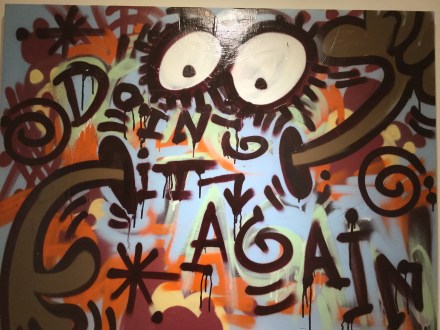
Simba Muzira. Doing it again.

img_0541

Spray paint. Street art. Bold statements. Clear expressions. Innocent eyes. Pure soul.
Courage. Suffering. Passion.

img_0544

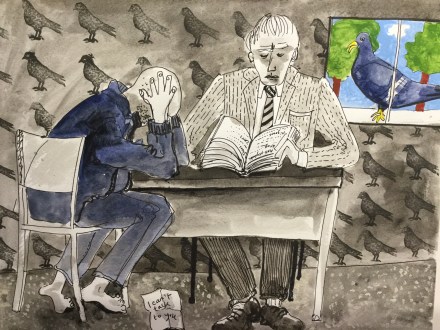
Pigeons telling him not to wear his shoes. Pigeons everywhere! No words!

img_0549

A mother’s tribute to her talented son who died at 32 after living with mental illness for a few years, in and out of the hospital. Her accounts of doing things in his best interest which turned out otherwise. Her heartbreak at having to live away from him when he was too ill to be at home. Her sense of an utter waste of a young life full of promise. Her guilt. Again and again. Her love. Immeasurable.

I salute you. Sara and Simba Muzira.


Day 842

A Psychiatrist recently expressed his point of view- “If I take everyone who tells me they want to end their lives seriously, I would have to admit almost everyone I see to hospital. What we need is for people to be able to verbalise how they feel rather than dash straight to a perceived solution.” I suppose he means it would be helpful if everyone had an emotional vocabulary, a way of describing how they feel – happy, worried, excited, frustrated, scared, wretched, rotten, hopeless, angry…  a process that ideally should start when we’re kids. Just like we learn to identify objects and name them, we should develop the ability to identify our feelings and name them.

“If you’re happy and you know it…clap your hands.”
“If you’re happy and you know it, hug a friend.”
“If you’re sad and you know it, cry a tear – “boo-hoo.”
“If you’re mad and you know it, use your words “I’m mad.”
“If you’re scared and you know it, get some help, “HEEELLLLPPP!”
“If you’re silly and you know it, make a face, “BBBBLLLUUUUHHHH!”

“A large and more complex feeling vocabulary allows children to make finer discriminations between feelings; to better communicate with others about their internal affective states; and to engage in discussions about their personal experiences with the world”
– Centre on the Social and Emotional Foundations for Early Learning (CSEFEL)

Adults can proactively teach young children to identify their feelings and those of others. Through stories, modelling and role play they can pair an emotion with a coping strategy, for example, taking a deep breath when angry; requesting a break when annoyed, talking to someone when sad. Positive emotions may need to be regulated too.

When I was young, feelings didn’t get much attention. They were often set aside, ignored or suppressed. They didn’t seem to be important. They came and went and changed all the time. So, it was easy to not hang on to them. Doing, behaving, achieving and knowing were important. They were tangible and afforded rewards. So, it was easy to focus on them. I didn’t have an emotional vocabulary. I didn’t know there was such a thing. I didn’t know many people who had it. Now I am learning.

Ref:

The feelings song: https://www.youtube.com/watch?v=UsISd1AMNYU

On Monday when it rained: https://www.youtube.com/watch?v=eOhwGmxDPl8

Click to access handout6.pdf