Day 657

When someone becomes depressed, many of their activities function as avoidance and escape from aversive thoughts, feelings or situations. Depression therefore occurs when a person develops a narrow range of passive behaviours. As a result, someone with depression engages less frequently in pleasant or satisfying activities and obtains less positive reinforcement than someone without depression.

40 years ago the first behavioural treatment for depression was described by Lewinsohn et al. Many successful trials were done which somehow got forgotten with the advent on CBT in the 1980s.

Behavioural Activation (BA) focuses on activity scheduling to encourage patients to approach activities that they are avoiding. It focuses on encouraging people to take part in meaningful activities that are linked to their core values. It helps people find out which activities make them feel better. Patients are also taught how to analyse the unintended consequences of their ways of responding, including inactivity and rumination.

A recent paper published in the Lancet by Richards et al at University of Exeter studied 440 people with depression. They were randomised into 2 groups – one received BA and the other received CBT. They found that BA, a simpler psychological treatment than CBT, can be delivered by junior mental health workers with less intensive and costly training, with no lesser effect than CBT. Hence, effective psychological therapy for depression can be delivered without the need for costly and highly trained professionals.

Professor David Richards says:

“Effectively treating depression at low cost is a global priority.
Our finding is the most robust evidence yet that Behavioural Activation is just as effective as CBT, meaning an effective workforce could be trained much more easily and cheaply without any compromise on the high level of quality.
This is an exciting prospect for reducing waiting times and improving access to high-quality depression therapy worldwide, and offers hope for countries who are currently struggling with the impact of depression on the health of their peoples and economies.”

UK is one of those countries.
Day 654

Driving around in hot weather, I found myself looking for a shady spot to park the car so that it wouldn’t be too hot when I came back to it. Walking in the piercing sunshine, I found myself once again, looking for shade. I just expected trees to be there when I needed them. I stopped to think how many trees had I planted myself to rightfully expect them to be there for me. None. Not one.

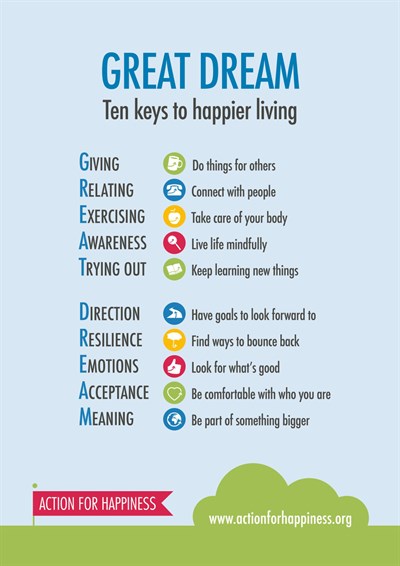
Oprah Winfrey talks about the poverty she faced in childhood. One year her mother took her aside and said there would be no Christmas. However, at midnight there was a knock on the door and a few nuns brought gifts for Oprah and her siblings. She was deeply moved by the fact that someone remembered them and their predicament that night. She went on to raise funds for thousands of poor children to receive gifts on Christmas. ‘Give what you are given’ she says.

great_dream_1000_400x566

If you want to feel good, do good.

I did plant a bay tree about 12 years ago but after 3 years it died. I felt awful and stuck with indoor plants thereafter. I think it is time to try again.


Day 642

What makes a good life?

An answer to this age-old question was attempted by a huge study at Harvard. It followed 724 men from their teenage years for a period of 75 years. Half the men were students at Harvard and the other half were disadvantaged inner city boys of Boston. They all went on to pursue various fields of work – brick-layers, teachers, solicitors and one even became the president of America. Every year, each one of them answered a paper questionnaire and was interviewed in person. Bloods tests and brain scans were performed on them and a large body of data was collected and analysed.

What did they find?

Loneliness is toxic. Loneliness kills.
The way to health and happiness is through good relationships.
Cholesterol level is not a predictor of good health but the quality of one’s social connections is.
Good relationships protect the brain too. People who have friends and relatives they can count on retain their memory for much longer than the ones that don’t.
So, while relationships can be messy, difficult and trying, they are worth leaning into, be it with family, friends or a community.

How can this be done in real terms?

  • Replacing screen time with people time?
  • Doing something new – going for a long walk, gardening, volunteering, watching a black and white film, trying a new recipe?
  • Calling an old friend you’ve been thinking of for a while?
  • Putting a grudge or mistrust aside and reaching out?
  • You know best.

“There isn’t time for bickering, apologies, heart burnings, calling to account. There’s only time for loving. An instant for that.” – Mark Twain.

Good life = Good relationships.


Day 588

Thursday night in the City is chock-a-block. Standing room only in every pub. Sometimes not even that. For many, Friday is a write-off and so is Saturday if the workload at A&E departments all over the country is anything to go by. While on a visit to a Neuro-surgical Intensive Care Unit in Scotland, the recurring theme was ‘fell off a bar stool’, ‘fell off a bar stool’ and ‘fell off a bar stool’.

Today I anaesthetised for a hand surgeon and of the 6 patients on my list, 2 young men landed up there because they punched a wall, a mirror or a glass window in a state of extreme drunkenness.

There is widespread social approval of excessive alcohol consumption for nearly all social strata and all age groups in our society. Alcohol is a depressant. It is often used as an unhealthy coping mechanism by the young and old alike. The more one drinks, the more one needs to drink for the same effect – tolerance. When young people drink heavily, it has a serious negative effect on the development of their young adolescent brains. If everyone drank responsibly, the NHS would save billions of pounds.

Jung said that these behaviours – smoking, drinking, avoiding, not being able to achieve an intimacy with others, point to “a fatal resistance to life in this world”.

Here is a set of ideas penned down by an anonymous author:

We drank for joy and became miserable.
We drank to be sociable and became argumentative.
We drank to feel sophisticated and became obnoxious.
We drank for friendship but made enemies.
We drank to help us sleep but woke up exhausted.
We drank to feel strong and it made us weaker.
We drank for exhilaration but ended up depressed.
We drank to help us calm down and ended up with the shakes.
We drank to gain confidence and became afraid.
We drank to make conversation flow more easily and the words came out slurred.
We drank to lessen our problems and saw them multiply.
We drank to feel heavenly and felt like hell.

Day 586

“In an interconnected world characterized by profound mobility of people and goods, few threats to health are local anymore.
Air pollution is a trans-boundary hazard that affects the global atmosphere and contributes to climate change.
Drug-resistant pathogens, including the growing number of “superbugs”, travel well internationally in people, animals, and food.
The marketing of unhealthy foods and beverages, especially to children, is now a global phenomenon.
Safeguarding the quality of pharmaceutical products has become much harder, with complex manufacturing procedures and supply chains spanning multiple companies and countries.
Ensuring the quality of the food supply is also much harder when a single meal can contain ingredients from all around the world, including some potentially contaminated with exotic pathogens.
The refugee crisis in Europe taught the world that armed conflicts in faraway places will not stay remote.
The Ebola outbreak in 3 small countries paralyzed the world with fear and travel constraints.
Last year, a business traveller returning home to the Republic of Korea, infected with the MERS coronavirus, disrupted the country’s economy as well as its health system.
The rapidly evolving outbreak of Zika warns us that an old disease that slumbered for 6 decades in Africa and Asia can suddenly wake up on a new continent to cause a global health emergency.
This year’s appearance of urban yellow fever in Africa, now confirmed in the capital cities of Angola and the Democratic Republic of Congo, is yet another serious event with potential for further international spread.”
– an except from the address to the 69th World assembly by Dr Margaret Chan, Director-General of the World Health Organization. Geneva, Switzerland. 23 May 2016.

While there was much to celebrate and worry about in her speech, it mainly focussed on physical illnesses. ‘Non-communicable disease’ and ‘drug problem’ were the possible indirect references to mental illnesses. 

In 2013, the Lancet published the largest study looking at Global Burden of Disability (GBD) caused by mental illness. It used DALY as the unit of measurement. DALY stands for Disability Adjusted Life Years.  One DALY equals 1 year of healthy life lost. The highest DALYs attributable to mental illness and Substance use disorder were found between 10-29 years of age. Majority were due to depression, followed by anxiety and then Drug and alcohol disorders. As compared to 1990, the rise in disabilty from these causes in 2010 were 37.6% higher. These findings show the striking and growing challenge that these disorders pose for health systems in developed and developing regions. In view of the magnitude of their contribution, improvement in population health is only possible if countries make the prevention and treatment of mental and substance use disorders a public health priority.