Day 578

image

This is the question : How can we Re-create Psychiatry?

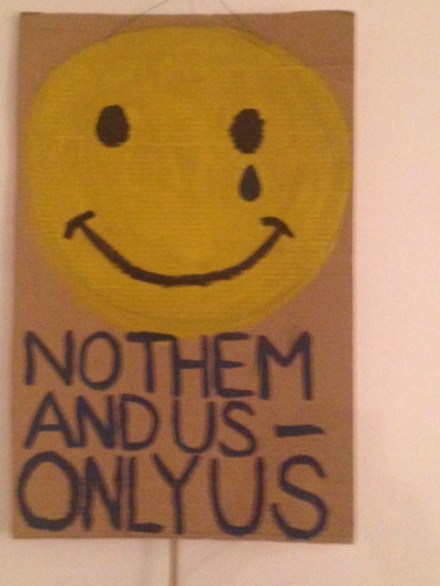
How can we break down the“us” versus “them” approach?

How can we stop ourselves from putting people into neat little labelled boxes rather than perceiving each one as a unique individual with their own unique story and experience?

How can we communicate in a way where we respect boundaries but do not create barriers? How can we truly listen in a way that we can put ourselves in someone else’s shoes?

There is a hierarchy in knowledge. Intellectual knowledge is considered superior to emotional or experiential knowledge, which in turn is rated higher than seemingly irrational knowledge, which could come from ‘patients’ with seemingly little insight. Who makes these decisions? How come the power balance between psychiatrists(intellectual/clinical) and patients(experiential/seemingly irrational) is so extremely warped? Does looking at people through templates give us any idea of who they truly are?

The Open Dialogue approach is a philosophical/theoretical approach to people experiencing a mental health crisis and their families/networks, and a system of care, developed in Western Lapland in Finland over the last 25-30 years. In the 1980s psychiatric services in Western Lapland were in a poor state, in fact they had one of the worst incidences of ‘schizophrenia’ in Europe. Now they have the best documented outcomes in the Western World. For example, around 75% of those experiencing psychosis have returned to work or study within 2 years and only around 20% are still taking antipsychotic medication.

Working with families and social networks, as much as possible in their own homes, Open Dialogue teams work to help those involved in a crisis situation to be together and to engage in dialogue. It has been their experience that if the family/team can bear the extreme emotion in a crisis situation, and tolerate the uncertainty, in time shared meaning usually emerges and healing is possible.

This Open Dialogue training launches in London next month.


Day 575

‘Everyone’s better than me’
‘I’ll never be good at anything’
‘I’m not as clever as my friends’
‘I’m fat’
‘I’m ugly’
‘I’m hideous’
‘Everyone hates me’
‘Other people at school tell me to die’

Lack of self-worth is driving increasing numbers of young people to thoughts of suicide, according to national charity PAPYRUS Prevention of Young Suicide. Young people need to be taught that good relationships with others start with their own self-care. PAPYRUS is calling for more general mental wellbeing sessions in schools and awareness by society in general, to help young people begin to build a positive self-relationship. As well as the basics – getting enough sleep and rest, fresh air and exercise, eating well – we need to teach young people how to deal with negative put-downs.

Contacts made with HOPELineUK helpline services last month increased by 130% over April last year. Lack of self-worth is now a dominant theme and increasing numbers of much younger callers (around 11 plus) say they are not good enough.

“We must all watch out for invitations from young people that say ‘I need help: please ask me how I am feeling’,” urges Ged Flynn, CEO of Papyrus. “Talking about suicide is not easy, but society needs to toughen up. Young suicide is everyone’s business. Talking about it does not make it more likely happen – and it can save young lives.”

Day 574

It’s official. Core Psychiatry Training is on the ‘shortage occupation list’ which means there are not enough resident workers to fill all the vacancies.

“Catastrophic is the word I would use for the shortage we are now facing. We have always struggled to recruit significant numbers but this year is particularly acute. It has got to the point where you can count the number of UK doctors coming into it in tens, when we have hundreds of training posts to fill” says Prof Robert Howard, dean of the Royal College of Psychiatrists (RCP) in the Telegraph.  He goes on to say that due to the lack of competition, jobs are given on the basis of ‘appointability’ rather than great ability. This means that the standard of competence of those selected is just above the basic minimum rather than excellent.

One reason trainees may be reluctant to apply for specialty training in psychiatry is because of the misconceptions and stigma associated with the speciality. For instance, a study presented at the Royal College of Psychiatrists’ 2013 congress found that 26% of medical students and 47% of the public said they would be uncomfortable sitting next to a psychiatrist at a party for “they would know what you are thinking.”

Another reason may be that medical students and other doctors often think that treatments in psychiatry are “unscientific,” and that they lack the same evidence base as treatments in other specialties. Other myths include a sense that psychiatric treatment is inhumane and that psychiatrists resemble those portrayed in films such as One Flew Over the Cuckoo’s Nest and Silence of the Lambs.

While speaking with a young Consultant Psychiatrist it was clear that the prospect of working with very limited resources and support is what makes a career in Psychiatry very unattractive.

A huge recruitment drive is on. Medical students and junior doctors are being introduced to various possibilities within psychiatry early on in their education. Let’s hope it works.


Day 571

Two things tend to greatly suffer in mental illness- creativity and human relationships. Sarah Wheeler believed this as she lived with Borderline Personality Disorder and Depression. She set out to create a space that was open-hearted, connecting, non-judgemental, creative and safe – The Dragon Cafe on Borough High Street in London. And it is exactly that – a little bit of heaven for those who’ve been in hell.

Sarah set up “Mental Fight club”. It’s mission is to put on imaginative events for people of all mental health experiences. Every event seeks to connect our inner and outer world and ourselves to one another, whoever we may be. It is no wonder that I intended to be there only for a couple of hours but ended up spending more than double that time, feeling totally relaxed and quite happy.

All visitors are called patrons. Each one is important. You don’t have to do anything. You may do some art, read poetry, dance, sit around and chat, drink tea, have some heavily subsidized, freshly cooked vegetarian food or have a nap on a bean-bag in the Quiet Room.
I will definitely be back there next Monday.

From our conversations it was clear that it is the focal point of many lives. It gives them hope, some thing to look forward to and a strong sense of acceptance and belonging. These are basic human needs that are so often unfulfilled.

Maybe mental illness is not a disease of the brain, but that of society.

This poem by Ben Okri is one of Sarah’s inspirations:

An illusion by which we can become
More real.
A moment unremarked by the Universe,
By nature, the seasons or stars.
Moment we have marked out
In timelessness.
Human moment.
Making a ritual, a drama, a tear
On eternity.
Domesticating the infinite.
Contemplating the quantum questions,
Time, death, new beginnings,
Regenerations, cycles, the unknown.

Day 570

She lost her son to suicide in 1993. One year before Saagar was born. She wrote to me in response to an article I wrote for the Papyrus newsletter in March 2016 entitled “Mandatory Suicide Prevention Training- Why not?”

It is a beautifully hand-written letter. In her slightly shaky cursive writing she says “I wholeheartedly agree that the profession of GPs must be more tailored to suicide prevention. When Claire Gerarder was chair of the College of General Practice, a fourth year of GP training was discussed. If the length of GP training was as long as Specialist Medical training (7 years), hopefully more disasters could be prevented. For many years I have suffered the indifference and stigma of colleagues and society. Since my son died in 1993 I have worked on ways of prevention of Suicide.”

She signed off with, ”Yours in hope of help, EP.”
“PS: I am not on the internet. I have no e-mail.”
For her, 23 years have passed. Clearly, she is still hurting.
And nothing much has changed.
She sounds a bit like me.

How would she have coped so many years ago?
How did she get through all these years?
Where will I be in 23 years? How would that feel? Will anything change?
It is quite unthinkable.