Day 720

Back in London, I notice the filthy water of the Thames, the inescapable stenches of various kinds emanating from nooks and corners on the streets, the stress of the daily commute and the demanding work environment. Patients demanding to be treated like ‘customers’ who are always right and managers trying to get results unachievable with the realities and limitations on ground. Me, finding myself stuck in the middle of the two. One patient, who was denied a separate room that she demanded for no valid reason said that this is the National Health Service but their ‘customer service’ is very poor.

Many nurses and doctors feel demotivated and exhausted by constant firefighting and not having the time to actually do the work they want to, taking care of patients. This leads to earlier burnout and sideways movement of highly trained staff away from frontline work to more lucrative and glossy management roles.

Stress is the biggest killer of modern times. One of the definitions of stress is, not living up to one’s own expectations. With fewer job prospects, growing number of ‘zero hour’ contracts, rising property prices, longer working hours and rising living costs, it is not surprising that young people find themselves not achieving as much as they are capable of.

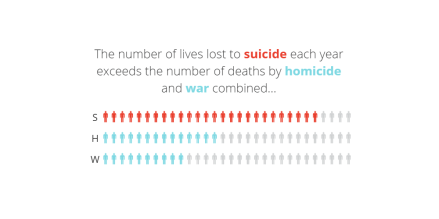
The latest figures published by the Office for National Statistics highlight that young suicide in the UK is at its highest for the past 10 years. In 2015 1,659 young people under 35 years took their own lives; an increase of 103 more than in 2014 and 58 above the previous highest recorded figure (1,631 in 2011).

Suicide is the biggest killer of young people in the UK and tragically the figures continue to rise. It is a national crisis yet far from prominent on the government’s agenda.
 

Day 717

Sunday lunch at the start of autumn on a warm day of blue skies and a warm sun, sitting under a wise old carob tree with supported branches and multiple dried brown beans hanging from a wide umbrella of dark green leaves with friends and strangers making introductions followed by conversations, smiles and laughter, references to this and that, occupations, travels and hobbies, daughters and mothers, food and wine, so on and so forth …. as if straight out of a film set infused with a sweet subtle smell of eucalyptus.

All of it completely meaningless, empty, futile, feckless, inane and pointless. Words, words and more words! Exhausting! I had to get up and walk away with my i-pad and take pictures of something. Anything.

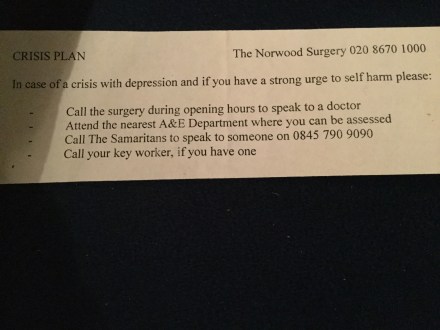
In 2 weeks time he will be dead. Around this time 2 years ago he was scoring max on his depression scores and he gave it in writing to his GP in the form of a PHQ-9 form but got no help. No escalation of care. No attention. No mention of ‘suicide’ to us and yet holding a firm belief that a safety plan was in place. Sent home with the suggestion, “It will get better. Give it time. Rome was not built in one day” and a piece of paper.

img_0279

It was early autumn then and it is early autumn now.
I lived in what I thought was our world then.
I live in a world of my own now. It sort of overlaps with this one in places but most of this one is irrelevant to me.

img_0270

Day 710

Can someone press the ‘Refresh’ button for me please?
Hello! Anyone there?
Nope.
Just me.
I’ve got to do it myself.

Many people ready and willing to hold my hand while I do it. Many waiting patiently for it to happen.
‘Re-fresh’.
Re-invent. Re-define. Re-create. Re-invigorate.
Re-enthuse. Re-affirm. Re-generate. Re-vive. Re-vitalise.
Re-make. Re-vamp. Re-novate. Re-build.
Re-model. Re-store. Re-new. Re-instate.
Re-live. Re-smile. Re-settle.

It’s coming up to two years!
Is that a measure of anything though?
Time means nothing.
The absolute finality of death brings Time to a halt.
The suddenness of it puts emergency breaks on Time and forces it to come to a dead stop.

The question I ask myself – how much of this being ‘stuck’ is natural and how much is generated by my ‘ego’? I am sure Eckhard Tolle would ascribe a lot of it to my ‘pain-body’.

“It is not so much that you cannot stop your train of negative thoughts, but that you don’t want to. This is because the pain-body is living through you, pretending to be you. And to the pain-body, pain is pleasure. It eagerly devours every negative thought. In fact, the usual voice in your head has now become the voice of the pain-body. It has taken over the internal dialogue. A vicious circle becomes established between the pain-body and your thinking. Every thought feeds the pain-body and in turn the pain-body generates more thoughts. At some point, after a few hours or even a few days, it has replenished itself and returns to its dormant stage, leaving behind a depleted organism and a body that is much more susceptible to illness. If that sounds to you like a psychic parasite, you are right. That’s exactly what it is.

The beginning of freedom from the pain-body lies first of all in the realization that you have a pain-body. Then, more important, in your ability to stay present enough, alert enough, to notice the pain-body in yourself as a heavy influx of negative emotion when it becomes active. When it is recognized, it can no longer pretend to be you and live and renew itself through you.

It is your conscious Presence that breaks the identification with the pain-body. When you don’t identify with it, the pain-body can no longer control your thinking and so cannot renew itself anymore by feeding on your thoughts. The pain-body in most cases does not dissolve immediately, but once you have severed the link between it and your thinking, the pain-body begins to lose energy. Your thinking ceases to be clouded by emotion; your present perceptions are no longer distorted by the past. The energy that was trapped in the pain-body then changes its vibrational frequency and is transmuted into Presence.”

Conscious Presence.
Awareness of the ‘self’ which is infinitely more expansive than thoughts and feelings.

Day 709

Often I feel like I am hanging in between life and death. Neither fully alive nor fully dead. Will this plague stay within me forever or set me free one way, or another?

Andrew Sullivan, who suffered with AIDS and its accomplices writes :

“ And for a precious short time, like so many other (HIV) positive people, I also sensed that the key to living was not a concentration on fighting the mechanics of the disease (although that was essential) or fighting the mechanics of life (although that is inevitable), but an indifference to both of their imponderables. In order to survive mentally, I had to find a place within myself where plague couldn’t get me, where success or failure in such a battle was of equal consequence. This was not an easy task. It required resisting the emotional satisfaction of being cured and the emotional closure of death itself. But in that, of course, it resembled merely what we all go through every day. Living, I discovered for the second, but really the first time, is not about resolution; it is about the place where plague can’t get you.”

The grief of loosing Saagar is not the plague. It is unbearably sad but the plague is that voice in my head that screams – “You didn’t love him enough to save him. You could have done more. Love is in actions, not words. Love is not just an emotion. All this campaigning and writing is a cover-up. You will be found out. You didn’t care enough for your own child.”

That is the plague.
Living is, to find a place where the plague can’t get me.
To find a place where it can’t get me.
Cannot get me.

Day 708

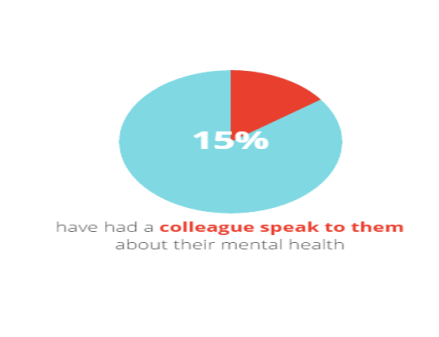
suicide_homicide_warA survey of 500 people revealed that a third of people didn’t feel comfortable at all talking to someone at work about mental health related issues and only 15% have had a colleague speak to them about their mental health.
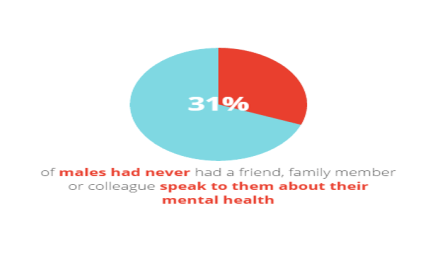
The survey also uncovered an interesting trend: nearly a third of all male respondents have never had a friend, family member or colleague speak to them about their mental health. Worryingly, this statistic rises to 42% for males aged 45 and over and increases yet again to 60% for males aged 54 and over.
( Source:  www.team24.co.uk/suicide-prevention-day )

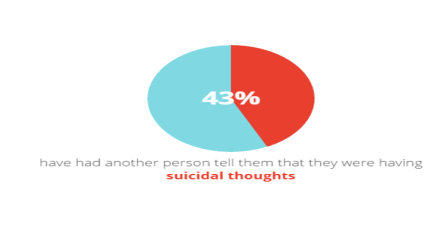
43_per_cent_suicidal_thoughts

33_per_cent_dont_feel_comfortable_talking

31_per_cent_males_never_speak_mental_health

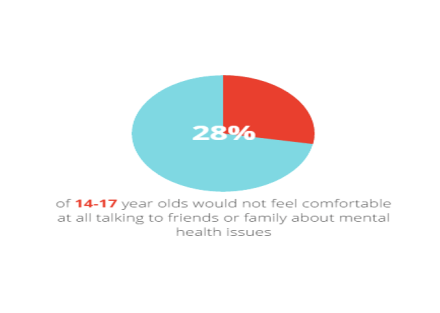
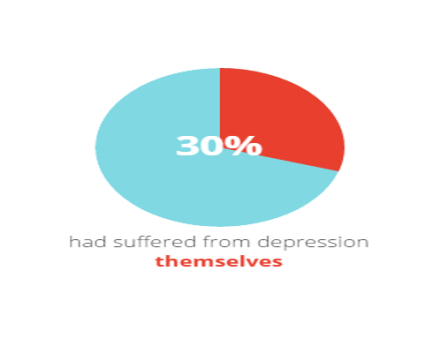
30_per_cent_suffered_depression28_per_cent_14_17_dont_feel_comfortable


15_per_cent_colleague_mental_health

“I would say that the vast majority of people who die by suicide, don’t necessarily want to be dead—they want to end their suffering and don’t know what else to do. We know from our clinical treatment research that suicidal suffering can be effectively treated. There is hope; suicidal states can be effectively treated and people can and do recover from suicidal suffering.”

David A. Jobes, Ph.D., ABPP. Professor of Psychology. Author of Managing Suicidal Risk

Prevention starts with a conversation.

Let’s start the conversation.