Day 713

“Thank you Gas-lady” said the surgeon at the end of our working day as he picked up his bag to leave the operating theatre. I acknowledged it with a smile and a nod. That’s sweet. At that moment it didn’t register but later I realised that he does not know my name. We have worked in the same theatre complex one day per week for the past 4 years and he does not know my name. That’s interesting. I wondered how many people I see on a regular basis and don’t know the names of.

How did that make me feel? Not exactly insulted but definitely unimportant. I found myself making excuses for him – may be he finds my name difficult to remember. It is a foreign name after all. But this is London and many people here have foreign names. May be it is a reflection of a basic power imbalance – every one knows his name but he doesn’t have to know everyone’s name.

Knowing a name is a small thing, but it makes the difference between making someone feel that they matter or they don’t. When our name is known, we are more likely to have a sense of belonging to a person or a group. It also means that who we are is central to the interactions we have.

“Could someone get the defibrillator please?”
“James, could you please bring in the defibrillator?”

Which one of these two statements is likely to produce a quick and effective result? Knowing names can make it easier to get a job done.

Patients are not diabetics, schizophrenics, bed 10, ‘last on the list’, so on and so forth. They have their names and unique identities. Of course, it is not always easy to remember names. It does take some effort. It is easier to put in that effort if we know how much of a difference it can make not only to others but also to us. I find myself paying more attention to names now. Even if I get it wrong, I like to think I tried.
It is definitely worth the effort.

( Saagar was really good at remembering names. In fact, the more unusual the name, the more fun he had with it. Well, there’s a name I’ll never forget – Saagar.)
Day 712

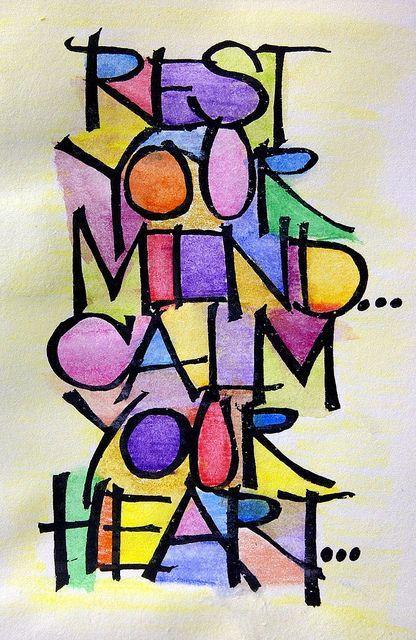
rest-your-mind-calm-our-heart-quote-1

I long suspected that doing nothing was under-rated. I could do ‘doing nothing’ for hours, given a chance. Psychologists now believe that ‘doing nothing’ is in fact a positively restful activity. Day-dreaming is good for us and letting one’s mind wander is healthy.

Rest and doing nothing –same thing?
Rest and relaxation – same thing?
Rest and laziness – same thing?
Rest and ‘not at work’ – same thing?
Rest and lying in bed –same thing?

The Rest Test is a survey taken by the ‘old people’s ‘ radio – BBC Radio 4 to look into various aspects of rest. In the fast paced lives of today where each one of our free moments can potentially be invaded and claimed by phone calls, e-mails, face-book, texts and tweets, this survey is well timed.

It is the largest of its kind with 18,000 people from 134 countries participating in it.

What did it find?

More than 70% believe they need more rest than they get.
(http://www.bbc.co.uk/programmes/articles/5GF8npkXxpp4z0KBqGx2pl7/the-ten-most-restful-activities)

The most restful activities are: reading, being with nature, being on your own, listening to music, doing nothing, having a bath or shower, walking or exercising, day-dreaming, watching TV and meditating or practicing mindfulness.

All of the above are true for me but breathing consciously tops the list. Being with my breath keeps me connected to ‘right here right now’, to my ‘self’ and my sanity. The breath is a free resource. About 10 years ago I learnt to use it as a source of energy and calm at the same time. (http://www.artofliving.org/us-en/research-sudarshan-kriya) I experience deep rest through breathing exercises and meditation. 

Rest is often the unwritten part of a doctor’s prescription for various stress-related disorders. It is vital for our well-being.

Here’s a poem from the programme:

I expect you might at some point tonight
Beneath the sheets before sleep
Still reeling from the flaming lights
Want or more likely seek

Rest.

There’s no manifesto in this
No snake like lists of things to do
There’s no tomorrow either
There’s poetry as ever and YOU.

Day 711

photo-7

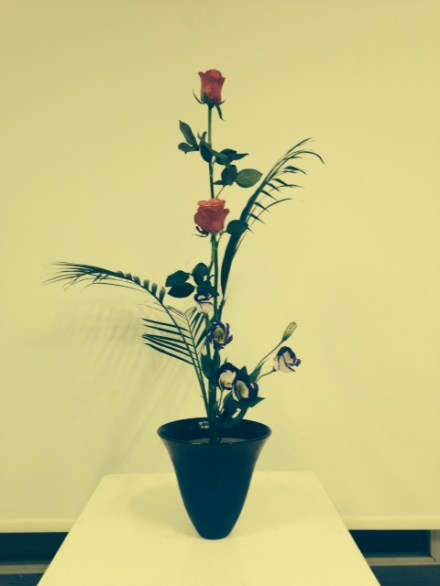
“This study is ok for the bed-room” said my teacher scrutinizing my floral arrangement, “not for the living room.”

Resuming Ikebana lessons has reminded me how much pleasure I derive from touching, feeling, smelling and putting different types of flowers and foliage together. After a long day of practicing anaesthesia, it is a refreshing change to be in a position where the big decisions to be made are – which colour do I want the flowers to be, how long should this stem be, which leaves should I keep and which ones should be trimmed away and other such important considerations.

I belong to the Ikenobo school of Ikebana, an ancient art of Japanese flower arranging. It endeavours to bring nature indoors and establish a perfect balance between the beauty outside and inside homes. It is a classical art form based on deeply philosophical principles.

The study I am presently working on is called Shoka Shofutai. In this composition 3 types of materials are used and arranged in 3 groups named Shin, Soe and Tai.

Looking over my notes I found that the Tai group has 3 stems right in the front of the arrangement, representing the present, the past and the future. The one representing the present should stand tall and should have some buds. The one representing the future should be bending forward and should have buds. The one representing the past should be in between the two and should be the smallest in size.

I wonder if there is a message in that.


Day 710

Can someone press the ‘Refresh’ button for me please?
Hello! Anyone there?
Nope.
Just me.
I’ve got to do it myself.

Many people ready and willing to hold my hand while I do it. Many waiting patiently for it to happen.
‘Re-fresh’.
Re-invent. Re-define. Re-create. Re-invigorate.
Re-enthuse. Re-affirm. Re-generate. Re-vive. Re-vitalise.
Re-make. Re-vamp. Re-novate. Re-build.
Re-model. Re-store. Re-new. Re-instate.
Re-live. Re-smile. Re-settle.

It’s coming up to two years!
Is that a measure of anything though?
Time means nothing.
The absolute finality of death brings Time to a halt.
The suddenness of it puts emergency breaks on Time and forces it to come to a dead stop.

The question I ask myself – how much of this being ‘stuck’ is natural and how much is generated by my ‘ego’? I am sure Eckhard Tolle would ascribe a lot of it to my ‘pain-body’.

“It is not so much that you cannot stop your train of negative thoughts, but that you don’t want to. This is because the pain-body is living through you, pretending to be you. And to the pain-body, pain is pleasure. It eagerly devours every negative thought. In fact, the usual voice in your head has now become the voice of the pain-body. It has taken over the internal dialogue. A vicious circle becomes established between the pain-body and your thinking. Every thought feeds the pain-body and in turn the pain-body generates more thoughts. At some point, after a few hours or even a few days, it has replenished itself and returns to its dormant stage, leaving behind a depleted organism and a body that is much more susceptible to illness. If that sounds to you like a psychic parasite, you are right. That’s exactly what it is.

The beginning of freedom from the pain-body lies first of all in the realization that you have a pain-body. Then, more important, in your ability to stay present enough, alert enough, to notice the pain-body in yourself as a heavy influx of negative emotion when it becomes active. When it is recognized, it can no longer pretend to be you and live and renew itself through you.

It is your conscious Presence that breaks the identification with the pain-body. When you don’t identify with it, the pain-body can no longer control your thinking and so cannot renew itself anymore by feeding on your thoughts. The pain-body in most cases does not dissolve immediately, but once you have severed the link between it and your thinking, the pain-body begins to lose energy. Your thinking ceases to be clouded by emotion; your present perceptions are no longer distorted by the past. The energy that was trapped in the pain-body then changes its vibrational frequency and is transmuted into Presence.”

Conscious Presence.
Awareness of the ‘self’ which is infinitely more expansive than thoughts and feelings.

Day 709

Often I feel like I am hanging in between life and death. Neither fully alive nor fully dead. Will this plague stay within me forever or set me free one way, or another?

Andrew Sullivan, who suffered with AIDS and its accomplices writes :

“ And for a precious short time, like so many other (HIV) positive people, I also sensed that the key to living was not a concentration on fighting the mechanics of the disease (although that was essential) or fighting the mechanics of life (although that is inevitable), but an indifference to both of their imponderables. In order to survive mentally, I had to find a place within myself where plague couldn’t get me, where success or failure in such a battle was of equal consequence. This was not an easy task. It required resisting the emotional satisfaction of being cured and the emotional closure of death itself. But in that, of course, it resembled merely what we all go through every day. Living, I discovered for the second, but really the first time, is not about resolution; it is about the place where plague can’t get you.”

The grief of loosing Saagar is not the plague. It is unbearably sad but the plague is that voice in my head that screams – “You didn’t love him enough to save him. You could have done more. Love is in actions, not words. Love is not just an emotion. All this campaigning and writing is a cover-up. You will be found out. You didn’t care enough for your own child.”

That is the plague.
Living is, to find a place where the plague can’t get me.
To find a place where it can’t get me.
Cannot get me.