Day 941

images-1

Karma – Good or bad, to each his own.

Valmiki started his life as a thief — looting to feed his family. He felt that he was protecting them and doing his duty. He was about to steal from Saint Narada who questioned him on his stealing ways.

Saint Narada: Why do you steal?
Valmiki: It’s my duty to protect my family. I only know how to steal and kill.
Saint Narada: By killing and robbing others you are acquiring lot of bad karma. Go and ask your family members whether they can take any part of your karma.
(Valmiki goes to his family)
Valmiki: Can any of you take part of my karma that I have incurred for you, due to my stealing habits.
Valmiki’s Mother: I didn’t know anything about the bad things you were involved in. Therefore, in no way can I be part of it.
Valmiki’s wife: I didn’t know anything about the bad things you were involved in. Therefore, in no way can I be part of it.
Valmiki’s children: We didn’t know anything about the bad things you were involved in. Therefore, in no way can we be part of it.
Valmiki (to Saint Narada): Nobody is willing to share any part of my bad karma. What’s the salvation for me then?
Saint Narada: Chant ‘Rama’, all day and all night.
Valmiki chanted ‘Mara’ as he misheard the saint. He chanted for many years. An anthill formed over him. People heard only the sound. When he came out of his meditation, he wrote the famous epic Ramayana.
Day 938

Oooops! Sorry!

If a previously healthy man recognises that he is a huge risk to himself. If he takes himself to a mental health facility and pleads for help. If they admit him and then classify him as ‘low risk’ and leave him unsupervised. If he then goes on to end his life in the hospital within hours of being there. This has got to be wrong. One would think this to be nearly impossible. It isn’t. It happens.

A Canadian study published in 2014 on inpatient suicides concluded that “It is possible to reduce suicide risk on the ward by having a safe environment, optimising patient visibility, supervising patients appropriately, careful assessment, awareness of and respect for suicide risk, good teamwork and communication, and adequate clinical treatment.”

Recently, a Coroner’s report on an inpatient suicide found the same things that came out in Saagar’s case:
-Risk of suicide was not properly and adequately assessed and reviewed
-Transfer of verbal and written information was poor
-Risk assessment and quality of observation was poor
-Adequate and appropriate precautions were not taken to manage the risk of suicide
In addition, they found that previous recommendations on risk and environmental factors were not implemented adequately. This means that similar deaths had occurred before but nothing had changed.

How many people need to be sacrificed before something changes?
Ed Mallen, 18, died while he was on a waiting list.
Many thousands are still waiting!

Ruby is a lovely young lady who shares the joys of being on a waiting list, among other things. Here’s the link. This time it’s 18 minutes.
Thank you Ruby! We wish you well!!!

https://soundcloud.com/user-474898075/ruby-201517

Day 922

Me and Mine

Where dost thou seek Me?

Lo! I am beside thee.
I am neither in temple nor in mosque
I am neither in Kaaba nor in Kailash.
Neither am I in rites and ceremonies,
nor in Yoga and renunciation.

If thou art a true seeker, thou shalt at
once see Me : thou shalt meet Me
For the priest, the warrior, the trades- man,
and all the thirty-six castes alike are seeking for God.
Hindus and Moslems alike have achieved that End, where remains no mark of distinction.

O friend!  Hope for Him whilst you live, know whilst you live,
understand whilst you live, for in life deliverance abides.
If your bonds be not broken whilst living, what hope of deliverance in death ?

It is but an empty dream, that the soul shall have union with Him
because it has passed from the body
If He is found now, He is found then,
If not, we do but go to dwell in the City of Death.

If you have union now, you shall have it hereafter.
Bathe in the truth, know the true Guru, have faith in the true Name!
It is the Spirit of the quest which helps ; I am the slave of this Spirit of the quest.”

Do not go to the garden of flowers.
O Friend! go not there.
In your body is the garden of flowers.
Take your seat on the thousand petals of the lotus, and there gaze on the Infinite Beauty.

TELL me, Brother, how can I renounce Maya?
When I gave up the tying of ribbons,
still I tied my garment about me
When I gave up tying my garment,
still I covered my body in its folds.
So, when I give up passion, I see that
anger remains ; And when I renounce anger, greed is
with me still ; And when greed is vanquished, pride
and vain glory remain; When the mind is detached and casts Maya away, still it clings to the letter.

THE moon shines in my body, but my
blind eyes cannot see it.
The moon is within me, and so is the
sun. The unstruck drum of Eternity is
sounded within me, but my deaf
ears cannot hear it.
So long as man clamours for the me
and the Mine, his works are as naught.

When all love of the me and the Mine
is dead, then the work of the Lord
is done. For work has no other aim than the
getting of knowledge.

When that comes, then work is put
away.

Saint Kabir 


Day 888

Dying from Inequality – Samaritans commissioned eight leading social scientists to review and extend the existing body of knowledge on socioeconomic disadvantage, ie. being poor, addressing three key questions:

  • Why is there a connection between socioeconomic disadvantage and suicidal behaviour?
  • What is it about socioeconomic disadvantage that increases the risk of suicidal behaviour?
  • What can be done about it?

A few excerpts:

Neighbourhoods that are the most deprived have worse health than those that are less deprived and this association follows a gradient: for each increase in deprivation, there is a decrease in health. Additional support for those living in deprived areas is needed to reduce geographical inequalities in health and the risk of suicidal behaviour.

Economic uncertainty, unemployment, a decline in income relative to local wages, unmanageable debt, the threat or fear of home repossessions, job insecurity and business downsizing may all increase the risk of suicidal behaviour, especially for individuals who experience socioeconomic disadvantage.

Unmanageable debt is an important risk factor for suicidal behaviour. Financial advice and support for those at risk of having unmanageable debt can help reduce the risk of mental health problems and suicidal behaviour.

Suicidal behaviour and mental health problems, such as mild-to-moderate anxiety and depression, could be reduced through labour market policy design, such as higher spending on active labour market programmes and unemployment benefits.

People living with socioeconomic disadvantage and inequalities are more likely to experience negative events during their life, such as job loss, financial difficulties, poor housing, and relationship breakdown. This can lead to negative emotions and increase the likelihood of suicidal behaviour.

Ref:

Dying from Inequality: http://www.samaritans.org/sites/default/files/kcfinder/files/Samaritans%20Dying%20from%20inequality%20report%20-%20summary.pdf

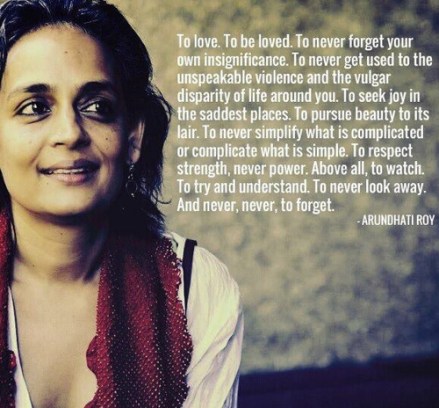
arundhati-roy_picture-quote

Day 876

The second year I thought was harder than the first. Now, I think this year is harder than the second. As time goes by, the finality of death slaps me harder in the face. It becomes clearer that this is it. “Deal with it. Despite all the help and love in the world, you have to do this on your own for the rest of your life” says the merciless voice in my head, “You will never see him again. Get used to it.”

Each breath strings up a bunch of moments together and one by one they slip and slide away. On some days the seemingly humungous task of getting from the front door of the house to the car takes forever. At other times, hours fly by like weightless nebulous clouds on wings. Seconds linger like sumo wrestlers battling with sleep, yet a week can be gone in a flash.

Red-hot intensity of grief starts to tire and turns to ashes of resignation. Questions know they are unanswerable and yet they incessantly repeat their customary laps round and round the velodrome of headspace. Like a stubborn arrogant squatter, guilt refuses to pack its bags and evict this cold, dilapidated building.

What is better? What is worse?
What is the truth?
Who makes that judgement?
The witness?
Or the witness of the witness?