Acer and Ajahn

After Saagar’s death, it felt as if a big black boulder had landed in the middle of our living room. There wasn’t much space around it. It occupied the entire room. I had no escape from this uninvited guest. I had to squeeze my way around it to get past. Its roughness abraded my skin. It was stubborn, heavy, ugly, lifeless, crude and unmoving. It had made a home in our house. It was here to stay. I had no choice but to live with it and look at it. It stared right back at me non-stop. Its weight was suffocating. It sat on my chest, jutting its chin out, determined to get me. I pushed with all my might but it didn’t budge an iota.

It’s still there. But I can negotiate my way around it without the jaggedness making me bleed. We can sit and watch each other without wanting to kill each other. It has relaxed and settled into my space and I can breathe. A green shoot has peeped from underneath it. Another slender sapling has appeared out of the crevice near the window.  The old sharp corners don’t catch anymore. They have rounded off. Life is happening around it.

If I had remained firmly rooted in the pure physicality of the world, I couldn’t have co-existed with this deeply unpleasant and unwanted occurrence. Spiritual teachings and practices have been a respite from my mind, the generator of pain. I am nowhere near ‘wise’ but I remain open to universal knowledge. I allow it to bring me peace, however momentary.

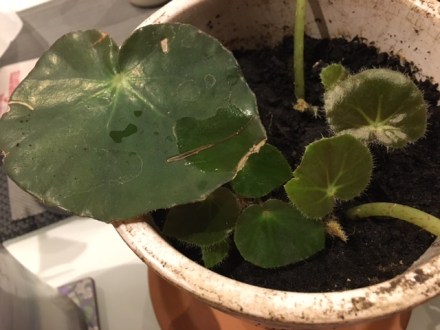
Amaravati Buddist monestary is one of my refuges. A few months ago I spent 5 days there in Silent retreat. A beautiful plant with asymmetric leaves overflowed from an indoor pot. With permission I brought 3 leaves home, allowed them to root in water and then planted them in soil. They look happy.
IMG_6211

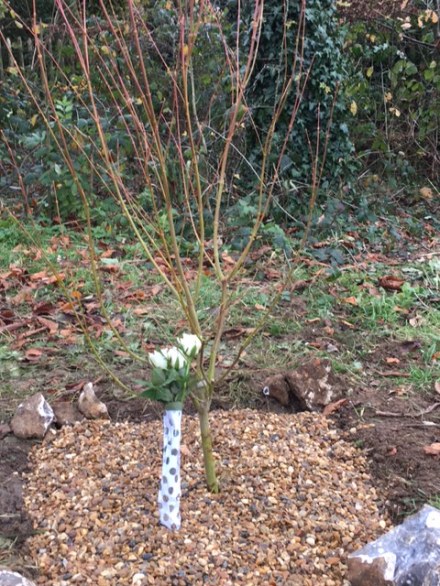
In December 2017 we planted an Acer in Saagar’s memory at Amaravati. It’s called ‘Winter flame’ or Acer Palmatum. A friend of a friend is a ceramist. She is making a set of drums and drumming sticks with Saagar’s initials, to be placed at the tree. I have never met her. She has never met me or Saagar. But we are connected. We all are connected.
IMG_5924

An excerpt from a Dhamma talk by Ajahn Anando:

“We suffer because we constantly chase pleasure. We run away from pain.
Loose the greed for sensuous things.
See that the letting go of the world is peaceful.
Time is nothing. There is only ‘now’ and ‘change’.
Past and future are ‘thoughts’ in the Now.
Is there any way you can get into the past? Or the future?
Is there any way you can get out of ‘Now’?”

Resource:

https://www.amaravati.org/audio/

Turn the page…

Screen Shot 2018-02-17 at 23.12.32

The wisdom of Paulo Coelho:

“One always has to know when a stage comes to an end. If we insist on staying longer than the necessary time, we lose the happiness and the meaning of the other stages we have to go through.
Closing cycles, shutting doors, ending chapters – whatever name we give it, what matters is to leave in the past the moments of life that have finished.

Did you lose your job? Has a loving relationship come to an end? Did you leave your parents’ house? Gone to live abroad? Has a long-lasting friendship ended all of a sudden?
You can spend a long time wondering why this has happened.

You can tell yourself you won’t take another step until you find out why certain things that were so important and so solid in your life have turned into dust, just like that.
But such an attitude will be awfully stressing for everyone involved: your parents, your husband or wife, your friends, your children, your sister.
Everyone is finishing chapters, turning over new leaves, getting on with life, and they will all feel bad seeing you at a standstill.

Things pass, and the best we can do is to let them really go away.
That is why it is so important (however painful it may be!) to destroy souvenirs, move, give lots of things away to orphanages, sell or donate the books you have at home.

Everything in this visible world is a manifestation of the invisible world, of what is going on in our hearts – and getting rid of certain memories also means making some room for other memories to take their place.
Let things go. Release them. Detach yourself from them.

Nobody plays this life with marked cards, so sometimes we win and sometimes we lose.
Do not expect anything in return, do not expect your efforts to be appreciated, your genius to be discovered, your love to be understood.

Stop turning on your emotional television to watch the same program over and over again, the one that shows how much you suffered from a certain loss: that is only poisoning you, nothing else.

Nothing is more dangerous than not accepting love relationships that are broken off, work that is promised but there is no starting date, decisions that are always put off waiting for the “ideal moment.”

Before a new chapter is begun, the old one has to be finished: tell yourself that what has passed will never come back.
Remember that there was a time when you could live without that thing or that person – nothing is irreplaceable, a habit is not a need.
This may sound so obvious, it may even be difficult, but it is very important.

Closing cycles. Not because of pride, incapacity or arrogance, but simply because that no longer fits your life.

Shut the door, change the record, clean the house, shake off the dust.
Stop being who you were, and change into who you are.”

Let’s play Politics!

National Confidential Inquiry into suicide and homicide in people with mental illnesses 2016:

In-patient suicides:

Suicide by mental health in-patients continues to fall, most clearly in England where the decrease has been around 60% during 2004-14. This fall began with the removal of ligature points to prevent deaths by hanging but has been seen in suicides on and off the ward and by all methods. Despite this success, there were 76 suicides by in-patients in the UK in 2014, including 62 in England.

Suicides after discharge:

The first three months after hospital discharge continue to be a period of high suicide risk. In England the number of deaths rose to 200 in 2014 after a fall in the previous year. Risk is highest in the first two weeks post-discharge: in a previous study we have shown that these deaths are associated with preceding admissions lasting less than 7 days and lack of care planning. There has been a fall in post-discharge deaths occurring before first service contact, suggesting recognition of the need for early follow-up. In all there were around 460 patient suicides in acute care settings – in-patient and post-discharge care and crisis teams – in the UK in 2014.

First of all I want to say that every suicide is a huge tragedy and must be prevented at all costs. Behind each of these numbers are precious lives and beautiful people. I don’t allow myself to forget that even when I am angry. This blog is a mere observation on how I have seen politics being played in front of my eyes in the last week. In light of the above findings, in consultation with his expert advisors and in all his wisdom, Mr Jeremy Hunt has decided to focus his attention on in-patient deaths – a group that is manned by the most highly trained professionals in a very controlled environment, a group that is on the list of ‘never-events’, a group that has already shown a decrease by 60%, a group where even a small reduction in numbers will amount to a big percentage and will make him look good.

With all good intentions, he has converted a healthy aspiration of Zero-suicide in the community to an unhealthy target for in-patients creating huge anxieties. Last week at the NSPA conference I heard Mr Hunt speak in the most self-congratulatory of tones about how wonderful it is that UK is the first country to legislate for ‘Parity of Esteem’. I am sorry Sir, that means nothing on the ground. The workforce coming in contact with the majority of suicidal people in the UK is largely untrained. They don’t even know how to talk with them, let alone ‘look-after’ them. The massive funding cuts focus on mental health which in turn results in poor training of junior doctors. When questioned directly about ‘parity of training’, he masterfully slips and slides away.

In my eyes you don’t look good Mr Hunt.


Bad doctor!!!

Screen Shot 2018-01-28 at 21.23.13

Despite check-lists, protocols and guidelines, mistakes happen. As long as human beings carry out jobs, mistakes will happen. To err is human. Safety is an outcome of a person’s attitudes and actions within a given environment. Both, the person and the environment have a strong impact on each other and the outcomes. The bad mood of one person affects the whole team. Similarly, a stressful milieu for any reason such as lack of time and resources has a direct impact on the performance of each person in it.

In my 19 years in the NHS, the working conditions and morale amongst the staff have gradually worsened.  When things go wrong, clinicians, being visible on the frontline are expected and often willing to take responsibility. Holes in the system and staff morale are hidden. Only on a closer look are they clearly seen.

I sit in a unique position where I work for the same organisation that is at least partly, if not fully responsible for the fact that my son is not in this world any more. Yet, I know and see many doctors and nurses work way beyond their call of duty. However, our very own GMC took the case of a paediatric registrar, Dr Bawa-Garba to the High Court, supposedly in the best interest of the public. She had looked after 6 year old Jack Adcock before he tragically died of severe sepsis under her care. Her Counsel summerised:

“The events leading to [Dr Barwa-Garba’s] conviction did not take place in isolation, but rather in combination with failings of other staff, including the nurses and consultants working in the CAU that day, and in the context of multiple systemic failures which were identified in a Trust investigation.”

Yet, the high court convicted her of ‘manslaughter by gross negligence’.

A blog by concerned UK paediatric consultants stated that:

“On this day: Dr Bawa-Garba did the work or three doctors including her own duties all day and in the afternoon the work of four doctors.
On this day: Neither Dr Bawa-Garba (due to crash bleep) nor the consultant (due to rosta) were able to attend morning handover, familiarise themselves with departmental patient load and plan the day’s work.
On this day: Dr Bawa-Garba, a trainee paediatrician, who had not undergone Trust induction, was looking after six wards, spanning  4 floors, undertaking paediatric input to surgical wards 10 and 11, giving advice to midwives and taking GP calls.
On this day: Even when the computer system was back on line, the results alerting system did not flag up abnormal results.
On this day: A patient who had shown a degree of clinical and metabolic recovery due to Dr Bawa-Garba’s entirely appropriate treatment of oxygen, fluids and antibiotics was given a dangerous blood pressure lowering medication (enalapril) which may have  precipitated an arrest.”

The case has now been put to the Court of Appeal.

So, whose fault is it? No handover, no induction, no senior support, temporary nursing staff, poor IT services, shortage of doctors … whose fault is it? Obviously the doctor’s. Why this huge disparity in the way in which hospital doctors are treated as opposed to the others? It’s not ok for the sickest of patients to die in a hospital whereas fit and healthy young men and women are allowed to die in the community with not an eye-brow raised.

Parity of esteem? Bollocks!


The Change

images-1

It’s January. It’s cold, damp and dark. I feel tired all the time. All I want to do is hibernate – sleep, read, potter around the kitchen drinking endless cups of tea, listen to the radio and watch films. Is this normal? Are other people feeling the same way? Most people I talk to say they do. Those who routinely exercise, like Si, are the ones that look happy and buoyant. They strongly recommend exercise. I promise I am thinking about it.

Could it be an under-active thyroid? Am I anaemic or is this natural for this time of year? 51 is the average age for levels of oestrogen in women to drop. Could this be incipient hormonal chaos? No personal weather system yet. That must be good news.

However, the symptoms of menopause can start up to 4 years before and carry on for many years after. Just as puberty is a difficult time of change, so is menopause. Feelings of irritability, fatigue, anxiety and depression are common. Juggling a demanding job, ageing parents, teenage kids and a full- fledged household can be stressful. Collectively or individually, they can all bring on tiredness, worry, insomnia and low mood. It’s easy to overlook menopause as a cause.

Many women struggle around this time as they may be confused by their symptoms. The problem is often compounded by the fact that they are poorly understood by their partners, kids, employers and colleagues. Many are wrongly started on antidepressants without addressing the cause of the problem or the side effects of the medication.

Hormone Replacement therapy (HRT) helps with most symptoms but is associated with a higher incidence of Breast Cancer. It is the recommended remedy but is controversial. It’s best to read about it and consult a gynaecologist. The joys of womanhood!

Books:
“Is it me or is it hot in here?” by Jenni Murray
“How hard can it be?” by Allison Pearson