Room 9 – A short story

One dank dark evening I walk towards my hospital thinking, ‘why me?’.

5th night-duty in a row – running around screaming babies, stressed out labouring mothers and their families. A place where temperatures and emotions run high. I love it and it kills me. My sleep cycle is mushed up into a ball and my head is scrambled. I want to turn right around, head home and dive straight into bed. But there is one more night of madness between that bed and me.

The master-board directs me to Room 9. I get changed into scrubs, one size bigger than usual, just for comfort. I get my hair out of my face and bind it in a scruffy pony tail. I sling my mid-wife ID lanyard around my neck. It’s heavy. I look in the mirror to check if the concealer has successfully hidden the semi-lunar hollows under my eyes. It hasn’t. Well. Do I really care? One more night and then I can get back to normal until the next time. Deep breath!

I am told to expect Mrs Natalie Cunningham, 33, in the next few minutes – first baby. Cunningham! Hmmm. Nice. I smile a feeble smile. I prepare the room and look up some of her records on the computer. She seems unchallenging.

A wheelchair is being pushed down the main corridor. She’s slight. She smiles politely in between contractions. All she has is a bump. He shoulders and ankles are slender, like a teenager. Her skin, clear and radiant. Her face, kind and content. She knows how to breathe in synchrony with her contractions. An ideal patient. She apologises before calling her husband. He’s visiting his mum who’s not well.

“Hi darling. I am in. Don’t panic. All is well. Come when you can. No rush. Plenty of time yet.”
“Can you pick up the i-pod from home on your way? I forgot to pack it.”
“Great. Thanks. See you my love.”
He’ll be here soon, she says. I check her in, get her changed into a hospital gown, put on some monitors and settle her down. She’s easy to work with. Thank God!!!  I leave the room to get a few things from the store.

I return with the drip stand and such after about 8 minutes. She’s not in her bed. The man bending down to plug the i-pod into the wall stands up. He’s Matt. Matthew Cunnigham. My Matt. I freeze. He looks up and clocks me. After 3 years and 4 months.

“I am 28. I want to travel and keep my career options open. I am not ready for a family” he had said.
“I am” I had said.

That was that.

The bathroom door clicks open and Natalie declares that her waters have broken. I want to snap back into work mode but I am paralysed. I need air. There is none in the room. I leave. Someone swaps into my place. I creep into a quiet, dark corner and sit. For as long as I can remember.
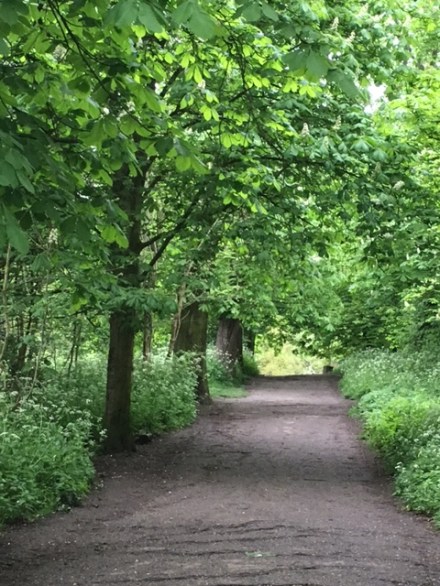
I love tree-tunnels.

IMG_6360

I love tree-tunnels and I know why. They are proof that in every separation, there is a meeting. A river separates its two shores but also links them. I once heard a story of 2 prisoners in solitary confinement. Their cells were separated by a thick wall. Over time they learnt to talk with one another by a particular pattern of tapping on this wall. The very thing that kept them apart, connected them.

Every year I seem to forget what this time of year looks like. Then I am surprised and delighted by the blossom and the fresh greenness on the trees. Even on a dull day like today, walking, looking and driving through tree-tunnels, channels light into my life. The trunks of these trees stand on either side of the road but the roots intertwine underground and the leaves meet up in the air and dance together. It feels like nature is not just giving me permission but actively encouraging me to enjoy life and look beyond what is visible. I need to give the same permission to myself. This light is mine.

Maybe this apparent separation from my darling Saagar is not at all real. Maybe this chasm is the link between me and my higher self. Maybe the greatest life lessons come to me through this gorge. Maybe this deep cleft of pain has been created for growth to take place. Maybe this fissure has appeared to make more space for love and kindness in our world. Maybe.


We all are Sakura.

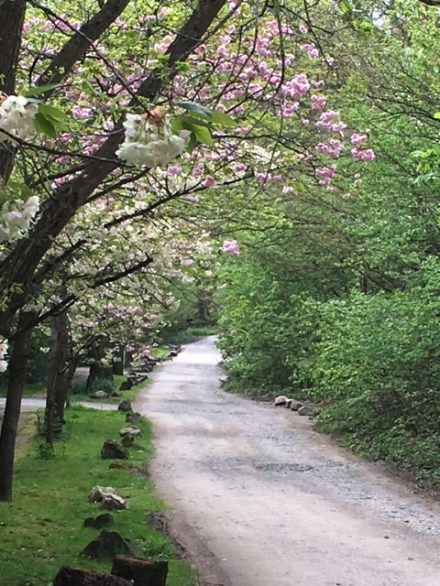
After a long, harsh and adamant winter, the hope and light of spring is here. The former is still lurking around the corner, waiting to jump back when it can. But for now, it’s hiding. Pink and white clouds of blossom hover a few feet above the ground.

IMG_6355

For centuries cherry-blossom or sakura has lived in the hearts of and ignited the spirit of the Japanese people. They wait for this time of year as the blossom signifies beauty and celebration. Its delicate pinkness stands for innocence and fragility. Families get together ceremoniously to marvel at this spring-time bloom. This occasion of watching and admiring of the blossom is called Hanami.

These feathery pink  flowers have inspired much of Japanese painting, poetry, film, music, food, textile design, ceramics and other art forms. In addition to being exquisite to look at, they carry a deep philosophical meaning. They are a timeless metaphor for human life. While this blooming season is intoxicatingly brilliant, it is tragically short. It  reminds us of the splendour and brevity of our own lives. It encourages us to appreciate our time on earth with the same joy and passion as we do the blossoms. It awakens our senses and forces us to pay attention – notice the present moment, welcome what’s to come, honour what has passed, acknowledge the transient nature of everything and hold ourselves in a stance of grace and gratitude.

The samurai embodied this combination of beauty and mortality. They appreciated the inevitability of death without fearing it. A fallen petal or blossom is said to symbolise the end of their short lives.

Sakura also indicates renewal. In Japan, this is the month in which the school, calendar and fiscal year start.  Aside from deep historical, religious and cultural significance, it also has connotations of agricultural optimism.

Beautiful, fragile and transient – that is us.


Community is the answer.

“…the lonelier a person gets, the less adept they become at navigating social currents. Loneliness grows around them, like mould or fur, a prophylactic that inhibits contact, no matter how badly contact is desired. Loneliness is accretive, extending and perpetuating itself. Once it becomes impacted, it is by no means easy to dislodge.” – By Olivia Laing, The Lonely City.

In the summer of 1999 I moved from New Delhi to a little place called Antrim in Northern Ireland. I lived in a tiny room in the accommodation for junior doctors on hospital grounds. I didn’t know a soul there. Slowly I made a few friends at work. Unlike now, there were no mobile phones, whatsapp, skype, facetime or facebook then. Telephone calls costed a bomb.  People were friendly but everyone was a stranger. Initially I didn’t get their sense of humour at all. I felt foolish. I longed to speak my own language with someone. Anyone. But there was no one who would understand.

One evening I went to buy some chocolates to a nearby petrol station. There were 2 cashiers but only one of them had a long queue of people waiting their turn. I didn’t understand why. I went up to the cashier without a queue and made my payment. I didn’t get the meaning of the looks on people’s faces. It didn’t help that I was the only coloured person for miles. From some face expressions it was obvious that they had never ever seen a coloured person outside of the television. I felt alone. Very alone.

Urban loneliness is a common phenomenon.  Isolation causes inflammation. Inflammation can cause further isolation and depression. The cytokines released as a result suppress the immune system giving rise to more illness.

Frome is a historical town in Somerset. It is known as one of the best places to live in the UK. Dr Helen Kingston, a GP, kept encountering patients who seemed defeated by the medicalisation of their lives. They were treated like a cluster of symptoms rather than a human being with health problems. Staff at her practice were stressed and dejected by what she calls “silo working”.

With the help of the local council and Health connections Mendip, she launched a community initiative in 2013. It main intervention was to create a stronger community. They identified and filled gaps in communications and support in the community. They employed ‘health connectors’ and trained up volunteers to be ‘community connectors’.  They helped people with handling debt or housing problems, sometimes joining choirs or lunch clubs or exercise groups or writing workshops or men’s sheds (where men make and mend things together). The aim was to break a familiar cycle of misery.

In the three years that followed, emergency hospital admissions rose by 29% across the whole of Somerset. In Frome they fell by 17%.

No other intervention, drug or procedure on record has reduced emergency admissions across a population.


Salute.

IMG_6242

A mother of a teenager in Molenbeek, a suburb of Brussels got this text message, “Congratulations,” it read. “Be proud of him. He is now a martyr. Be happy he died fighting the unbelievers.” Molenbeek is said to be the jihadist capital of Europe and has lost many of its young to radicalisation.

NATO bombs have been falling on migrant boats, night markets, residential buildings, motels, random vehicles, hospitals, wedding parties filled with innocent people like you and me, in the name of liberty and democracy, killing sons and daughters of many mothers.

Continuous shellings, massacres, occupations and sieges in places like Mosel, Raqqua, Aleppo, Ghouta and Gaza carry on for weeks, months, years and decades, claiming innumerable lives of children of mothers who mourn for the rest of their lives.

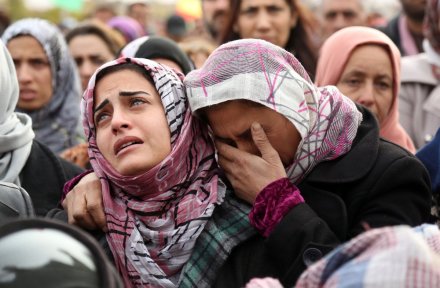
Some mothers have everything taken from them. They are unable to provide for the most basic needs of their children due to various reasons, one of them being the blockade to aid, such as the one in Yemen. Some have to exchange sexual favours for minimal aid. Some are forced to watch their kids starve. Some of the realities are unimaginable.

delil-souleiman

(Source: War through Syrian eyes)

We all are on the same grid of heart-breaking, unconditional love. Today, on Mother’s day, I send my love to mothers all over the world. I salute their tenacity  and commitment. I admire their strength. I hope for peace  and wisdom for all. I honour their grace and grief. I pray for their healing. I stand with them, their pain and helplessness, their love and longing. Our empathy envelops this burning globe like a silk scarf.