Day 581

After more than a year of Saagar’s death I could see that nothing at all had changed. Nothing was going to change. There is no power behind a Coroner’s inquest report, no legal, professional or financial implications for anyone concerned. Hence no lessons learnt.

I approached the GMC for help with the view that may be they will see things as they are and have more power to influence change but this is the letter I received from them today:

“In January 2016 documents regarding Saagar’s care were referred to a GMC Medical Case Examiner for review. I can confirm that the Case Examiner was specifically dealing with Dr GP and any issues surrounding his fitness to practise when they reviewed the documents. A decision was made by the Case Examiner that there was nothing contained within the documents which would call into question Dr GP’s fitness to practise and that as such the case should be closed with no further action.”

  1. Really? Is this protectionism or is it a reflection of a deeper level of ignorance within the medical community than I thought?
  2. Am I the one who’s crazy? Imagining things? Over-reacting? Making false judgements just because I am grieving?
  3. The job at hand is clearly much harder than I thought it might be. I can teach children to ask for help. I can teach parents and teachers to identify signs of crisis and get professional help for them. They can take them to the GP. And then what?

The GP may ask them to fill out a PHQ-9 questionnaire. They may score 27/27. The GP might not discuss that with the parents. Not get anyone’s advise on the phone. Not refer them to a mental health specialist. They may send them home with a medicine that might worsen their suicidal ideation. They may also reassure them that they will get better.

That is like sending someone with terminal cancer home with the assurance that they will get better. That however would be unacceptable because cancer is a physical illness.

Severe depression can be invisible to the untrained eye. So, it’s ok for GPs to send young men with the greatest degree of depression home. Unquestionably.

‘Parity of esteem’ is a joke.
 

Day 578

image

This is the question : How can we Re-create Psychiatry?

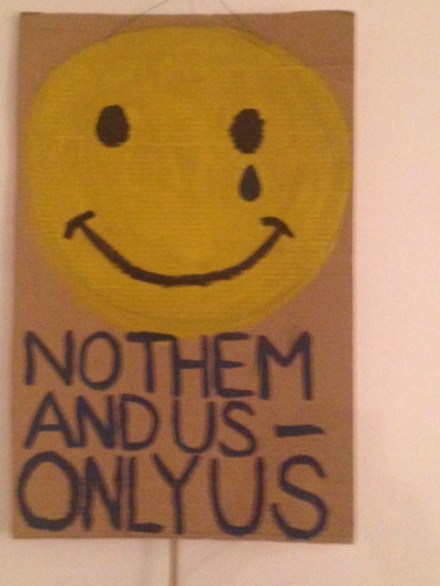
How can we break down the“us” versus “them” approach?

How can we stop ourselves from putting people into neat little labelled boxes rather than perceiving each one as a unique individual with their own unique story and experience?

How can we communicate in a way where we respect boundaries but do not create barriers? How can we truly listen in a way that we can put ourselves in someone else’s shoes?

There is a hierarchy in knowledge. Intellectual knowledge is considered superior to emotional or experiential knowledge, which in turn is rated higher than seemingly irrational knowledge, which could come from ‘patients’ with seemingly little insight. Who makes these decisions? How come the power balance between psychiatrists(intellectual/clinical) and patients(experiential/seemingly irrational) is so extremely warped? Does looking at people through templates give us any idea of who they truly are?

The Open Dialogue approach is a philosophical/theoretical approach to people experiencing a mental health crisis and their families/networks, and a system of care, developed in Western Lapland in Finland over the last 25-30 years. In the 1980s psychiatric services in Western Lapland were in a poor state, in fact they had one of the worst incidences of ‘schizophrenia’ in Europe. Now they have the best documented outcomes in the Western World. For example, around 75% of those experiencing psychosis have returned to work or study within 2 years and only around 20% are still taking antipsychotic medication.

Working with families and social networks, as much as possible in their own homes, Open Dialogue teams work to help those involved in a crisis situation to be together and to engage in dialogue. It has been their experience that if the family/team can bear the extreme emotion in a crisis situation, and tolerate the uncertainty, in time shared meaning usually emerges and healing is possible.

This Open Dialogue training launches in London next month.


Day 534

Professor Guy Goodwin, the main author of the third and latest revision of the BAP Bipolar Guidelines said in his e-mail accompanying the publication:

“The third revision of the British Association of Psychopharmacology (BAP) Bipolar guideline is now available. It is substantially revised from last time to reflect changes in the available evidence, obviously, but also a changing perspective on how to weigh the evidence. It is intended to provide a counterbalance to the NICE document of 2014 which in places shows partiality (to psychological treatments) and a lack of common sense. The authors hope that the BAP revision will be useful in guiding and improving treatment of what remains a curiously neglected disorder.

 09c48df2-1880-4795-a043-562daa8a726a

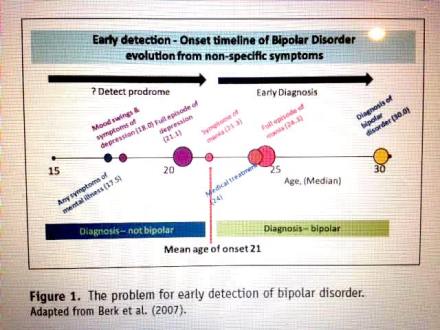
The BAP Guidelines for Bipolar Disorder is a 59 page document. The above picture is on page 20. It is a clear depiction of the evolution of the disease and elicits a ‘full episode of depression’ at the age of 20 years and a few months which was exactly the age Saagar was when he had the full episode of depression – 20 years, 5 months and 10 days. Yet he was discharged to the GP without highlighting the possibility of this happening and all the doors to access specialist services were closed behind him.

On page 23, it goes on to say – “Premature discharge to primary care can further dilute the treatment package available in the early stages of managing the illness.”

He was discharged by the Psychiatrist to the GP after 20 days of having made the diagnosis of Bipolar Disorder.

What more can I say? Poor kid!


Day 531

May your angels always win
over your demons.

May your light always shine bright
even though it flickers with all its might.
May the winds never be so strong
As to blend it into a dark night.

May the tides of neuro-endocrine biochemicals
rise and fall in your favour.
May you always emerge from your silences
stronger and wiser.

May the ignorance and biases of people
find forgiveness in you.
May your peace and happiness
Always be with you.

May the ‘big-ass’ moon and its lunacy
shine on you with love.
May you always know that you
Are never alone and much loved.

May the pills not mess with you
Too much.
May they help you keep your ‘balance’
And such.

May this day mark the
true acceptance on everybody’s part.
Vincent Van Gough was a genius at Art.
He had his struggles too.
Just like me and you.
His birthday is today
and so is World Bipolar day.

30th of March it is.
Pity! I didn’t hear a whisper about this!
In years to come, let’s not miss
the day, nor the illness dismiss.