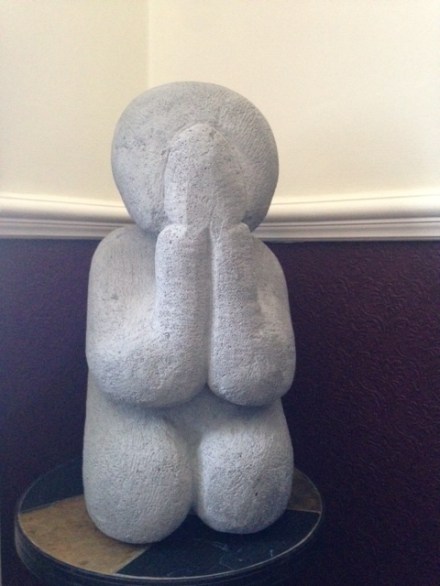
Day 815

photo

(A sculpture by Ruth M, who lived with Bipolar Disorder, expressing her depression)

In the 1940s, mental hospitals were places of isolation and confinement, probably closer to prison than hospital. Netherne, in Surrey was seen as a progressive asylum at the forefront of waves of reform and development for nearly 50 years, till the eventual closure of the British asylums. They enthusiastically adopted physical treatments, now viewed as barbaric- insulin coma therapy, electroconvulsive therapy and lobotomy, then seen as optimistic approaches to treatment.

Edward Adamson (1911-1996) was a pioneer of British Art Therapy. He encouraged and collected the paintings, drawings and sculptures by people compelled to live in Netherne Hospital between 1946 and 1981. He describes that many people who came to his first lecture there had shaved or bandaged heads, bruised faces and black eyes, following brain surgery.

Adamson started collecting art during his early visits when a man on a locked ward gave him the first of his several drawings done on toilet paper with a charred matchstick. He later met other people on the wards who would have had no personal possessions, working with whatever materials they could find to create something for themselves.

The Adamson Collection has 6,000 of these works of an estimated 100,000 when he retired. The collection is seen as unique in the history of art therapy of the reforming psychiatry of the 1950s and 60s, collected by an artist rather than a psychiatrist, with a strong representation of works by women. Above all it is a memorial to all those who suffered in the asylums and to the human need to express.

“Edward Adamson practiced art as healing before there were ever terms or labels like ‘Art Therapist’. Being with him for anyone was therapy and yet he didn’t play at clinician, but rather served so sweetly as a supreme friend, ‘there’ for those who had none other. There were for Edward no patients. I think that is why so many lost people in his care found their way back to themselves. Adamson’s was an alchemy of the highest sort.”

– Rebecca Alban Hoffberger, Founder/Director American Visionary Art Museum, 2011

13ec28aed459f20a9816caf08304393c

Ref: http://www.adamsoncollectiontrust.org/wp-content/uploads/2016/09/2-2011.-DOF-Raw-Vision-for-EAF.pdf
Day 808

Yesterday our Prime Minister put Mental health at the top of the national agenda. Great to have these focussed conversations in prominent places with special emphasis on schools and work places being equipped to intervene early for children and young people with difficulties. These announcements are welcome but are also met with a slow applause as this government does not have a great track record with the NHS.

Relevant tweets:

“Schools will be linked to local NHS #mentalhealth services to support early intervention for Children and Young People” in PM speech.

“You can make the promises, but you need the workforce to deliver them.”

“Biggest challenge PM faces -getting funding to the front line. Services over-pressed, under-staffed + facing even more demands.” – President of the Royal College of Psychiatrists.

In my opinion, as long as we stick strictly to the medical model of mental illness we will never get it right as it does not put enough emphasis on prevention. We need to start with educating young parents about the family, environmental, individual and social factors that contribute to the mental well being of a child.

Thereafter the schools need to be aware that if a child is happy, he or she is more likely to perform well. Hence putting them under academic pressure can be counterproductive. Bullying policies must be strictly implemented. Kids must be allowed to fail sometimes. There is grace and learning in defeat.

By no means do I claim to have all the answers but this would be a good start. Prevention is better than cure.

Day 806

search

Alan Turing was a lonely, awkward boy. His only friend in school died of tuberculosis in 1928. This awful event had a formative impact on the life of this young man who went on to become a brilliant mathematician and code breaker at Bletchley Park from 1939-45. Cracking the Enigma code significantly shortened World War 2 and potentially altered its outcome. He was the first man to indicate how thinking machines might be built. He later came to be known as the father of modern computing. He was one of the most influential men of his time and we owe our freedom to him. Steve Jobs wanted his company logo of the bitten apple to be associated with Turing’s love of apples.

An accomplished runner, he also had a great interest in the paranormal. And there is Turing the composer, responsible for some of the earliest computer music recorded by the BBC in Manchester. He is described as “shy, gay, witty, grumpy, courageous, unassuming and wildly successful genius”.

In 1952, he was arrested under a homophobic law for ‘gross indecency’. The chemical castration that Turing underwent thereafter was highly unjust and disgusting. Tens of thousands of less famous men were similarly prosecuted between 1885 and 1967.

He was found by his cleaner when she came in on 8 June 1954. He had died the day before of cyanide poisoning, a half-eaten apple beside his bed. His mother believed he had accidentally ingested cyanide from his fingers after an amateur chemistry experiment, but it is more credible that he had successfully contrived his death to allow her alone to believe this. The coroner’s verdict was suicide.

These countries still punish homosexual acts by death: Saudi Arabia, Afghanistan, Nigeria, Qatar, Iran, Somalia, Yemen, Sudan, Mauritania and UAE.

World gay rights map:
https://www.washingtonpost.com/graphics/world/gay-rights/

Day 804

This time of the year is difficult for many families. Financial pressures, obligatory socialising with people whose affections may not be entirely genuine, a perceived time for evaluating various aspects of one’s life, overindulgence, having to revert back to traditional gender roles, the need for things to be just so…

Many women fear the festive period. Not a year goes by when there isn’t a seasonal rise in incidents of domestic violence reported to the police. Humberside Police Force reports that calls rose from 38% in the rest of the year to 54% in December 2015.

“For too many children across Ireland, being home at Christmas, is not a place of safety, warmth and happiness. It’s a place of fear, loneliness, pain and neglect,” said the ISPCC (Irish Society for the Prevention of Cruelty to Children). On Christmas day more than 1000 calls were received by their 60 strong staff on Childline service from children reporting distress due to domestic violence and/or alcohol abuse.

Pangs of loneliness are more acutely felt by the elderly and floating populace at this time of the year. Age UK works steadily on reducing loneliness in the elderly, 1.2 million of whom suffer from it on a chronic basis. Their objective is : ‘No one should have no one on Christmas’.

For those of us who have recently lost a dear one, their physical absence is more visibly, painfully and deeply felt than other times. That one less present, that one less seat on the dinner table, that one less name on the card, that one less beaming smile, that one less hug …

Ref: http://www.newstatesman.com/politics/welfare/2015/12/it-s-hardest-time-year-why-domestic-violence-spikes-over-christmas

https://www.rt.com/news/371953-child-abuse-helpline-ireland/

Day 802

Water Water Everywhere
(A short story)

She lives in sheltered accommodation. As an octogenarian, it is safer. Her sons think so. When she moved in, she had hoped for some company. She likes a bit of chit-chat. She enjoys people. But she is fairly content. Every other day she neatly pins her hair up, wears one of her long skirts with a woolly jumper, wraps herself up in her sea-green duffle coat, puts on a smile and walks to the high street.

Betsy goes to the post-office to buy and post a card for her grand daughter’s birthday. She picks one with flowers and butterflies and queues. The only other person in the queue is a young woman. She has big black cordless head-phones with a ‘b’ in red covering her ears. She also has a vacant look in her eyes. It seems she is elsewhere. No chance of a chat here. When Betsy arrives at the window, the teller appears to be preoccupied. He is worried that the Post office might have to close down soon. He’s not sure how soon. That worries her. Last year her bank had shut down the branch on this high street.

She used to be able to go to the GP Surgery on days she felt a bit off. In the waiting area she often ran into someone she knew. It was good. But now the rules have changed. There are screens with smiley pictures and buttons. Appointments have to be made weeks in advance. One can’t just show up. Now, she feels like an outsider at her own surgery. She doesn’t like to go there anymore.

The grocery store is always a good place for a chat. The staff are friendly. Sometimes she even runs into familiar faces. She strolls around at her own pace and picks up a pint of milk and a pack of 80 PG tips teabags. As she approaches her favourite part, the check out desk, she is ushered in a perfunctory manner towards three ugly self check-out machines. That confuses her. She is not sure what to do.

It’s been one week since she spoke to anyone. On TV they said that the population of the world is the highest ever and rising – 7.4 billion! That must have lots of zeros.

Where is everyone?