Day 824

What brings you enjoyment?

This was on the list of questions being asked of young doctors at an interview skills practice session for their upcoming promotions.

One of the young women enthusiastically told me not only how much she enjoyed her work but also the stories behind how the interest started and developed and then narrowed itself down to a specialist area, the places her aspirations took her to and the inspiring people she met along the way. Her eyes shone like sparkling diamonds as she spoke and her smile beamed. Towards the end of her answer, there was a brief mention of tennis, friends and cycling.

90% of her answer was her work. Her honesty was clear.

That was me. My work has brought me great joy over the years. I have spent far too many hours at work. It gave me self-esteem. It was something I could hide behind. It gave me meaning and purpose. It made me look and feel successful. It was fulfilling and satisfying and everyday was challenging and exciting. I loved it.

It took away all my energy and I came home spent. It took up a lot of space in my head for many long years. It made me loose my balance. It sucked me in so completely that I couldn’t see the aspects of it that were draining me dry. It deprived me of sleep for years and it drove me crazy. Yet, I loved it.

If I could go back and change what it meant to me, would I?
No.
But I would cut the number of evenings and weekends I spent away from home. I would conserve more energy for home. I would say ‘NO’ more often. I would claim some of my life back.

Day 823

search

One of the core principles of Buddhism is the ‘Ten world Principle’. It outlines the continuous changes in our inner lives. It classifies the subconscious human experience of various states of being, thus graded from lowest to highest:

1.Hell
2.Hunger (Wanting more of love/money/approval etc)
3. Animality (Need to dominate/be dominated)
4. Anger
5. Humanity (Tranquility)
6. Heaven (Rapture/ Temporary happiness)
7.Learning
8. Realisation
9.Bodhisattva (Compassion)
10. Buddhahood (Enlightenment/Absolute happiness)

Most of us have a fundamental tendency to occupy one or two of these worlds. Despite many self-improvement endeavors, we find it nearly impossible to change our default worlds.

For majority of the human race, the six lower worlds (1-6) apply. The problem with these states is that they do not last. They are completely reactive, at the mercy of our environment, bouncing back and forth depending on external circumstances resulting in a roller-coaster existence. True happiness cannot be rooted in this shifting quicksand.

The higher worlds (6-10) are known as the ‘four noble worlds’. Learning, realization and compassion are proactive, not reactive states. They are the basis on which a state of absolute happiness can be created.

The tenth and highest world is difficult to describe as we often don’t experience it. It is determined by the degree to which we establish a solid self, a true self that exists in harmony with the universe. For me, brief glimpses of this world are achievable through meditation. It is deeply restful.

Attaining Buddhahood is a process of discovering what currently lies dormant within our hearts, of discovering our true universal self.

‘Hell is to drift, heaven is to steer.’
– George Bernard Shaw.

Day 820

One of the French companies worst affected by suicides has been the telecommunications giant, France Télécom/Orange, where 12 employees took their own life in 2008, nineteen in 2009, 27 in 2010 and 11 in 2011. Despite a new agreement on workplace conditions negotiated with the trade unions, there has been a renewal of suicides in recent years with eleven cases in 2013 and ten suicides in 2014.

Suicides took place at a time when the company was restructuring, including a plan to cut 22,000 jobs in three years. Suicidal individuals shared a similar profile: these were typically skilled male engineers or technicians in their fifties who had been forcibly redeployed into low-skilled roles, often in call-centres.

On 17 January 2014, a 42-year old employee dealing with business customers at a France Télécom/Orange office in Paris, threw himself under a suburban train on his way to work. His sister, who is pursuing a claim against the company, contends that her brother had repeatedly complained to his bosses that he was a victim of bullying by his manager. Occupational doctors had also reported a deterioration of working conditions at the agency where he worked, with a rise of workplace stress as a result of company restructuring. Prior to his suicide, the victim had sent e-mails to family members complaining of an unmanageable workload and of constant surveillance and he referred to “humiliation”, “intimidation” and “bullying”. He held several meetings with senior management where he complained of harassment by his manager. Five days before his suicide, he sent an e-mail to his head of service in which he reiterated his request to change teams. These e-mail exchanges are being used as evidence in the investigation by the public authorities into his suicide.

Whilst in France work place suicides are an urgent public health phenomenon, in the UK, despite severe deterioration in working conditions, workplace suicide is not recognised in legislation and there are no specific official mechanisms for data collection. Even when it takes place in the workplace, suicide is presumed to be an individual and voluntary act and according to Health and Safety Executive (2016) legislation: “All deaths to workers and non-workers, with the exception of suicides, must be reported if they arise from a work-related accident.”

(Source: When work kills : http://www.emeraldinsight.com/doi/abs/10.1108/JPMH-06-2016-0026?mobileUi=0&journalCode=jpmh)

Day 819

scan-3

The night temperatures are below freezing. The weather forecasts are sending out warnings of frost and black ice. I thought a hot water bottle for the night would be a good idea for uninterrupted sleep. I placed it against my lower back as I drifted off in fetal position. It was comforting and sleep-inducing, resting perfectly still against my lumbar spine. I was wrapped up in my duvet and the bottle, in a thick white cotton towel under the duvet.

Sometime during the night, I surfaced to a semi-awake state and felt a small bundle next to me. It was warm and cuddly. Still half submerged in slumber, my mind floated away into the past. My hands brought the bundle up to my chest and held it close. It didn’t move. I hugged it and kissed it. The pain of the love and the longing came back. The absolute joy of cuddling my baby came back. The memory of how he slept with his bum in the air came back. The sense of the way he moved round in his sleep came back. The tears came back. The pillow got soaked but the eyes stayed closed and the attention went to the sobs, the sadness and the breath and then slowly…the sleep came back.

Day 817

photo

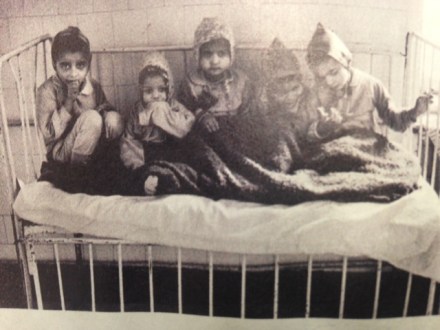
“Terrible poverty causes brain damage”, says Charles Nelson, a professor of neuroscience and paediatrics at Harvard Medical School.
In 1989, when the communists were overthrown in Romania, 170,000 children were abandoned and were living in government-run institutions under very poor conditions. Nelson and his team started studying them in the late 1990s. They found that the kids were deprived of key experiences during critical periods of development. Babies lay in cribs for their first year or more and their visual experience was limited because often the ceilings were painted white. There was no one to talk to them and care-giving was limited, so they were deprived of psychosocial stimulation. Their physical growth was greatly stunted too. The kids were very very small.

“We had a rule: no crying in front of the kids. But I can’t tell you how tough it was.”
The team wanted to find out if high-quality foster care for these kids could rectify the negative impact of poverty they might have. They recruited a sample of 136 kids, from 6-31 months of age and randomly assigned half of them to high quality foster care. The other half remained in institutional care. Foster parents from Bucharest were volunteers who had been intensively screened and interviewed. They were paid a small wage and provided with material support such as toys and diapers. The families were closely monitored by social workers.

Two years into the study they found that across the board, the kids in institutions lagged behind in language development, IQ and mental well being. The prevalence of anxiety and depression were reduced no matter how old the kids were when they were placed in foster care.

They are now about 16 years old. Those in institutions are starting to experience significant mental health issues such as psychotic disorders and paranoia. 20 of them showed a sharp drop in IQ from the age of 12.

One year following this research, the Romanian government passed a legislation banning the institutionalisation of children below the age of 2 years unless they were severely disabled. They also started government foster care.

This is a  classic example of science giving rise to political will to improve lives of kids.
UK’s Child Poverty Action Group reports that 3.9 million children in this country live in poverty at present. This means more than one in 4 children are growing up in families with less than 60% of the median income. In the US, 15 million children live below the poverty line. Western levels of poverty may not be anything close to the hardship endured by many in developing countries but it has long lasting detrimental effects on the physical and mental health of children.
With a strong political will, child poverty can be alleviated but despite setting goals and targets, our government is spectacularly failing to deliver. Dealing with child poverty and its life long consequences is not a matter of political choice but that of moral duty.

Source: New Scientist October 2016.