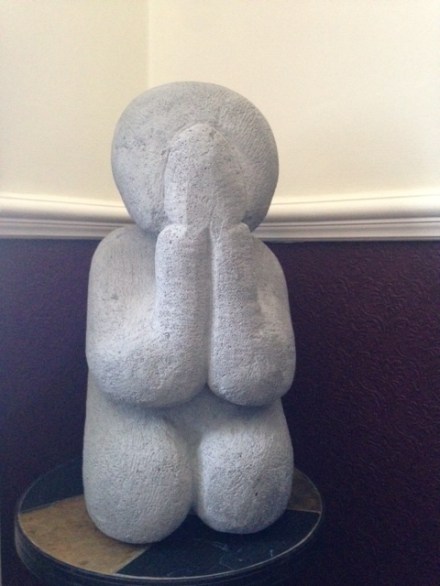
Day 815

photo

(A sculpture by Ruth M, who lived with Bipolar Disorder, expressing her depression)

In the 1940s, mental hospitals were places of isolation and confinement, probably closer to prison than hospital. Netherne, in Surrey was seen as a progressive asylum at the forefront of waves of reform and development for nearly 50 years, till the eventual closure of the British asylums. They enthusiastically adopted physical treatments, now viewed as barbaric- insulin coma therapy, electroconvulsive therapy and lobotomy, then seen as optimistic approaches to treatment.

Edward Adamson (1911-1996) was a pioneer of British Art Therapy. He encouraged and collected the paintings, drawings and sculptures by people compelled to live in Netherne Hospital between 1946 and 1981. He describes that many people who came to his first lecture there had shaved or bandaged heads, bruised faces and black eyes, following brain surgery.

Adamson started collecting art during his early visits when a man on a locked ward gave him the first of his several drawings done on toilet paper with a charred matchstick. He later met other people on the wards who would have had no personal possessions, working with whatever materials they could find to create something for themselves.

The Adamson Collection has 6,000 of these works of an estimated 100,000 when he retired. The collection is seen as unique in the history of art therapy of the reforming psychiatry of the 1950s and 60s, collected by an artist rather than a psychiatrist, with a strong representation of works by women. Above all it is a memorial to all those who suffered in the asylums and to the human need to express.

“Edward Adamson practiced art as healing before there were ever terms or labels like ‘Art Therapist’. Being with him for anyone was therapy and yet he didn’t play at clinician, but rather served so sweetly as a supreme friend, ‘there’ for those who had none other. There were for Edward no patients. I think that is why so many lost people in his care found their way back to themselves. Adamson’s was an alchemy of the highest sort.”

– Rebecca Alban Hoffberger, Founder/Director American Visionary Art Museum, 2011

13ec28aed459f20a9816caf08304393c

Ref: http://www.adamsoncollectiontrust.org/wp-content/uploads/2016/09/2-2011.-DOF-Raw-Vision-for-EAF.pdf

Day 814

A bereaved mum’s lament: Went out for dinner with friends. What could go wrong? All went well until there was talk of an acquaintance of one of the guests who is suffering from a debilitating mental illness. They had tried to take their life but survived. The guest herself is a breast cancer survivor. She said that she had visited the person and said “did they not realise how hard she had fought to live and there they were throwing away their life”. Its a shame she didn’t appreciate just how hard the other person was fighting to stay alive … my son lost that fight. When will they realise Depression is as dangerous and potentially fatal as cancer. You know when you are stuck in a situation when its just not appropriate to make a fuss but you want to scream “How ignorant are you ???”

From the individual level, right through the media, the regulatory bodies and up to the government, we are all ignorant. Mrs May speaks of parity between physical and mental illnesses, ie. both being given the same importance. Many others have talked about it before her but we are miles away from it.

The Ebola Outbreak in West Africa was a public health emergency of international concern and we heard about it everyday, non-stop on the radio and TV from 2014-2016. 1 person was infected with the virus in the UK and fortunately there were no deaths from it. 1 person dies every 2 hours by suicide but it is not mentioned in the media. Public health England are not particularly concerned. Suicide claims 4 young lives every day but it’s no big deal.

Imagine a middle aged man presenting to his doctor with severe chest pain and being sent home with pills that take 3 weeks to work. I am sure the GMC would have something to say about that. A young man presents to his doctor with debilitating depression together with a strong desire to end his life and he is sent home with pills that can potentially make suicidal ideation worse and the benefit, if any might be seen in 3 weeks. The GMC finds that acceptable practice.

1 in 4 patients present with a mental illness to the NHS and only 10-12 % of the NHS budget is spent on mental health.

Survivors of physical illnesses proudly claim bravery and wear their survival as a badge of honour whereas those surviving mental illness hide in corners feeling ashamed.

The acceptable faces of mental illness are Dementia and Alzheimer’s disease. This is apparent from the t-shirts worn at charity events, walks and runs. I hardly see anyone running in support of Bipolar Disorder research or British Schizophrenia Foundation or Borderline Personality Disorder Charity. 

Things most resistant to change are cultures and mindsets.
Parity of esteem?
We have aeons to go!!!

Day 813

Short stories have always intrigued me. Of late my attention span has become so short that those are the only kind of stories I can relate with and appreciate.

Here’s an abridged version of ‘Grief’ by one of the greatest writers of short fiction, Anton Chekov.

‘Grief’

It is twilight. Large flakes of snow are falling. A cab-driver, Iona, waits for a customer. He sits in his cab with his body bent as double as a living body can, immobilized by misery. ‘To whom shall I tell my grief?’

At last an officer arrives. Iona sets off in his cab with the officer at the back. He turns around to speak to him.
“My son…er…my son died this week, Sir.”
‘Hm. What did he die of?’
“It was a fever.”
Silence. Iona turns around again to find the officer nodding off.

As the evening progresses, Iona attempts to talk to someone three times. He tries to tell the story of his son’s death again and again. The second passenger, a high browed businessman interrupts Iona and says, ”We all must die one day.” Another man simply gets out of the sleigh. Later Iona tries to speak with a house porter but he brusquely tells him to drive on. Still later Iona offers one of his fellow drivers a drink but the young man promptly falls asleep. Just as the young man has been thirsty for water, Iona thirsts for speech. There is so much he needs to share.

“One must tell it slowly and carefully; how his son fell ill, how he suffered, what he said before he died, how he died. One must describe every detail of the funeral and the journey to the hospital to fetch the defunct’s clothes. His daughter Anisya remained in the village – one must talk about her too. Was it nothing he had to tell? Surely the listener would gasp and sigh and sympathise with him?”

Finally at the end of the working day, Iona returns to the stables. He starts to speak to his horse, “Now let’s say you had a foal, you were that foal’s mother and suddenly, let’s say that foal went away and left you to live after him. It would be sad. Wouldn’t it?”

The mare munches hay and breathes on her master’s hands. She doesn’t close her eyes, nor walks away, nor interrupts with her own wisdom on the matter. And it’s enough. Iona tells her everything.

At the risk of repeating myself, I tell the story I need to tell:

(Special thanks to Diane Morrow and her book: One Year of Writing and Healing)

Day 812

The boundaries between ‘sanity’ and ‘insanity’ are elastic. Each one of us has a place on the spectrum and it constantly shifts and shuffles depending upon the changes in our outer and inner landscapes. Each of us with our own fears, anxieties, sadnesses, communication problems and struggles to fit in move up and down that range.

“The world is but a great Bedlam, where those that are more mad, lock up those who are less.” -Thomas Tryon (1689)

“Surely we’re all mad people, and they, whom we think are, are not.” -Thomas Middleton, The Revenger’s Tragedy (1606)

Some days are impossible. I have to roll as a stone on the road, slither on sharp stairs, climb up through a lift shaft, squeeze under the door to the room and then at the end, to finally assemble myself on a chair to make a complete feeling. Today, the feeling is of nothingness. All I feel are my empty arms. The air between them is painful. The arms ache. They stretch out, crying, wanting to hold him. They hate it but they are… empty.

My heart and soul are empty. This house is empty. This whole world is empty. Reality is not what it seems to be. Nor is it otherwise. Am I now bordering on the insane? Am I always like this, but covering it up? Who is to decide what is what? No one knows. No one has ever known.  A rock is just a rock. A river is just a river. Misfortune is just bad luck! It is just what it is – the experience of being human. It is absolute. It does not need validation. It does not need a name.

(Inspired by an exhibition at the Wellcome Collection: Bedlam- the asylum and beyond)

Day 811

Her Voice – a short story

‘I hear her. Her voice is in my head’ says Joe.
“How long has the voice been there?” asks the trainee psychiatrist.
‘Since I was 12.’
“And you are now 18.”
‘Yes.’
“Is it really upsetting for you?”
‘Yes. Distressing. I feel terrible.’
“What does the voice say?”
‘Different things. Often cries desperately.’
“How often does this happen?”
‘At least 3-4 times every day. It’s painful.’
“Hmmm. Let me speak to my senior and come back to you in a few minutes.”

A few minutes later.

“We think you might have Schizophrenia. Let’s start you on Quetiapine and see how it goes.”
‘Okay.’

Joe waits at the pharmacy to collect his medication. A trainee nurse is also waiting there to collect some meds for a patient on the ward. They talk. He tells her why he’s there. She asks him who is ‘she’? Whose voice does he hear?

‘She is my little sister. When we were kids we shared a bedroom. At night, my mum’s boy friend would come into our room and trouble my little sister behind a curtain. She cried. I could hear her but I was powerless. I could hear her then. I can hear her now.’

‘Do you think these pills will work?’