Long shadows

A few months after Day 0, at a SOBS (Survivors of Bereavement by Suicide) meeting at the All Saints near Euston, I met a father who said, “Eight years” when I asked him how long it had been since his son died. I looked at his face as if he was the most spectacular and wondrous impossibility of the world. Is it possible to live as long as that after the death of a child? He was proof. It was. I had never seen anyone who had been bereaved that long, standing and smiling and speaking sense.

Last Monday I joined the 3 dads on the last leg of their long walk to Westminster alongside many people who want the government to add suicide awareness and helpful resources to the school curriculum. We walked and talked in the rain. I said ‘Nearly eight years’ in response to how long has it been since my son passed. I got the same look from a young mum recently bereaved. She stopped and looked into my eyes through the thick rain drops. Past and future, face to face. “Gosh! Does it get any easier?” she asked. It does, I replied, holding her hands.

All these years I have tried to keep Saagar alive in every way I could – writing, public speaking, teaching Youth Mental Health First Aid courses, advocating for young people, working with various people, charities, NHS, Churchill Trust and other organisations, making films and so on.

I have read other people’s accounts of loss, hoping to lessen my pain and deepen my understanding. The latest book I read was ‘The Year of Magical Thinking’ by Joan Didion. She says:

I know why we try to keep the dead alive: we try to keep them alive in order to keep them with us.

I also know that if we are to live ourselves there comes a point at which we must relinquish the dead, let them go, keep them dead.

Let them become the photograph on the table.

Let them become the name on the Trust accounts.

Let go of them in the water.

Knowing this does not make it easier to let go of him in the water.”

Eight years! No time at all.

Time is the school in which we learn.

Time is the fire in which we burn.”

  • Delmore Schwartz.

Random stuff

After many years, things are being taken out of cup-boards and off shelves, turned inside out and properly looked at. Dusty books, clothes, folders, boxes and sachets. Some familiar fragrances are escaping and some old scenes are playing out on the screen of the mind. Bits of stuff slipping out of other stuff and falling to the ground with a clink. Some stuff that was believed to be misplaced is being placed. Some that was believed to be forgotten is being revisited.

Sample 1

A nappy pin. Special feature – A white safety cap to prevent accidental opening up while the baby has his cloth nappy on. Commonly used in India and other developing countries. Original owner: Baby Saagar.

Sample 2

A business card. Special feature – Simplicity. An invitation to music and joy. Original owner: Saagar.

Sample 3

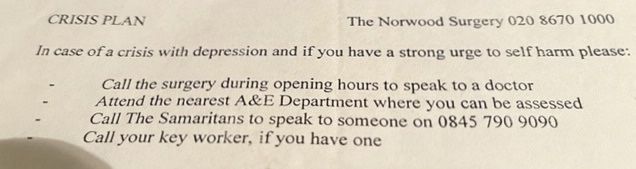
A Crisis Plan. Special features – Not worth two pennies. Highly ineffective. Not accompanied by a conversation. No detail. Not individualised. Not created in partnership with the patient. Not an alive document. Does not mention anything more than ‘self-harm’. Doesn’t tell us what ‘Crisis’ looks like. Doesn’t identify any helpful distractions, activities, friends or family. Doesn’t appear to know the patient, for example, a key fact – does this person have a key worker? Does not express any understanding or compassion.

Commonly used in developed countries.

Oops! The name of the GP surgery is visible. It doesn’t matter. It closed down years ago. We were it’s last few unlucky patients. Owner: Saagar Naresh (1994-2014).

(Resource: Safety Planning is essential to safety: https://stayingsafe.net/home)

Where I live.

One or two years after Saagar, continuing to live here, in this house was painful. Everything screamed his name – the road from the station to our house that he did not take, our vet, our cat, our dentist, our GP Surgery and pharmacy, our local shops and cafés, our bins, his school, our neighbours, our radio and TV. Everything yelled out his absence.

The thought of moving away filled me with a terrible sense that I would be leaving him behind.  As long as I lived here, this would be his home. What if, one day he was to return? I should be here to receive him. I ironed his full-sleeved light brown t-shirt, a set of dark blue Super-dry sports trousers and kept them ready for use. His Vans shoes too, for that same reason. The boring, practical, Virgo, me. I couldn’t have gone anywhere.

Nearly eight years on, I have come to inhabit my body in a way that my home is where I am. I am comfortable here. Now he’s not separate from me. His home is inside my body once again. He lives in me as love. Divine love. It’s not possible for me to leave him behind ever. He goes everywhere with me, as my beating heart, my smile and my tears. We both share a home. His light shines through my eyes and his laughter rings through my chuckles. I can’t be without him no matter where I am. There is no insecurity. I am free and so is he.

Twenty-two years ago, I traveled from New Delhi to London with my eyes full of dreams and a suitcase full of books. Soon, I shall be crossing the oceans in the other direction, heading back with Si, with absolutely nothing to lose.

Bed number 19.

I never really left. I was always there. At home with my folks. Even when I flew across oceans, a part of me remained at home. The part that refused to leave. The rest of me has been homesick since that day.

The first time I was to leave my Motherland, India, twenty-three years ago, my dad noticed I was close to tears at the airport. He said, “Chin up my dear. Remember who you are and how proud we are of you.”

Two weeks back he had a routine surgery on his neck that has left him unable to breathe adequately for now. He has received all the support he needs in a timely and gentle manner. For a while he was sedated but when he came out of it, the first thing he verbalised on seeing my mum and I was ‘I love you.’

Two days back I left him again. This time in an Intensive Care Unit bed. Bed number 19. I left his doctors, my brothers, my mother and all the extended family in-charge of him and of each other. I left a list of plans, strategies and resources. I left not knowing what happens next. I left as I breathed and meditated and pleaded with the Gods to heal him.

Once again, I see the fragility of human life. I witness people and situations in a constant state of flux, the tide of hope rising and plunging, our uneven shallow breaths and his, our collective helplessness, the tentative stepping forward and standing back, the engagement of distant Healers, the comforting holding and massaging of hands, hours of sitting in air-conditioned rooms and waiting, second-guessing other’s needs, the tender wetting of lips and applying Vaseline, the daily mid-morning updates that set the tone for the day.

Walking purposefully through hospital corridors is something I’ve done a lot of. But this time it’s me who’s walking through them, lost and vacant.

After four weeks, we hope to return home for a longish time. The very thought makes my heart sing. May Mother Nature do its magical, mysterious dance – make things worse and then, make them better again.

Entrances and exits.

The two little lads were inseparable. Saagar and Rohan. They cycled together all evening after school and kicked a ball about for hours. They had dinner at each other’s houses. They created snowmen and played with snowballs together. They even shared a bath every now and then. Luckily, they lived right next to each other and their parents were friends.

At Ulster Hospital in East Belfast, the staff accommodation is a set of six flats. Rohan‘s family lived in the one just below us. His mum, Shruti, was the best grower of indoor plants. A gentle, sweet lady. She was also a doctor but at that time, was not working. Over time our families became close friends and continued to visit each other even after we moved to London and they moved to the north of England. If you ask me to name my oldest friends in the UK, Shruti’s name would be on top.

Eventually Shruti started working in Psychiatry and seemed to enjoy it, even though the exams were a struggle as they are for many of us, when they must fit somewhere in between work, kids, husbands, homes, pets, friends, sleep and homesickness.

When Saagar was diagnosed with Bipolar disorder, I needed to speak with her. I needed her. I asked her by text what time would suit. She said she’s call me after work and she did.

“Hi Shruti. Thanks so much for calling.”

‘No problem. I am driving so we may get cut off. I’ll call you back if that happens.’

As soon as I started speaking it got cut off and she called back and the same thing happened again. And again. And then she didn’t call back.

When Saagar died, she came to see us the very next day with her husband, utterly shocked.

A month later I needed to connect with her again. She said she’d call me back after work. She called while driving. She had to pick someone up from somewhere or drop someone off somewhere. She was on the move. On – Off – On – Off : our phones connected and then rudely disconnected mid-sentence and stayed disconnected for seven years.

Two days back a message arrived from Shruti on Whatsapp saying, “Please join us and bless the couple.” Rohan gets married soon. A nice little electronic invitation to the reception was posted underneath the message. The invitation wasn’t for anyone in particular. It had no names on it. I can’t be entirely sure it was for us.

I am happy for the family and for Rohan. Wishing them all possible happiness, I RSVP’d with apologies for being unable to attend. There’s nothing here and let’s not pretend there is. I felt sad for a little while at this loss of a valued friendship, but not for long. This is an opportunity to let go. Yet again. If there is one thing I want to be skilled at, it is to keep letting go, remembering what the Bard of Avon said – ‘All the world’s a stage, and all the men and women merely players: they have their exits and their entrances …’ I get it.

I would like to live

like a river flows

carried by the surprise

of its own unfolding.”                                    

John O’Donahue