Day 627

photo

(A young artist’s pictorial depiction of Bipolar Disorder)

Everyday I struggle with what it must have been like for Saagar. What state of mind did his illness create? Why couldn’t he find any words for it? How much of it was due to the medicines he was on? I have tried to imagine it and learn about it from various books and blogs. The closest understanding of it comes from reading the first hand accounts of those who suffer from Bipolar disorder. Their writing is as honest and as human as can be.

“It has been a fascinating, albeit deadly enemy and companion. I have found it to be seductively complicated, a distillation both of what is finest in our natures and of what is most dangerous. At first my illness seemed to be simply an extension of myself- that is to say, of my ordinarily changeable moods, energies and enthusiasms. I perhaps gave it at times too much quarter. And because I thought I ought to be able to handle my increasingly violent mood swings by myself, for the first ten years I did not seek any kind of treatment. Even after my condition became a medical emergency I still intermittently resisted the medications that both my training and clinical research expertise told me were the only sensible way to deal with the illness I had.

Manic Depression distorts moods and thoughts, incites dreadful behaviours, destroys the basis of rational thought and too often erodes the desire and will to live. It is an illness that is biological in its origins, yet one that feels psychological in the experience of it; an illness that is unique in conferring advantage and pleasure, yet one that brings in it’s wake almost unendurable suffering and not infrequently, suicide.

Medications brought with them seemingly intolerable side-effects. It took me far too long to realize that lost years and relationships cannot be recovered, that damage done to oneself and others cannot always be put right again and that freedom from the control imposed by medication looses its meaning when the only alternatives are death and insanity.”

– an excerpt from “An Unquiet Mind”, a personal testimony of her own struggle with Bipolar Disorder since adolescence by Kay Redfield Jamison, a Professor of Medicine.

Day 620

Arthur was 15. He died after sustaining severe head injuries as a result of falling 60 feet from a cliff near Brighton last July. He was Nick Cave’s son. The inquest heard that Arthur had taken LSD with a friend and he was seen “staggering” on his own before he fell off the cliff. The friends went there thinking it would be a safe place to experiment with the drug for the first time.

Many youngsters experiment with drugs they do not understand and then make tragic mistakes. Last year, one in six children aged between 11 and 15 in England said they had taken drugs – nearly a third of a million kids!

Elizabeth Burton-Phillip’s son Nicholas ended his own life following a period of addiction and she found the strength to share their story in a book called “Mum can you lend me 20 quid?” Here is an insightful interview with her.

Into my arms by Nick Cave and the Bad Seeds. 

I don’t believe in an interventionist God
But I know, darling, that you do
But if I did I would kneel down and ask Him
Not to intervene when it came to you
Not to touch a hair on your head
To leave you as you are
And if He felt He had to direct you
Then direct you into my arms

Into my arms, O Lord

And I don’t believe in the existence of angels
But looking at you I wonder if that’s true
But if I did I would summon them together
And ask them to watch over you
To each burn a candle for you
To make bright and clear your path
And to walk, like Christ, in grace and love
And guide you into my arms

Into my arms, O Lord

But I believe in Love
And I know that you do too
And I believe in some kind of path
That we can walk down, me and you
So keep your candles burning
And make her journey bright and pure
That she will keep returning
Always and evermore

Into my arms, O Lord
Into my arms

Day 619

photo

An entire family of doctors, some of them psychiatrists, with 2 young men in the family who live with a mental illness, all get together every year and talk about everything except the illness. They often speak on the phone to each other about all kinds of things but never about the illness. There just isn’t the space for that specific topic. This happens with ‘educated’ families.

A highly qualified mental health professional who specialises in children and adolescents is someone I have known for years and is very close to our family. When Saagar was ill, I wrote an e-mail asking for help but there wasn’t as much as a phone-call to find out what the problem was. In this age of Facetime, Skype, Viber, Whatsapp and what not, the means of communication couldn’t have been a barrier.

What are the barriers? Is mere talking about it too uncomfortable? Is it too much responsibility to take on? Is it too difficult to accept that the problem exists in such close proxomity? Is it too scary? Is it shameful?

I just googled ‘Stigma’ and this came up on top:

“stigma
ˈstɪɡmə/
noun

  1. a mark of disgrace associated with a particular circumstance, quality, or person.

“the stigma of mental disorder”
synonyms:        shame, disgrace, dishonour; More

  1. (in Christian tradition) marks corresponding to those left on Christ’s body by the Crucifixion, said to have been impressed by divine favour on the bodies of St Francis of Assisi and others.”

This is the society we live in. It is ours to keep or change. EP, my 81 years old friend is also a doctor. She lost her son to a mental illness in 1993 and has been working tirelessly for the last 23 years on the medical community to address this problem of stigma. She doesn’t use the internet but her beautifully hand written letter says:

“Not to give up is the first task. To support each other is the next priority.”

Day 617


photo-1

Of late I am being introduced to a whole new vocabulary – Pallof hold, farmer’s walk, goblet squats, dead-walk, dead-bug, burpies, dead-lifts and bench presses. A whole new world of weird and wonderful movements designed to improve core strength and what not. In the gym environment where most people are doing similar stuff, I robotically follow instructions to precision. It’s only a day later that I discover places in my body that I didn’t know existed.

It’s not pleasant. The simplest of movements like getting in and out of the car can be painfully uncomfortable. Yet, I feel good and a couple of days later, go back for more. My instructor is a lovely young man who often reminds me of Saagar. He has a very self-deprecating sense of humour and he does make me laugh.

If half an hour of moderate exercise could be packed into a little pill, it would be the best supplement of all. The physical benefits of exercise are well known but it’s effect on the mind is intriguing. I find it to be stimulating and relaxing at the same time. I feel better on days that start with a session of exercise. I sleep better too. Even though everything aches, I feel more energetic.

While it is hard work, its good. 


Day 616

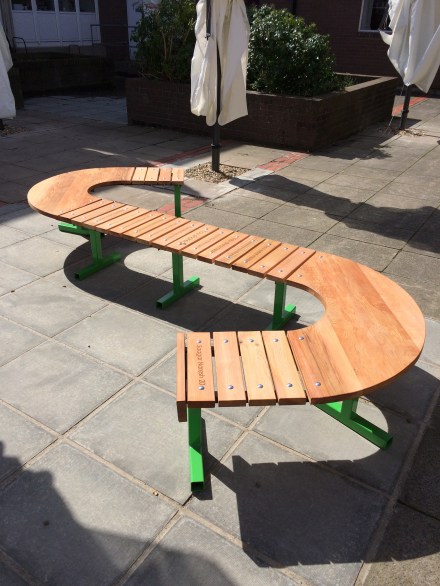
S Bench 2

The lush green school grounds, the theatre, the officious but friendly teachers, the man-boy students, the flowing laughter, the drinks and nibbles, the chatty parents, the Design show at Saagar’s school.

We were invited. We were there to see Saagar’s memorial bench holding pride of place. The show-stopper!

The highly talented and very sweet young man T, who made it was there too with his family. We met them for the first time. His mother said that he had worked really hard on this project as he felt honoured to be asked to do it. He was apprehensive about meeting me but thereafter he relaxed and enjoyed doing it.

A few years ago Saagar studied Design and Technology(D&T) for his GCSEs. He loved it. One day he sat down to discuss his project with me. He asked me what kind of a jewelry stand I would like – the rough shape and size of it and other requirements it should fulfil. He made me a beautiful jewelry stand for my trinkets – with mirrors, rods for necklaces, little pots for finger-rings and ear-rings and smaller pots for safety pins and hair pins. He paid attention to every detail. The stand took centre stage on my dressing table from the day it entered the house.

I hope he appreciates the lime-green legs on his bench. That’s me returning the favour, if at all possible.