Day 582

A lovely lady came up to me at the end of the Mental Health First Aid for Youth training today and asked, ”This may sound silly but could I have seen you on a morning TV show last summer?” I said yes, quiet possibly. I had put one of Saagar’s black and white pictures up before talking about him at the end of the training. She had seen that picture on TV 10 months ago and seeing it again had reminded her of him and me. Interestingly she had registered Saagar’s image much more strongly than mine. Well, he is unforgettable and not just for me.

She went on to share how she had been inspired that day to look into Mental Health issues closely and make the wellbeing of her students her top priority. She is an English teacher and is passionate about creative writing and now, Mental Health.

On the afternoon of 22nd July last year, at 3 pm I received a call to ask if I would be prepared to show up at BBC studios at 8 am the next day to appear on TV on a live current events show to talk about some issues around suicide. It was very short notice but with the help of my work colleagues I was able to arrange the morning off work. It was a short but meaningful conversation. The responses on Twitter, I am told were many, from people who were deeply touched by it. That one step was taken in a state of being lost and dazed, very unsure of myself having never done anything like that ever before, speaking about the most painful event of my life on national television.

After meeting this lady today, I can see the impact of real stories and conversations.
My faith in the Universe gets stronger everyday. We shall overcome.

“Take the first step in faith. You don’t have to see the whole staircase. Just take the first step.”
Dr Martin Luther King Jr.

Day 581

After more than a year of Saagar’s death I could see that nothing at all had changed. Nothing was going to change. There is no power behind a Coroner’s inquest report, no legal, professional or financial implications for anyone concerned. Hence no lessons learnt.

I approached the GMC for help with the view that may be they will see things as they are and have more power to influence change but this is the letter I received from them today:

“In January 2016 documents regarding Saagar’s care were referred to a GMC Medical Case Examiner for review. I can confirm that the Case Examiner was specifically dealing with Dr GP and any issues surrounding his fitness to practise when they reviewed the documents. A decision was made by the Case Examiner that there was nothing contained within the documents which would call into question Dr GP’s fitness to practise and that as such the case should be closed with no further action.”

  1. Really? Is this protectionism or is it a reflection of a deeper level of ignorance within the medical community than I thought?
  2. Am I the one who’s crazy? Imagining things? Over-reacting? Making false judgements just because I am grieving?
  3. The job at hand is clearly much harder than I thought it might be. I can teach children to ask for help. I can teach parents and teachers to identify signs of crisis and get professional help for them. They can take them to the GP. And then what?

The GP may ask them to fill out a PHQ-9 questionnaire. They may score 27/27. The GP might not discuss that with the parents. Not get anyone’s advise on the phone. Not refer them to a mental health specialist. They may send them home with a medicine that might worsen their suicidal ideation. They may also reassure them that they will get better.

That is like sending someone with terminal cancer home with the assurance that they will get better. That however would be unacceptable because cancer is a physical illness.

Severe depression can be invisible to the untrained eye. So, it’s ok for GPs to send young men with the greatest degree of depression home. Unquestionably.

‘Parity of esteem’ is a joke.


Day 580

Ode to Broken Things
by Pablo Naruda

Things get broken at home
like they were pushed
by an invisible, deliberate smasher.
It’s not my hands or yours
It wasn’t the girls
with their hard fingernails
or the motion of the planet.
It wasn’t anything or anybody
It wasn’t the wind
It wasn’t the orange-colored noontime
Or night over the earth
It wasn’t even the nose or the elbow
Or the hips getting bigger
or the ankle
or the air.
The plate broke, the lamp fell
All the flower pots tumbled over
one by one. That pot
which overflowed with scarlet
in the middle of October,
it got tired from all the violets
and another empty one
rolled round and round and round
all through winter
until it was only the powder
of a flowerpot,
a broken memory, shining dust.

And that clockwhose sound was
the voice of our lives,
the secret
thread of our weeks,
which released
one by one, so many hours
for honey and silence
for so many births and jobs,
that clock also fell
and its delicate blue guts
vibrated
among the broken glass
its wide heart
unsprung.

Life goes on grinding up
glass, wearing out clothes
making fragments
breaking down
forms
and what lasts through time
is like an island on a ship in the sea,
perishable
surrounded by dangerous fragility
by merciless waters and threats.

Let’s put all our treasures together
— the clocks, plates, cups cracked by the cold —
into a sack and carry them
to the sea
and let our possessions sink
into one alarming breaker
that sounds like a river.
May whatever breaks
be reconstructed by the sea
with the long labor of its tides.
So many useless things
which nobody broke
but which got broken anyway.

Day 579

header_Geel-by-Gary-Porter

Hospitals can sometimes be a problem rather than a solution.  They cannot provide the collaborative information sharing needed to care for today’s typical patients who may have multiple problems. This is especially true for the elderly and the mentally ill. Royal College of Physicians has proposed the concept of “hospital without walls” which aims at providing continuity of care for patients, coordinated and delivered by a single consultant-led clinical team. The hospital ceases to be “somewhere”. It becomes everywhere.

The little market town of Geel  in Belgium is well known for its early de-medicalisation of care of the mentally ill. For at least 7 centuries, it’s inhabitants have been taking the mentally ill or disabled into their homes as ‘guests’ or ‘boarders’. These are people who, whatever their diagnosis, have come here because they’re unable to cope on their own, and because they have no family or friends who can look after them. When they meet their new families there is no clinical diagnosis. During the Renaissance, Geel became famous as a place of sanctuary for the ‘mad’, who arrived and stayed for reasons both spiritual and opportunistic.

A boarder is treated as a member of the family, involved in everything and particularly encouraged to form a strong bond with the children, a relationship that is seen as beneficial to both parties. They call it ‘family care’, possibly the best form of therapy. Often the boarder lives with the family till they die, first as a child, then a sibling and later on as an uncle or aunt. Doesn’t that fulfil a basic human need of relatedness with other beings? The tradition still exists albeit to a limited extent due to faster paced city life, fewer farms and more double income families. However, the main reason for its longevity is not just tolerance, but pride. “Half of Geel is crazy, and the rest is half crazy,” runs a local joke.

Today, in London we aim to provide ‘Community Care’ in the absence of a community and no understanding of the word ‘care’. It’s obviously not working because the basic values on which it is based are wrong ie. cost saving.

We, the people need to educate ourselves, open our hearts and develop a deeper understanding of our human condition.

To kick off the Mental Health Awareness week, here are a couple of attempts on my part:

18 Months on…

Podcast from Croydon Radio


Day 578

image

This is the question : How can we Re-create Psychiatry?

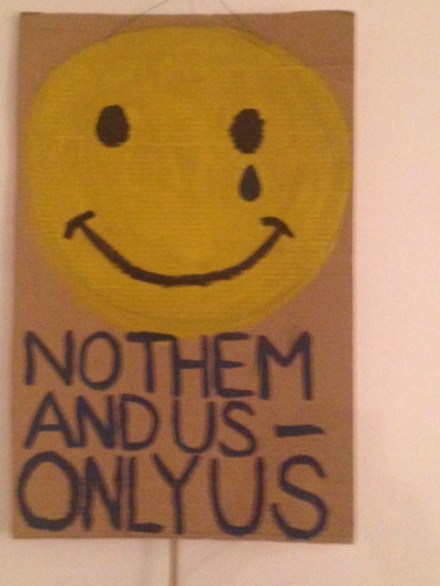
How can we break down the“us” versus “them” approach?

How can we stop ourselves from putting people into neat little labelled boxes rather than perceiving each one as a unique individual with their own unique story and experience?

How can we communicate in a way where we respect boundaries but do not create barriers? How can we truly listen in a way that we can put ourselves in someone else’s shoes?

There is a hierarchy in knowledge. Intellectual knowledge is considered superior to emotional or experiential knowledge, which in turn is rated higher than seemingly irrational knowledge, which could come from ‘patients’ with seemingly little insight. Who makes these decisions? How come the power balance between psychiatrists(intellectual/clinical) and patients(experiential/seemingly irrational) is so extremely warped? Does looking at people through templates give us any idea of who they truly are?

The Open Dialogue approach is a philosophical/theoretical approach to people experiencing a mental health crisis and their families/networks, and a system of care, developed in Western Lapland in Finland over the last 25-30 years. In the 1980s psychiatric services in Western Lapland were in a poor state, in fact they had one of the worst incidences of ‘schizophrenia’ in Europe. Now they have the best documented outcomes in the Western World. For example, around 75% of those experiencing psychosis have returned to work or study within 2 years and only around 20% are still taking antipsychotic medication.

Working with families and social networks, as much as possible in their own homes, Open Dialogue teams work to help those involved in a crisis situation to be together and to engage in dialogue. It has been their experience that if the family/team can bear the extreme emotion in a crisis situation, and tolerate the uncertainty, in time shared meaning usually emerges and healing is possible.

This Open Dialogue training launches in London next month.