Day 566

The much talked about ‘Jurassic Park’ had just been released in New Delhi and tickets had to be booked well in advance. The earliest tickets available were for the 4th of May, which happened to be my EDD, Expected Date of Delivery. So we thought about it and went ahead with the bookings anyway. At worst I would miss it. At best I would watch it. As it turned out I did watch it and loved it, big belly and all. Saagar was born 2 days later, on the 6th of May.

This happened 22 years ago.

That day I stepped into an all-consuming ocean of love and I am still immersed in it. It carries me, guides me and motivates me at every juncture.

This year I will be delivering  my first Youth MHFA (Mental Health First Aid) course on the 6/7 May. This course teaches people how to identify, understand and help a person who may be developing a mental health issue. In the same way as we learn physical first aid, Mental Health First Aid teaches early recognition of the crucial warning signs of mental ill health so that a better level of recovery can be achieved. It teaches how to effectively guide patient towards the right support services. Most importantly, it helps breakdown the stigma attached with mental illness. In a nutshell, it really endeavours to fill a big gap in our society. MHFA course  was developed in Australia in 2000 and is now internationally recognised in 23 countries.

I think it would be a fitting tribute to Saagar on his 22nd birthday. Things change.


Day 551

photo

Having no time to think is not a bad thing.
It also means there is less time to hurt.
Running around chasing time.
Legitimately pushing feelings aside, rushing hurriedly past them.
Fully justified.

Back at my parents home,
lying in our bed, Saagar’s and mine when he was a baby,
looking at his beautiful pictures on the wall,
I cannot sleep.
Every toss and turn is filled with the crushing pain of memories,
that have left purple bruises on me..
The black ink of the night settles on me.
No matter how many times I splash it with the water of dawn, it refuses to leave.
The sun doesn’t darken me as much as the darkness of night.

A wanderer.
I have travelled through smoky galaxies like an entangled spark of consciousness,
an errant drop of divinity.
Landed on the earth like a moment cut-off from Time.
I wander aimlessly.
No country yet.
Neither a street, nor a home.
I wander as a soul in my own body.
Where is the destination?
Or is it just an illusion?
Like everything else?

Day 548

suicideGreatRecession03

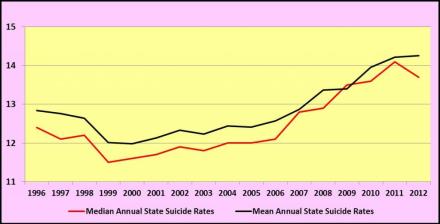
Yesterday a couple of things happened that made me think of the relationship between suicide rates and financial crises; there was a letter in the post for Saagar from Wonga offering him money and we watched “The Big Short”.

The 2008 global financial crisis affected economies around the world. It led to the deepest UK recession since World War II, with rises in unemployment, debt and home repossessions. Young people experienced particularly high levels of job losses and unemployment. In England, as in the rest of the world, the greatest rise in the incidence of suicide appeared to be in young men.

Disputes over benefits, wage cuts or demotions and reduced hours are among the other sources of distress. A range of sources of debt were identified, including loans (e.g. hire purchase and student loans), mortgage, rent arrears, gambling and debts to friends and family. Many people do not get in touch with mental health services or their GP in situations like these.

People in the ‘know’ seem to think that we all are headed towards another global financial crisis. Austerity measures and job losses are all over the news. Several studies have shown that the people most vulnerable to job loss and debt are individuals with pre-existing mental health problems or past psychiatric illness. Thus vulnerable individuals may become more vulnerable during periods of recession.

Countries with more generous unemployment benefits and more investment in active labour market programmes (e.g. job search assistance, apprenticeships, subsidised employment) experience the smallest rises in suicide during recession.

A policy focus on creating work opportunities for young people is particularly important during periods of recession. Young people are the group most likely to be made redundant and experience difficulties finding work. Negative first experiences of job seeking and the labour market may have a permanent scarring effect.

Frontline staff most likely to be in contact with individuals whose mental health is affected by economic and employment difficulties should receive training in recognising and responding to risk.


Day 543

In 2009 Thomas Joiner proposed the Interpersonal-Psychological (I-P) theory of suicidal behaviour.

Author of over 385 peer reviewed journals, Thomas Joiner has worked extensively in the field of psychology, neurobiology and suicidal behaviour.
As per the I-P theory, an individual will not die by suicide unless s/he has both, the desire and the ability to do so.
Who desires suicide?
There are 2 specific psychological states in their minds simultaneously:

  1. Perceived burdensomeness
  2. Low belongingness/social alienation.

Perceived burdensomeness:

“My death will be worth more than my life to family, friends, society, etc.” – a view that often represents a potentially fatal misperception. Studies have shown that this is a robust predictor of suicide attempt status and of current suicidal ideation, even controlling for powerful suicide-related covariates like hopelessness.

Low belongingness:

Not feeling like an integral part of a family, circle of friends, or other valued group.  As with the research base on perceived burdensomeness, there is abundant evidence that this factor is implicated in suicidal behaviour. A study by Joiner in 2008 showed that college students’ suicidal ideation peaked in the summer semester when the campus is less active. This accounted, in part, for the association between semester and suicidality.

How does one overcome the powerful instinct for self-preservation?

By developing a fearlessness of pain, which is acquired through a process of repeatedly experiencing painful events such as previous self-injury, repeated accidental injuries, numerous physical fights and occupations like physician and front-line soldier in which exposure to pain and injury, either directly or vicariously, is common.

The Interpersonal-Psychological theory is a promising one with growing evidence base. It suggests that clinicians be cognizant of their patients’ levels of belongingness, burdensomeness, and acquired capability (especially previous suicide attempts), as this knowledge may aid clinicians in the task of suicide risk assessment and of targeting ttreatments.

Day 534

Professor Guy Goodwin, the main author of the third and latest revision of the BAP Bipolar Guidelines said in his e-mail accompanying the publication:

“The third revision of the British Association of Psychopharmacology (BAP) Bipolar guideline is now available. It is substantially revised from last time to reflect changes in the available evidence, obviously, but also a changing perspective on how to weigh the evidence. It is intended to provide a counterbalance to the NICE document of 2014 which in places shows partiality (to psychological treatments) and a lack of common sense. The authors hope that the BAP revision will be useful in guiding and improving treatment of what remains a curiously neglected disorder.

 09c48df2-1880-4795-a043-562daa8a726a

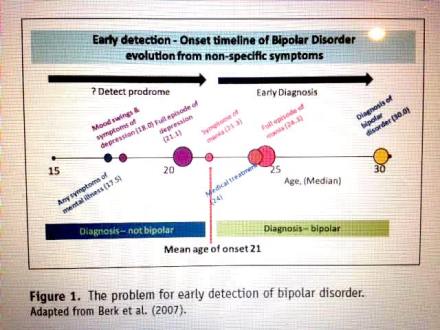
The BAP Guidelines for Bipolar Disorder is a 59 page document. The above picture is on page 20. It is a clear depiction of the evolution of the disease and elicits a ‘full episode of depression’ at the age of 20 years and a few months which was exactly the age Saagar was when he had the full episode of depression – 20 years, 5 months and 10 days. Yet he was discharged to the GP without highlighting the possibility of this happening and all the doors to access specialist services were closed behind him.

On page 23, it goes on to say – “Premature discharge to primary care can further dilute the treatment package available in the early stages of managing the illness.”

He was discharged by the Psychiatrist to the GP after 20 days of having made the diagnosis of Bipolar Disorder.

What more can I say? Poor kid!