Day 614

e92627b2-db1d-493c-9f9d-14781b423904-1

Seventeen years ago I packed a suitcase and flew from New Delhi to Belfast with 200 pounds and a job contract in my pocket. I didn’t have even one acquaintance in Belfast but I had fire in my belly. I wanted to study further, be better at my job and create a brighter future for my family.

Although my colleagues were very friendly I did not have any friends for a while. What kept me going was keeping a gratitude journal. Every evening I wrote down 5 things I was grateful for and went to bed smiling even though I missed my family a lot. I have misplaced those journals but I hope I will find them and read them again.

I found one random entry dated 1st Jan 2001 –

“Another year.
Another slot in the Time Machine.
Another measure of nothing.
Another invisible milestone.
On the road to an unknown destination.

Time and Ego are brothers. The latter being completely identified with the former – held upright by it’s past, it thinks it is ‘so and so’in the present and will be even more ‘so and so’ in the future.”

This blog is a journal of sorts. It helps me a great deal.
Today’s entry would be:

– Thank you for the gorgeous summer solstice, a full day of sunshine and the full moon.

– Thank you for my third Mental Health First Aid course with 14 participants. (Bringing the total to 37)

– Thank you for Saagar and the strength and purity of his love.

– Thank you for Si and his tender loving care.

– Thank you for this mind, body and spirit.

Thank you!
Day 612

Edward was 18. He had recently been offered a place at Cambridge University following 12 A*s at GCSE and 100% scores at AS level. He also excelled at playing the piano. He was a popular and friendly young man who now has the heartbreaking legacy of having played all of the music at his own funeral. He ended his own life in February 2015 following the unexplained, rapid and catastrophic onset of depressive illness.

He sounds so much like Saagar. His father, Steve Mallen strongly believes Edward was let down by the health services, just like Saagar was.

“Sometimes they call depression the curse of the strong. In other words the stronger, more resilient, more intelligent and more capable you are, the better you are able to conceal the difficulties you might be experiencing,” said Mr Mallen.

He has set up a The MindEd Trust with this mission statement:

“We mind what happened to Edward Mallen and we will do all we can to avert similar tragedies through the prevention and alleviation of mental ill-health amongst young people.”

Speaking to a friend in Bristol it emerged that CAMHS there now refuses to see youngsters who have attempted suicide. The charity Mind says on its website that the types of problems CAMHS is meant to help with include violent or angry behaviour, depression, eating difficulties, low self-esteem, anxiety, obsessions or compulsions, sleep problems, self-harming and the effects of abuse or traumatic events. CAMHS can also diagnose and treat serious mental health problems such as bipolar disorder and schizophrenia.

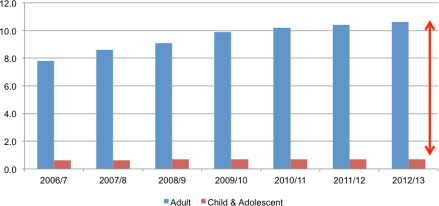
How have we come to this? In the light of the fact that the incidence of mental health problems in the young is on the rise, does the graph below on expenditure (in billions) on mental health services offer an explanation?

expenditure-on-mental-health


Day 611

The seminar hall at the All Souls Club was full. It was the Annual day of SOBS, Survivors Of Bereavement by Suicide. This is one of those support groups that wishes that it’s membership would continue to drop to the point where it would not need to exist. But sadly, year on year there are more and more families seeking help after being struck by this tragedy. They bring their stories, their feelings and thoughts to this sacred space where they are understood and honoured.

Some of the topics explored by us were – guilt being a major part of bereavement by suicide and how to deal with it; how much of a ‘choice’ is suicide; how useful and effective is the Coroner’s inquest and how can it be made more meaningful.

A few parents have been attending this annual meeting for more than 15 years. They all observed that at the meeting in 2009 there were roughly 10 parents present. Today there were more than 45 and they had to form 2 groups for meaningful exchange to take place.

Last year my friend N and I had to leave the meeting in the middle of a talk and we stood on the staircase hugging each other and crying inconsolably. Today N mediated one group of parents and I the other.

Getting through one day at a time, putting one foot in front of the other and then looking back, I see that bonds are strengthening, hearts are healing and light is entering not only into us but also into the world through our wounds.


Day 609

majnu-laila

Romeo and Juliet are young and beautiful fictional characters. Their love is expressed with great intensity. Romeo said,

“Heaven is here, where Juliet lives.”

Their self-annihilating thoughts come from immature, impetuous and impulsive teen brains.  Their tragic and irrevocable deeds are fuelled by a black and white perspective, typical of that innocent age. If they can’t be together, they don’t want to live. As simple as that.

“If all else fails, myself have power to die.”

Laila Majnu and Heer Ranjha are similar stories from the east where young lives end in tragedy.

Shakespeare and Waris Shah both explore the issue of whether marriage should be based on love or parental choice. Both narratives are stories of young love so all-consuming that the lovers would rather die than live without each other.

The 1973 hindi film ‘Bobby’ made on a similar theme was a great hit and was followed by many attempted and completed suicides.

While they explore some social issues, these stories are for entertainment. They falsely glorify suicide and give it the appearance of deep commitment, almost noble in it’s nature.

There is nothing romantic or noble about suicide.

Day 608

We live in an age of sleep deprivation. In the 1950s, most people got on an average 8 hours of sleep every night but now it is reduced by at least an hour and a half. Teenagers need 9 hours but they often get only about 5 on a school night.

Sleep is restorative. It helps with conservation and regeneration of energy. It also helps with basic brain processes such as memory, creativity, problem-solving and learning. Shortage of sleep and poor quality of sleep is deeply damaging, as in shift workers. Not only does it have subtle effects on one’s personality, it also increases the risk of road and other accidents due to micro-sleeps in the day and increased impulsiveness.

“You always get sleep disruption in people with mental illness. That’s because they don’t have jobs, so they go to bed late and get up late” remarked a psychiatrist. This led Dr Russell Foster into the study of relationships between sleep and mental illness. His team at Oxford found that in patients with schizophrenia, regardless of antipsychotic treatment, sleep patterns were not just disrupted but totally smashed. Bipolar and Seasonal affective disorders and depression also involve bad sleep as do dementia, Alzheimer’s and Parkinson’s disease.

Sleep disruption is being studied as a biomarker of potential mental health problems and it offers the possibility of early intervention.

Researchers at Oxford have found that if sleep can be partially stabilized using CBT in patients with schizophrenia, levels of delusional paranoia can be reduced by 50%. It is possible that consistent improvement in sleep patterns may delay the onset of certain conditions by knocking the brain into a different developmental trajectory.

“Sleep is the golden chain that ties health and our bodies together.”