Day 878

Gary’s story.
The Last Word.
Work Under Pressure.

These 3 powerful videos appear on the website of Mates in Mind (MiM). Suicide kills far more construction workers than work place accidents.  MiM is a charitable programme to improve and promote positive mental health in construction. It has been co-founded by Health in Construction and British Safety Council.

At present, one in 6 workers in the UK is experiencing depression, anxiety or stress. 6% of the UK work force is made up of construction workers, that is 2.1 million people. Hence at any given time at least 350,000 people in the industry will be dealing with mental ill health and possibly feeling alone. Raising awareness and generating champions through modular training in that community means there will always be someone close by who can help or are dealing with similar feelings.

A recent article in the BMJ states 5 facts about the conditions in anaesthetic training –

Workload – Nearly all had stayed beyond their shift. Nearly two thirds (62%) said that in the previous month they had gone through a shift without a meal, and 75% had done a shift without drinking enough water.

Health – Sixty four per cent of the anaesthetics trainees thought that their job had negatively affected their physical health, and 61% thought it had negatively affected their mental health.

Morale – Poor work-life balance, the burden of assessment, career uncertainty, frequent rotations, and terms and conditions of service sapped their morale.

Patient safety – This had worsened due to lack of available hospital beds, staff morale, and staff shortages.

Burnout risk – 85% of these young doctors were at risk of burnout.

I think Mr Hunt can take credit for some of these issues.

Mate in Mind is a fantastic example for other industries to make a concerted effort to address the well being of their employees in these difficult and uncertain times.

Ref:
https://www.matesinmind.org/employers.html

http://careers.bmj.com/careers/advice/Five_facts_about_conditions_in_anaesthetics_training
Day 873

It’s Thursday.
It’s the 16th.
It’s March 2017.
Exactly 29 months.
2 years and 5 months.

I am in the same part of the same hospital, doing the same job with the same people as I was on that day. I am taking a break in the same clutterred coffee room where Saagar visited me a few months prior to his death.

Today, I sit here reading the House of Commons Select Committee Progress Report on Suicide Prevention. It informs the Government’s strategy on the same.

In a nutshell, it clearly states – Suicide is preventable. Current rates of loss of life in this way are unacceptable and most likely under-reported. Even though 95% of Local Councils have a Suicide Prevention Strategy, its implementation is very poor. We must have a way to reach those at risk but not in contact with health services. It commends the work of the voluntary sector. It identifies stigma as a big hindrance. It emphasises better targeted training for frontline staff, medical students and GPs. It expresses disappointments at the poor follow-up of patients after discharge from psychiatric services, at poor information sharing with families and poor funding/staffing of services.

It identifies self harm as the single biggest indicator of suicide risk. Poor psychosocial assessment and safety planning of these patients possibly contributes to a high rate of suicides. Proper support for bereaved families should be an integral part of suicide prevention. Irresponsible media reporting is damaging. Coroner’s need to call a suicide, a suicide.

All the things that we have been saying for all these months!
To think that at least 15,000 more suicides have already taken place in the UK since Saagar’s death!

Report:
https://www.parliament.uk/business/committees/committees-a-z/commons-select/health-committee/news-parliament-20151/suicide-prevention-report-published-16-171/

Day 871

“I have opened a door that can never be shut. How will I ever get her to trust me again?”

19 out of 20 people who attempt to end their lives will fail.

These survivors will be at a 37% higher risk of suicide.

Anger, shame, guilt, fear, minimization and avoidance are few of the reactions they evoke.

The taboo associated with the act might make them feel even more isolated. Their families may not know how and where to access support for themselves and their loved one. The ones closest to them may feel drained, stressed, exhausted and let down. The trust between the two might be deeply damaged.

Their relationship might reach an all time low, just when it needs to be solid.

Both need to take responsibility for their own well-being and  that of each other.

Here are a few useful resources.

Ref:

Supporting someone after a suicide attempt:
https://www.suicideline.org.au/media/1114/supporting_someone_after_a_suicide_attempt.pdf

Advice for those who survived:
http://blog.ted.com/real-advice-for-those-whove-attempted-suicide/

TED:

Day 862

img_0561

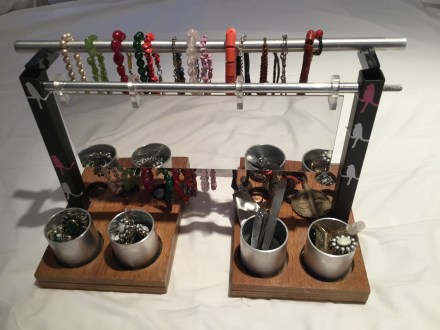
He often watched ‘How it’s made’ on TV. He was fascinated with the process. Be it guitars, dream cars, ballistic missiles or bubble gum, he was intrigued with how things were made. In school he studied Design and Technology (D&T). As a project he had to design and make something in his last year at school.

Together we came up with the idea of a jewellery stand. We discussed the desired features, materials, shape and size and over time he refined the idea with the help of his teachers. A few months later he brought home this beautiful piece of work. He had managed to add a mirror, adjustable fittings and decorations to it. I was immensely proud. Another one of his many gifts! May be his finger prints are still on it, intermingled with mine. 

dt

(Saagar, slightly blurred, in the background in his school D&T lab)

Two hundred and thirty one children in the UK died of suicide before finishing school in 2015. Nearly 100 children aged 10 to 14 killed themselves in the UK in the last decade, according to figures from the Office for National Statistics (ONS). The more I look into it, the more my heart breaks. I am sorry if my writing has the same effect on you. It is such a waste! We are loosing our future to suicide!

 “There can be no keener revelation of a society’s soul than the way in which it treats its children.”   – Nelson Mandela

Ref:

https://www.theguardian.com/society/2016/feb/04/female-suicide-rate-in-england-highest-for-a-decade-in-2014-figures-reveal

Day 851

article-2335030-19f33d94000005dc-704_634x422

“The university did not ring and tell us that she had been admitted to hospital critically ill. We were in the dark for hours as to what had happened. We found out off Facebook” says Nikki, mother of Miranda.

Miranda Williams 19. Student of Philosophy.
Daniel Green 18. Student of Law.
Kim Long 18. Student of Law.
-Deaths by suicide, first term of first year at the same University.

Lara Nosiru 23. Student of Neurosciences.
-Died by suicide, Final year at the same University.

All these lovely young people died within a few months of each other. On the surface of it the deaths do not seem to be related to each other.

At least 1600 families face this nightmare every year and at least 1600 beautiful young lives are wasted year on year with no sign of a drop in numbers, only a rise.In 2007, there were 75 university students died of suicide in England and Wales. In the ghastly year of Saagar’s death, 2014, the number went up to 130, nearly 75% higher.

Why?

Underdiagnosed anxiety and depression at school.
Problems identified but not dealt with.
Stigma stopping young people from asking for help.
Unfamiliar surroundings.
Being away from home/family/friends for the first time.
Excessive drinking culture.
Trying their best to start off Uni on the right foot.
Debt / financial pressures.
Academic pressures.
Suddenly being treated like ‘adults’.
Trying to cope with pressures all alone.
Too proud, worried or ashamed to ask for help.
Not enough help available at Uni.
(“During Kim Long’s inquest this week, it was revealed that more than 600 Bristol University students were referred to support services by their tutors last year because they were deemed at “high risk”.)
Improper use of ‘Confidentiality’.
New students not being identified as high-risk.
Poor understanding and management of depression in the community

1600!!!

Ref: https://www.thesun.co.uk/news/2838174/is-a-cocktail-of-ballooning-costs-stigmatisation-of-mental-health-problems-and-academic-pressure-killing-our-kids/