Day 997

Moving home

The experts on the gardening programme  on the radio said that repotting is traumatic for plants. I had never thought about that before. Should it be any different for children and families moving house?

By virtue of my dad’s job, we moved more or less every 2 years. Some of the places we lived in are not easy to find on the map of India. I completed 12 years of schooling in 8 different schools in India. It was normal to be the new girl in class. We went to schools that catered to families that moved frequently. So, often there would be other new kids in class too. It was heart-breaking to leave friends just when our friendships were deepening. As time went on, it became a part of life and although it was sad, I could handle it much better. That was partially because I altered the quality of my relationships. I didn’t allow them to get too deep. I protected myself by holding back a bit of me for myself. That bit would always be safe. I didn’t know I was doing it then but I see it now.

The cycle repeated itself with Saagar. The difference was that he travelled outside India to places where he would be the only coloured kid in class, where they spoke a different language in a peculiar accent, where he had no close friends or extended family, where it was normal for people to live all their lives in one place and be buried in the cemetery two streets away from their primary school.

Grief can come in intangible forms – loss of trust, loss of innocence, loss of safety, loss of childhood, loss of control and loss of faith.  A 2010 study of 7,000 American adults found that the more times a person had moved house in childhood, the more likely they were to report lower life satisfaction and well-being, irrespective of their age, gender and education.

Reasons, timing and location matter. The good news is that something can be done about it.

Day 996


Tying the knot

IMG_0814

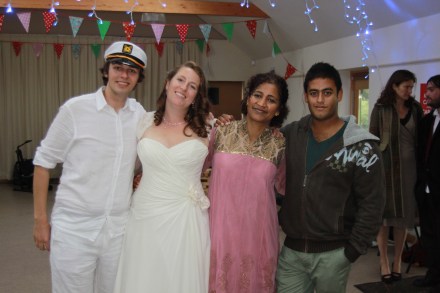
Today my friend and her fiancé tied the knot. 2 individuals and families came together and entwined their love and destinies forever. The sun and the flowers smiled as they poured out blessings. The fragrance of jasmine flooded the air as the pretty little white flowers adorned the hair of most women present. Chanting of Sanskrit verses in a rhythmic baritone meter sanctified the atmosphere. The fire at the centre of the auspicious ceremony bore witness.

The sights, sounds and smells conjured up images from the past. The food and music. The silk and gold. The gifts and festivities. The smiles and promises. The coconuts and beetle-nuts. The salutations and offerings to deities. The hopes and dreams of lifelong friendship, companionship, health, happiness and prosperity. Mischievous traditions of the bride’s friends hiding the bride-groom’s shoes and little competitions between the bride and groom. A reminder of times and people gone by.

In the last 2 years and 9 months I have turned down three wedding invitations. Couldn’t face the thought. Today was the first. It was good.

The last wedding Saagar and I attended was in September 2012. We drove to a small village near Brighton on a very wet day. Our Tom-tom took us to the middle of a field and declared, ‘You have reached your destination’ . We had to laugh. We drove up to the nearest set of houses, knocking on doors of complete strangers to find out more. We finally got there. It was great!

IMG_6808


Day 993

Ruth

churchhealing

Broken glass

“You are well enough to safely go home now”, said the panel.
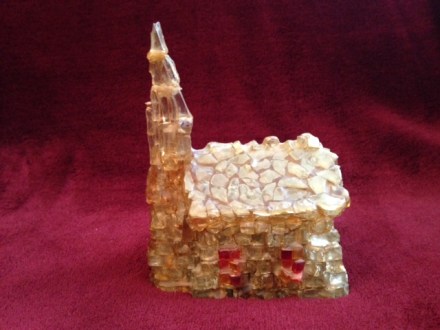
“But I can’t! I need one more day to complete my church!”, said Di, who was being treated at Bexley hospital for Postnatal Depression in 1966. She had a brilliant occupational therapist who took them to the swimming pool, organised hair-dressing days and helped patients to make things. Di made a church with bits of shattered wind-screen glass, put together with resin but the spire wasn’t on yet. This beautifully tactile piece of art was named ‘Faith’ by Ruth, her daughter.

Ruth

Ruth was a talented young lawyer. She was an actor and singer. She was kind, generous and gorgeous! She travelled extensively. She was diagnosed with Bipolar Disorder in her late 20s. She coped well with the help of health services, her friends and family but tragically lost her battle at the age of 47.

Di is in her second year of missing Ruth terribly. She has created the most beautiful garden in her memory. Some of the plants there are from Ruth’s house. Her mediterranean wall is stunning.

Mediterraneanwall

Being bereaved by suicide is a huge risk factor for suicide. Around 125 youth suicides a year occur soon after the person involved has experienced a bereavement. One in four (25%) of under-20s and 28% of 20 to 24-year-olds had lost a relative, partner, friend or acquaintance around a year or more beforehand. In 11% of suicides among under-20s, the person who those involved had lost had also taken their own life.

In a recent inquiry, bereavement was found to be an important theme in many deaths, said Prof Louis Appleby, the director.

People who have been bereaved need greater support to reduce the risk of them killing themselves. Agencies who are meant to help are not good at recognising this risk and need to improve.

This morning I caught up with Di over a cup of tea. We both believe that if Saagar and Ruth have met each other wherever they are, they must get on famously. The link below is a conversation with Di. She talks about her insights on mental health services over 5 decades. Thanks a lot Di!

Day 992

images

Strawberry Hill

“If you had a carpet bag and an umbrella you could be mistaken for Mary Poppins” one of my colleagues commented as he stopped his car right next to me at a red signal while I waited there on my bike. I often wear a tunic dress with leather shoes to work. I enjoy watching other cyclists in their multi-coloured and multi-logoed breathable jerseys, elasticated and padded cycling shorts, grippy mitts, electric yellow socks, clickity-clop shoes, snazzy sporty eye-wear and fancy headgear. Most of them are very serious.

My cycle belongs to the category of ‘hybrid’. It’s black and silver. It’s heavy compared to some of the feather-weights on the road. The special thing about it is that it is wholly unremarkable. Saagar used to call it ‘old lady bike’. Its first name is Strawberry and second name, Hill.

Space on roads is negotiated between cyclists, motorists and pedestrians. Cyclists move in packs and sometimes have disagreements amongst themselves. It’s clear from the behaviour of a cyclist if he/she has ever been behind a wheel. Likewise, it is easy to say if a driver is cyclist-aware. Pedestrians are a law unto themselves.

Within 3 turns of my wheels as I start off from a red signal, at least 10 bikes go past me. It’s another matter that a hundred yards hence we find ourselves waiting at the next set of lights. Some attempt to squeeze through the narrowest crevice in the traffic. Being stuck behind a bus is a special treat in terms of the quality of air. Smoking is mandatory.

The morning ride to work is a dream – fresh air, fresh me, very few people out and about, the wind behind me and the way mostly flat or downhill. In the evening – smoky air, tired me, lots and lots of people, riding into the breeze on a steady uphill road. Both, leisure times. Excuses to be a child again. As my quads toil hard to get me home inch by inch, I visualise the tub of Green and Black’s Dark Chocolate ice-cream waiting for me in the freezer. It helps with the speed and puts a song in my heart.


Day 989

Accidental findings

The_ACE_Pyramid

In the mid 80s, Dr Vincent Felitti ran an Obesity clinic in America. Many people enrolled and hundreds of pounds were shed by them. But he found that the drop-out rate from his programme was as high as 50% despite good results. He did not understand this and went back to look closely at patient notes.

“I had assumed that people who were 400, 500, 600 pounds would be getting heavier and heavier year after year. In two thousand people, I did not see it once. When they gained weight, it was abrupt and then they stabilized. If they lost weight, they regained all of it or more over a very short time.”

The turning point in Felitti’s quest came by accident. He was running through yet another series of questions with yet another obesity program. How much did you weigh when you were born…when you were in first grade…when you were in high school…when you first became sexually active…

One female patient replied – “Forty pounds” and broke down in floods of tears, “I was four years old.” He found similar common themes emerging from various stories and went on researching this subject for the next 25 years.

The obese people that Felitti was interviewing were 100, 200, 300, 400 overweight, but they didn’t see their weight as a problem. To them, eating was a fix, a solution like IV drug user calls a dose a “fix”.

Eating made them feel better. Eating soothed their anxiety, fear, anger or depression – it worked like alcohol or tobacco or methamphetamines. Not eating increased their anxiety, depression, and fear to levels that were intolerable. For many people, just being obese solved a problem. In the case of the woman who’d been raped, she felt as if she were invisible to men.

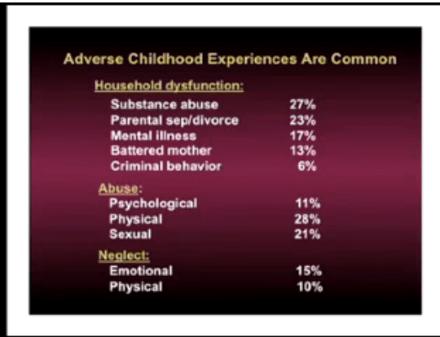
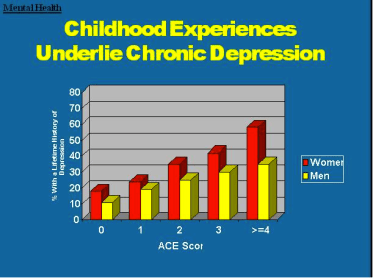
Felitti went on to further explore the  impact of childhood trauma on people and coined the term – ACE, Adverse Chilhood Experience. He found a strong co-relation between the number of ACEs and early death.

aceslist

acedepression

Film: https://www.youtube.com/watch?v=v3A_HexLxDY