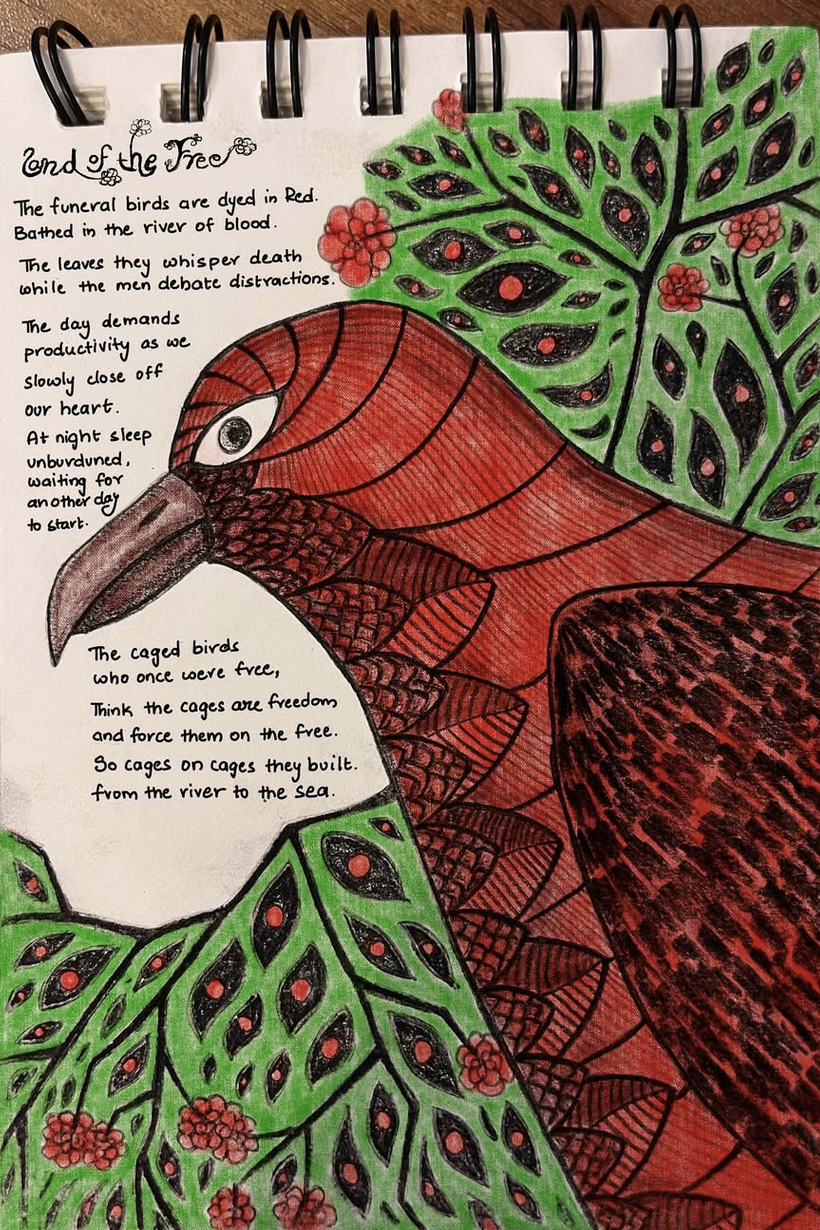
Othering our Ownkind.

“More than two thousand people read my post and saw my video today “ Yuval said.

‘They will see it and be moved by it. What then? What will they do?’ asked Basel.

That is the big question. What can we do? What will we do? Two young journalists from either camp came together to document the encroachment and destruction of a village called Masafer Yatta on the West Bank. They raise this question loud and clear for each of us. What can I do? The injustice of all this pushing and kicking, hurting and forcing fills me to the brim with a sense of sadness and powerlessness. My arms and legs go limp. So, thus far I’ve been running away from it. I must be a coward. What can I do? So many influential and powerful people have been quiet, watching the numbers and images get worse every day for decades.

Today, I watched No Other Land on the big screen. Live footage shot on a mobile phone over 4 years, 2019 to 2023. Running away is not possible anymore.

Harun’s mother prayed for his death. This young man was shot by a soldier while he was trying to stop his home from being demolished by the army. The bullet left him paralysed from his neck down. He was nursed in a cave as they had no house. No facilities. No transport. No freedoms. Everything around them was being bull-dozed – chicken coups, elementary schools, homes and villages. No one knew what new destruction each new day would bring. Toddlers were learning to speak, and older kids were trying to play and go to school in the middle of this madness. The respectable Mr Tony Blair graced the village with his pointless guest appearance for seven minutes.

Our world is bipolar, selectively blind. It’s okay for the politics of some nations to be tied to a faith but not for others, it’s okay for some nations to dishonour every treaty that they ever signed but not for others, it’s okay to condemn the exact same atrocities when committed by one nation and not another, it’s okay for third parties to fund and support the killing of women and children in plain sight. This is our world.

We humans have the arrogance to believe we are the smartest of all species, yet dogs don’t kill other dogs in millions every year. No other species has constructed the level of othering that humans have. We can’t see what we are doing to ourselves. We can’t see that there is no other. It’s only us in different garbs. Those of us who can see, must see. Those who can write, must write. Those who can sing, must sing. Let not our dark side win.

Arrogance, blindness and cowardice – a recipe for self-extinction.

By Abdul Raheem (https://www.instagram.com/mud._.lotus)

People

So many disappeared.
I saw them on Day 1 and 2 and then nothing. Not even a text or a call.
Luckily, the early days were a fog, a maze. Luckily, I have forgotten so much.

Some people, who were nothing more than work colleagues showed up big time. They could sit with my despair. They sent me little books of poems for difficult times in the post. They met with me for coffee in town. They called up and chatted on the phone. They made a note of Saagar’s birthday and death anniversary and sent me cards, saying, thinking of you today. Simple, small things that meant the world.

Some people spoke very little but their body language boomed loud and clear. They mirrored the contraction inside me. Their empathy shone through that. On the second day, Rajeev, an old friend sat with us for two hours in silence. Before leaving, he said, “If there is anything I can do, please let me know.” Over the next months and years, he followed my blog, commented on posts and casually dropped by when he could. He let me know he was there.

Some people possibly saw in me, the worst possible lashing of fate as a parent. Maybe they got frightened. The speed of their exit indicated their fear of catching it. Some people who were previously in the ‘life-long friends’ category, vanished. One of them was a Psychiatrist, a mother of two. One of her children, Rajat, was a close friend of Saagar when we were neighbours in Belfast. The two boys spent every evening together cycling, playing and talking. They often had their dinner and their bath in each other’s houses. I still have a picture of them at six-year-olds, with the alien they constructed together from their toys and balloons. We were the closest of friends for four years and then they moved to Birmingham and we, to London. We stayed in touch and visited each other but the boys grew apart as boys of that age do. After their visit on Day 2, our next contact was a wedding invitation to Rajat’s wedding by a WhatsApp message, eight years on.

Of course, people don’t understand. They can’t. It’s not their fault. I wouldn’t want them to because they would have to experience this. If this had happened to a friend of mine, I would like to think that I would’ve been there for her but I don’t know that for sure. The woman I was in the ‘Before’ might have been too busy or too afraid or too awkward. I don’t know.

Some of Saagar’s friends have been with us all along. We’ve attended every concert we could as Hugo and Azin have risen in their musical careers. We have met up for meals and walks as often as possible. We’ve met their partners, watched them buy houses and change jobs. Our connection with them seems to be made of the same silk as our love for Saagar, and his memory. We feel blessed to have these young people in our lives.

Yes. My address book has radically changed. Like me.

Resource: How to be with someone who is grieving:

https://outlive.in/suicide-loss

Forty pine cones and the story of a name.

(Courtesy: Mary Kennedy, my friend.)

S A A G A R.

In Delhi, it was simple and sweet.
In Belfast, it was a problem. It had to be spoken out slowly with exaggerated lip movements and spelt out clearly. Still, it was uttered in all kinds of ways – Segaar, Sega, Saaga, Sags, Sagsy-wagsy. “As long as you call him with love, you can say his name in any way.” I would say with a smile. But of course, it was his name. Not mine.

At the age of seven, one day he came home from school and said, “Can’t you change my name to Aran or something?” I felt for him but laughed. What else could I do? I asked him if something happened at school that day, if someone said something hurtful and he just picked up his soft stuffed grey elephant and cuddled it.

I told him the story of his name. I was 24 when I got married. My in-laws lived In Chennai. We visited them a few months after the wedding and one evening we all visited a place called Besant Nagar beach. That was the first time my eyes fell upon the expansive ocean. On the map this water body had the boring label, Bay of Bengal. The vision of a dark blue shimmer below meeting a pale blue glow above in a clean, delicate, straight line made everything else disappear. Its calm, its rhythm, its enormity, its subtle dance, its grace and openness pulled me in. All conversation faded away and there I was, completely soaked in the bliss of the ocean. My soul soothed. My body relaxed. My eyes quenched. My heart happy. I was in love. In that moment, I knew that if we ever had a son, he would be called, ‘Ocean’: Saagar. I reminded him that his name was Saagar because his heart was as expansive and as beautiful as the ocean. He smiled and wrapped his soft cuddly arms around my neck.

As he grew older, he came to own his name. He came to live it. The waters of this ocean ran deep. On the surface, it appeared playful but strong currents ran underneath. All I saw was the steady flow of gentle waves, rhythmically lapping against the shore, through all the seasons. It oscillated with the moon but the high tide was never too high and the low tide was never too low, until many years later it was.

In October 2000 we went shopping to the Abbey Centre, around Halloween. Saagar was six years old. He loved riding the miniature cars left dancing on thick metal springs atop short sturdy plinths, strategically placed outside women’s clothes stores. I planted him in a blue car, instructed him not to move and stepped into the shop for no more than a few seconds to take a closer look at a long black dress in the window. I felt the texture of the fabric between my right thumb and forefinger, looked at the label for the price and size and rushed back out of the store. He was not to be seen.
Just like that, we lost each other. He must be so scared. I was petrified! Gosh. The stories you hear… No. No. He’s got to be nearby. ‘Saagar! Saagar!’, I called out, trying not to yell, desperately hiding my panic, my eyes hunting, hurting from the assault of his sudden disappearance from the blue mini-car.
What felt like absolute eternity must’ve been no more than five minutes. An announcement sang out of the PA system. He was walking down the corridor accompanied by a big uniformed man. My son, in his blue jeans and dark blue jacket ran into my arms. Phew! I cried with relief. Thank God!!! I got down on my knees and held him tight. All colour had left his face. His eyes were wide and blank. “It’s okay beta. It’s okay. We’re fine.”
Later that day we went out to collect pine cones from the thick green grass underneath the trees within the premises of Whiteabbey Hospital. I wanted to nest with my baby. I wanted to keep him close to me in small, cozy places where he wouldn’t get out of my sight and I, out of his. We collected forty pine cones in a basket. We talking. The cones half-filled a wide spherical glass jar which took a place of pride in all of our many homes. It followed us everywhere as a reminder of the day we made the promise to never ever lose each other again.

Ms Helplessness

During Saagar’s illness, I was helpless. Also, I was rubbish at asking for help. A few weeks into Saagar’s unrelenting and forever changing moods, I was baffled. I realised I couldn’t do this alone, I needed to ask for help. Most of my family lived in India so I needed to hurry up.

Looking back, I asked somewhat hesitantly, by sending a group e-mail to my family members in India. Some tried to help and couldn’t. Others didn’t try. Yet others kept mum. Some advised me to send him to India. Some couldn’t even pick up the phone. I was so panicked that I couldn’t think straight. It didn’t cross my mind that I needed support too. The fact that I was a hot shot doctor at a hot shot hospital did not help. At that point, I was simply his desperate mother.

I texted a distant uncle on Tuesday night to say I was really worried about Saagar and we needed urgent help. He lived 20 minutes away. He texted back to say he could only help on weekends. By Thursday, it was all over. I suppose none of us had the slightest inkling of the disaster that was hurtling towards us.

Helplessness was the darkest cloud there ever was. It was a humiliating beast of a thing. It had completely obliterated the way I saw myself – capable, resourceful. It had made me a stranger to myself. Again and again, it invaded from the past to leave me without oxygen. I imagined I would limp through the rest of my life, trying to get to a point of relief, of grace. There was no way of getting that ghost of helplessness off my back.

A few years after his death, on a warm quiet afternoon on a beach in Goa, I invited Ms Helplessness to sit with me. We sat cross legged on the wooden floor of the beach hut. We looked into each other’s eyes for a few still moments. With tears streaming down my face, I extended both my hands toward her, and she took them in hers, gently squeezing them and then loosening her grip. I steeled myself and looked harder into her eyes.

I hate you. I forgive you for nearly killing me once. Thank you for showing me I can’t control what happens.

Maybe there’s a power beyond us both, that rules.

Promise me, you won’t be so cruel again. Will you? She had her gaze fixed on the ground in front of us. A tearful silence ensued.  Then she stood up and walked away.

London calling.

I applied for the London job only because I was sure I wouldn’t get it. In 2006, I had finished seven years of post-graduate training in Northern Ireland and it was time to look for a Consultant post. There weren’t any openings locally so I looked at vacancies on the ‘mainland’. If nothing else, it would be an opportunity to practice my interview skills. Halfheartedly, I applied for a job in London and kept absolutely mum about it. When I was short-listed, I was a bit miffed as my only free weekend that month would be spent preparing for an interview the outcome of which I didn’t really care for. But I didn’t want to look like a complete fool so I did prepare.

I also went shopping for a black pencil skirt with a smart white and black jacket. Why not? I already had a nice white top and black shoes to match.
“Will we have to move to London?” Saagar asked. He was 12.
‘I don’t think so. Unlikely. Let’s see.’

Early one Wednesday morning I checked into my flight at the then brand new Belfast City Airport. As I was saying bye to Saagar’s father, I asked him, “What shall I do if they offer me the job?”
Take it, he said.
The Big Ben spooked me as it peered through the window of the office where I was waiting for my turn. What am I doing here? The panel seemed friendly. I felt relaxed and shared my thoughts freely, to the point of being quite blunt about the unrefined appraisal process and such like.
Why did you apply for this job? They asked.
I had been looking at your job adverts for a while and finally they stopped asking for ‘a female doctor from ethnic minorities’. That’s when I applied.
Why do you think you are right for this job?
Because I have trained twice for it – once in India and then in Belfast.

I found myself smiling as I left the room. I had enjoyed the conversation but there was no reason for them to offer me a job. I was sure London had its own candidates, like Northern Ireland had its own.

That afternoon, I was waiting for my return flight at Heathrow when the phone rang. I flipped the silver Vodaphone open.
“Hello. Is that Dr Mahajan?”
‘Yes. Hello.’
“I am Dr Cunningham from St Thomas’. We met at the interview this morning.”
‘Oh yes. How are you?’
“I am well. I am ringing to offer you the position of a Consultant Anaesthetist at our Trust.”
‘Oh. Are you sure you have the correct number?’
“Ha. Ha. Yes. I am.”
‘Right. Wow. Thank you.’
“Would you be willing to accept the post?”
‘Yes. Thank you.’
“Great. The HR department will soon be in touch with you. Good luck.”
‘Thank you. Bye.’

I said yes only because I couldn’t say no. My ego was on an all time high. Of all the people in the world, one of the most prestigious teaching hospitals in London wanted me. Why in the world would I ever say no?

When I shared this exciting news with a senior colleague in Belfast, he said, “So, from being a rich doctor in Belfast you will be a poor nobody in London?” Another said, “Oh! We might find you swanning around the Royal College in a saree?” I smiled. May be this was a lucky escape.

Working in London was one thing but living in that city was quite another.
On our first day we parked our car in front of our rental flat. While we were waiting for our truck to arrive with our household stuff, we kept an eye on the car, expecting it to be stolen within minutes. When we came down to the car an hour later, an orange plastic envelope was stuck to the front wind-shield. It was a parking ticket. A big lady in uniform stood there with her hands on her hips, “Yo’ front wheels’ half on top’o da pavement. I don’t make the rules. Innit?”
Welcome to London!

From a detached three bed-room house in a friendly, modern development to a random three bedroom flat on a random Chestnut road. From having a front and back garden, a driveway and a double garage to no gardens and parking on the street. From a safe and quiet neighbourhood of friends and acquaintances, to a nameless road-side flat in one of the fastest metropolis, with no friends or family. Once again we were going to make a start with ‘just us’.

Resource: At present, more people than ever live in a country other than the one where they were born.

Evidence for suicide prevention strategies with populations in displacement: a systematic review