The man who loved yellow.

He dropped out of the security of an Engineering Course to enrol into the futility of a dance school. He carved his way through sheer hard work from a humble home in the north-east of India to the flashing lights at the heart of Bollywood. He personified simplicity. He had no god-fathers in this brutal industry known for its nepotism and ruthlessness. He stood on the sheer credibility of his talent.

Stars, moons and aliens took up a lot of space in his head. He spent hours on his beloved telescope which he called his ‘time-machine’.  He made new friends, kept old ones and his humility through the fame and the wealth of stardom. He stayed true to himself and his name which meant ‘Peaceful’.

His charm and talent won hearts all around. His youthful portrayal of his love of cricket came through in his films ‘KaiPoChe’ and “M.S Dhoni, the untold story“. But the media gave him a hard time as they saw him as an outsider. Of journalists he said, “First they’ll ignore you, then they’ll laugh at you and then they’ll fight with you. Right now, they’re laughing at me.”

Not anymore. Bollywood is in a state of shock. On the 14th of June 2020 Sushant Singh Rajput ended his life at the age of 34. It seems he had been on treatment for depression for the past 6 months. Police is frantically interviewing multiple people to establish a ‘cause’ for his death.  

Film contracts falling through? Not enough new offers of interesting roles? Disparaging remarks made by influential bitchy colleagues? Being bullied and ignored? Financial difficulties? A painful break-up? The death of his mother at the age of 16? The death of his young manager, Disha Salian 3 days prior to his? Unmet parental expectations? Inadequate treatment for Depression? Migration away from home? Loneliness? Stigma of having a mental illness? Not knowing how to ask for help? Being a man?

All of the above.  

RIP Sushant.

PS: India has the highest suicide rate in South-east Asia: 16.5 suicides per 100,000 people

Food, water, shelter and clothing.

That’s what it’s all about. Isn’t it? Our most basic needs.

For some, who were comfortable, these basics are threatened in the current climate. For some they have constantly been under threat. For the lucky ones, all is well. For now.

The fact remains that food needs to be grown by someone. Seeds need to be sown and nurtured. Given the right amount of nutrients, sun and water. Given time to mature and then harvested. Like Midas, even if everything else was made of gold, we could not eat it. Even if we put hundreds of satellites in space, we need our basic needs met.

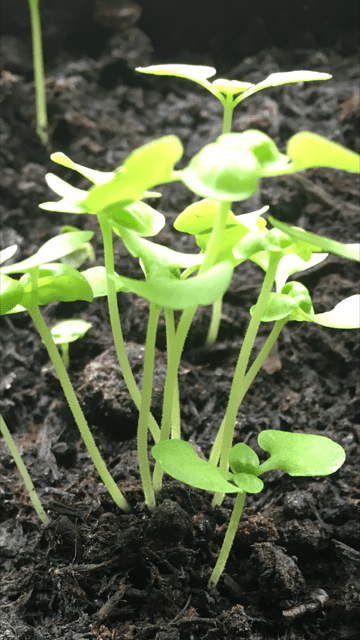
Over the past few months I have appreciated growing a few things from seed. Sunflowers, mint, coriander and sage. Not enough to keep me alive but enough to give me a smug feel of being someone who grows stuff. I have little trays laid out by the windowsill and they fill me with pride each day they reach out for the sun, a few millimeters more than yesterday. What must it be like to be a real farmer!

In India, more than 11 thousand farmers ended their lives in the year 2016. Too much rain. Too little rain. Aberrant weather. Poor quality seeds. Exploitative middle men. Illness in the family. Monsanto. Easy access to pesticides. False promises of relief measures, incentivising a farmer suicide. The government promises money but fails to deliver again and again. It then blocks articles and videos that try to make this information public.

Kheyti is an organisation that helps small farmers design and implement low-cost farming interventions. “Greenhouse-in-a-Box” is a low-cost greenhouse bundled with end-to-end services. This greenhouse fits in 2-5% of a small farmer’s land, protects crops from environmental risks and grows 7 times more food using 90% less water.

This prolonged lockdown is going to affect many individuals and small businesses. Many are starting to worry about their very basic needs. Uncertainty, insecurity and the feeling of being stuck is rising everyday. Helplines are receiving more calls. Food banks have had to expand beyond capacity. The indirect and unintended consequences of the pandemic might be worse than the direct and predicted ones. As incomes fall away, despair in our communities will rise further.

Each of us needs to think of one person we know whose income might be affected by this and call them. We need to think of one person recently bereaved and call them. Not text. Not e-mail. Phone call. Speak. Directly. Ask questions. Connect, have a chat, come up with ideas and creative answers. Signpost to resources. Reassure. Give hope. Together, figure it out.

This too will pass but before that it will test us. All of us.

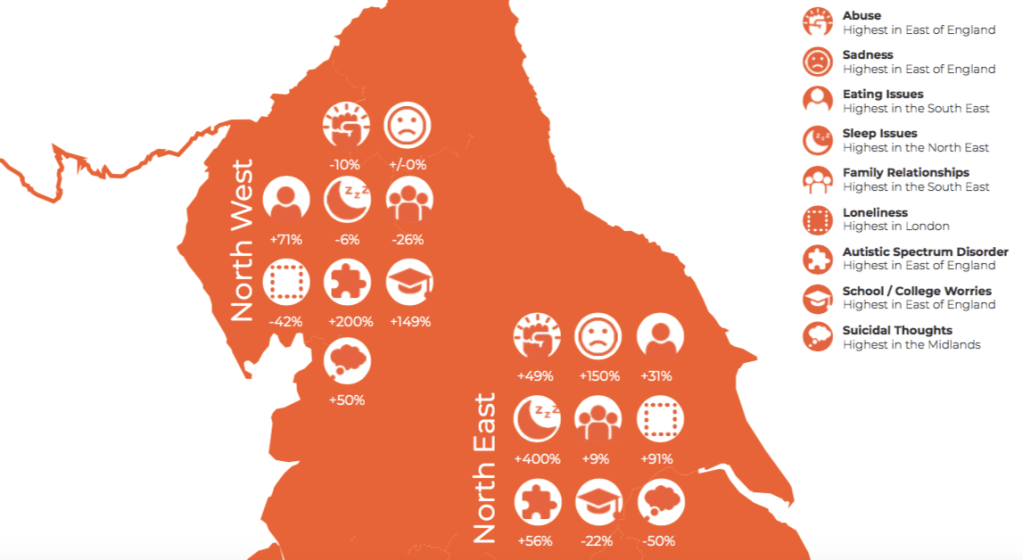
Kooth Infographics – suicidal thoughts rising. Highest in the Midlands.

Kooth Week 10 COVID infographics

India – talking Mental Health.

Asian countries account for more than 60% of world suicides.

According to the WHO, in the year 2016, suicide was the most common cause of death in the 15-39 age bracket in India, the highest in the South-East Asian region. India’s own official statistics, which map the number and causes of suicides in the country, have not been made public for the last three years, hindering suicide prevention strategies and efforts to implement the WHO’s recommendations in this regard.

In 2014, the WHO released a report with a series of recommendations for successful suicide prevention. It proposed a public health model for suicide prevention, consisting of four steps:

  • Surveillance
  • Identification of risks and protective factors
  • Development & evaluation of interventions
  • Implementation

India has not progressed beyond the first step. Lack of political will, social stigma and inadequate mental health awareness in the general and medical communities contribute to the continuous rise in the death rate of young people by suicide in India.

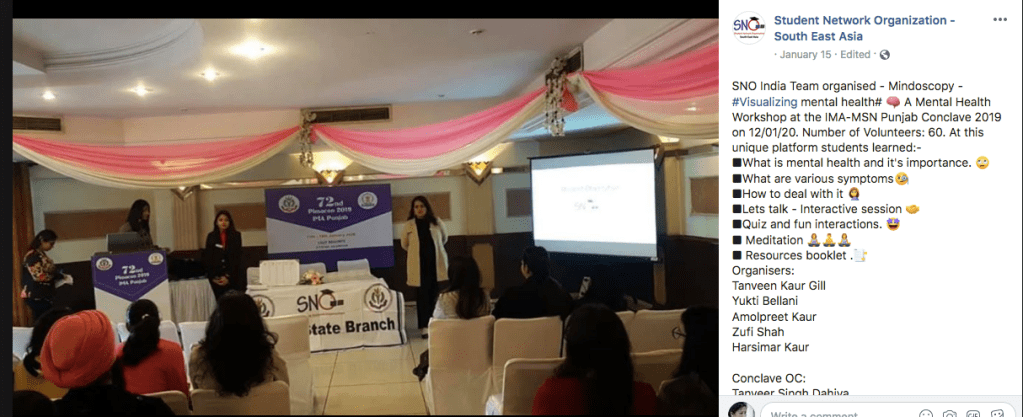
A Junior Doctors World Congress was held at my alma mater, Christian Medical College Ludhiana in April 2019. Si and I ran a Mental Health Workshop that was attended by 75 medical students from India and the wider South and South East Asia region. 

Motivated by this event, some students have established community mental health support networks and mentorship programmes at their respective institutions.  I am impressed with their passion to make a difference.

Here is an example:

Early March I was back in Delhi and was honoured to be invited by Shruti Verma Singh, the founder of a Youtube channel, Zen-Brain.com. She is determined to increase the emotional awareness in India and does it gently, through a series of interviews. We met one afternoon to talk about Saagar. I hope her work will help wake up the government, break social stigma and drive understanding and compassion.

A phone call.

Last week we got a call to assess a patient for a possible transfer to ITU. Our team of three anaesthetists went along with all our kit and PPE. From a distance, he didn’t look too unwell. And he looked young. I hoped he wouldn’t need too much intervention. We donned out protective equipment and looking like aliens, entered his cubicle. I checked his name and date of birth. He was born in the same year as Saagar. After making a quick assessment, we decided that his breathing needed support. We spoke to him about getting him off to sleep so that we could place a tube in his wind-pipe and assist his breathing. We explained to him that we would transfer him to ITU for further care.

By this stage he was shaking, his eyes swollen with fear. He asked to make a call to his mum. We stood back while he called her. He held the phone to his left ear while oxygen hissed through his face mask. We waited, watching his face slowly relax, his fear melting into tears that dripped down his cheeks. After what seemed like a long time, he said bye to her, told her he loved her, composed himself and said he was ready to go to sleep.

It was like watching the dance of life and death. Love and separation. Help and helplessness. I was grateful and pleased that this mum and this son could connect at this crucial time.

Saagar didn’t have this luxury. He didn’t get to call his mother. No words of comfort fell into his ears. No tears of relief spilt from his eyes. Nobody offered him their understanding. I felt sorry for his mother too. She didn’t have a chance to say good-bye, to tell him that she loved him, that she would pray for him and that she wished him the very best.

When there is political will, governments can bring countries to a shrieking halt, the world can come to a stand-still.

When it is a physical illness, millions of pounds can be spent in seconds. New hospitals can be erected within weeks. Multiple trainings can be put in place for the front-line staff. Awareness campaigns are everywhere. What to do, what not to do, repeated endlessly. Retired doctors can be redeployed. National economies can be allowed to crash. Everything else can be put on hold.

When it is a mental illness, there isn’t enough money. There isn’t enough time. Not enough people. Very little expertise. No effective awareness-raising campaigns. No appropriate spaces. Not enough beds. Not enough research. The bottom-line is that there just isn’t enough respect for the fact that people with mental angst suffer the same, if not worse than those with physical ailments. That on many occasions they too, die alone.

 Its about Respect and Political Will.

Nowhere to go.

On the 9th of March, I reached Melbourne for the second leg of the Churchill Fellowship. I had been looking forward to it for ages and just couldn’t wait to get started. I had the taken the whole month off. Despite the long journey I didn’t feel any fatigue. My AirBnB was homely and comfortable. After a good night’s sleep, I was ready for work.

The Beyond Blue Office was easy to find. After a brief introduction to the team, we all went out to get coffee together. I was already one of them and the coffee was great. The following days flew past with meetings, interviews, presentations and briefings. A trip to Headspace. Despite some background murmurings of a virus, I was having the best time, learning and exchanging thoughts and ideas. Then Australia closed its borders. Meetings and conferences started getting cancelled.

On the 16th, I took a return flight to London.  My trip shrank from 3 weeks down to one. I had to miss Sydney altogether. Now, I am back here with a blank diary for 2 weeks and I am loving it. I have volunteered myself to work and I am on standby.

I can now research and look up things I’ve been meaning to for a long time. I can clear out one cupboard every day and get rid of stuff I don’t need or use or get joy from. Unclutter and create space in my house and my head. I can go to bed without setting an alarm. That pile of unread books that’s been sitting atop my table, feeling ignored and giving me dirty looks, can now be tackled.

Part of me is rushing in to fill the time with a list of a hundred things to do but I am consciously slowing down. Having an easy routine. Fitting in things I love doing, like arranging flowers. Making time for friends. Cooking. Walking. Not getting hooked to the media but keeping an eye. Writing hand-written letters to loved ones. Sitting still. Enjoying our home. Truly appreciating the weirdness of our cat, Milkshake. Cherishing having breakfast, lunch and dinner with Si as he works from home.

Simplify. Make easy. Make plain.

The Way Back – supporting attempt survivors – an idea worth adopting.