Day 827

d76cbf12f3b7c366e563d19156b67e3f-1

Trading Stories

I have a story
about us.
You may like it.

Is it true?
Certainly not.
But it is a
most satisfying
lie.

Hmm..
The truth?
Truth has no words,
You know that.
Wonder why people
claim to speak it.

You have the truth.
or half of it.
My half
is a twinkle in the eye
shrugging off
the words
with no meaning
chuckling softly
at this frantic search
for a cloak that fits.

Let the truth be.
Let us trade stories
Till these new clothes
Fit better.

  • By Jo Aggarwal.

Day 826

img_0534

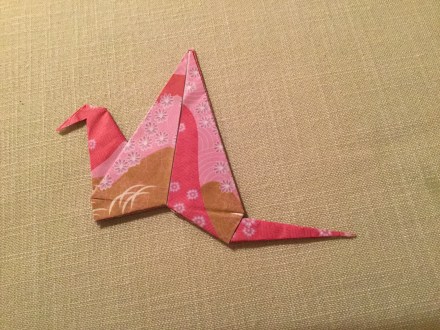
This forgotten book-mark in a book being revisited after two years is an origami crane – a symbol of healing in Japan. A school kid had given it to me at Hiroshima as a token of gratitude for helping him practise his spoken English.

Paper folding started in China in the first century and reached Japan in the 6th century. Here it was cultivated as an art of understatement. Origami suggests. It implies without announcing outright. It intimates without brashness. In Japanese folklore, a crane is fabled to live for a thousand years and is held in high esteem. It is believed that folding 1000 paper cranes brings the folder’s wishes come true.

A young girl called Sadako Sasaki survived the Hiroshima bomb when she was only two years old. Less than 10 years later she was diagnosed with leukemia, a cancer of the bone marrow. The disease progressed rapidly and the prognosis was not good. She set out to make a thousand paper cranes. She could complete 644 before she died on Oct. 25, 1955, less than a year after being diagnosed. Her classmates, family and friends made more to bring them up to 1000 and buried them with Sadako.

2013-08-20-sadakobybushcropped

Her story captured the imagination of the country and the world. Today, we recognize the crane as a symbol of peace and hope.

“She let out both the pain of our parents and her own suffering with each crane.”
“Her death gave us a big goal. Small peace is so important with compassion and delicacy it will become big like a ripple effect. She showed us how to do it. It is my, and the Sasaki family’s responsibility to tell her story to the world. I believe if you don’t create a small peace, you can’t create a bigger peace. I like to gather those good wishes and good will and spread to the world,” said Masahiro, her brother.

Peace and hope to Sadako and to us all.

Day 825

“But, you have the rest of your life in front of you.”
‘That is a terrible thing to say! That is such a terrible thing to say.’
(A conversation between Jackie Kennedy and her friend a few days after JFK’s assassination, in the film ‘Jackie’)

These days I randomly find myself standing in queue at ticket-counters at random cinema halls looking for a ticket for the next show, whatever it may be. Last week it happened to be ‘Manchester by the sea’ and today, just by chance, it was ‘Jackie’, both portrayals of death, devastation and dignity. Is this Universe’s way of letting me know that I am not alone?

Many, who have survived violent deaths of their loved ones.
Many, who have struggled to keep their legacy alive.
Many, who have shown great dignity despite housing a volcano of anger inside them.
Many, who have silently hidden and nurtured their incessantly weeping wounds.
Many, who have wished for their own death every night while staring into the darkness.
Come morning, many who have put on a ‘brave’ face.
Many, who have thought, ‘I could have saved him.’
Many, who have insisted the world witnesses the aftermath.
Many, who have held the bodies of those they love, in disbelief.
Many, who have not even had the chance to do that.

Well, I guess I am not alone.

Day 824

What brings you enjoyment?

This was on the list of questions being asked of young doctors at an interview skills practice session for their upcoming promotions.

One of the young women enthusiastically told me not only how much she enjoyed her work but also the stories behind how the interest started and developed and then narrowed itself down to a specialist area, the places her aspirations took her to and the inspiring people she met along the way. Her eyes shone like sparkling diamonds as she spoke and her smile beamed. Towards the end of her answer, there was a brief mention of tennis, friends and cycling.

90% of her answer was her work. Her honesty was clear.

That was me. My work has brought me great joy over the years. I have spent far too many hours at work. It gave me self-esteem. It was something I could hide behind. It gave me meaning and purpose. It made me look and feel successful. It was fulfilling and satisfying and everyday was challenging and exciting. I loved it.

It took away all my energy and I came home spent. It took up a lot of space in my head for many long years. It made me loose my balance. It sucked me in so completely that I couldn’t see the aspects of it that were draining me dry. It deprived me of sleep for years and it drove me crazy. Yet, I loved it.

If I could go back and change what it meant to me, would I?
No.
But I would cut the number of evenings and weekends I spent away from home. I would conserve more energy for home. I would say ‘NO’ more often. I would claim some of my life back.

Day 823

search

One of the core principles of Buddhism is the ‘Ten world Principle’. It outlines the continuous changes in our inner lives. It classifies the subconscious human experience of various states of being, thus graded from lowest to highest:

1.Hell
2.Hunger (Wanting more of love/money/approval etc)
3. Animality (Need to dominate/be dominated)
4. Anger
5. Humanity (Tranquility)
6. Heaven (Rapture/ Temporary happiness)
7.Learning
8. Realisation
9.Bodhisattva (Compassion)
10. Buddhahood (Enlightenment/Absolute happiness)

Most of us have a fundamental tendency to occupy one or two of these worlds. Despite many self-improvement endeavors, we find it nearly impossible to change our default worlds.

For majority of the human race, the six lower worlds (1-6) apply. The problem with these states is that they do not last. They are completely reactive, at the mercy of our environment, bouncing back and forth depending on external circumstances resulting in a roller-coaster existence. True happiness cannot be rooted in this shifting quicksand.

The higher worlds (6-10) are known as the ‘four noble worlds’. Learning, realization and compassion are proactive, not reactive states. They are the basis on which a state of absolute happiness can be created.

The tenth and highest world is difficult to describe as we often don’t experience it. It is determined by the degree to which we establish a solid self, a true self that exists in harmony with the universe. For me, brief glimpses of this world are achievable through meditation. It is deeply restful.

Attaining Buddhahood is a process of discovering what currently lies dormant within our hearts, of discovering our true universal self.

‘Hell is to drift, heaven is to steer.’
– George Bernard Shaw.