Long shadows

A few months after Day 0, at a SOBS (Survivors of Bereavement by Suicide) meeting at the All Saints near Euston, I met a father who said, “Eight years” when I asked him how long it had been since his son died. I looked at his face as if he was the most spectacular and wondrous impossibility of the world. Is it possible to live as long as that after the death of a child? He was proof. It was. I had never seen anyone who had been bereaved that long, standing and smiling and speaking sense.

Last Monday I joined the 3 dads on the last leg of their long walk to Westminster alongside many people who want the government to add suicide awareness and helpful resources to the school curriculum. We walked and talked in the rain. I said ‘Nearly eight years’ in response to how long has it been since my son passed. I got the same look from a young mum recently bereaved. She stopped and looked into my eyes through the thick rain drops. Past and future, face to face. “Gosh! Does it get any easier?” she asked. It does, I replied, holding her hands.

All these years I have tried to keep Saagar alive in every way I could – writing, public speaking, teaching Youth Mental Health First Aid courses, advocating for young people, working with various people, charities, NHS, Churchill Trust and other organisations, making films and so on.

I have read other people’s accounts of loss, hoping to lessen my pain and deepen my understanding. The latest book I read was ‘The Year of Magical Thinking’ by Joan Didion. She says:

I know why we try to keep the dead alive: we try to keep them alive in order to keep them with us.

I also know that if we are to live ourselves there comes a point at which we must relinquish the dead, let them go, keep them dead.

Let them become the photograph on the table.

Let them become the name on the Trust accounts.

Let go of them in the water.

Knowing this does not make it easier to let go of him in the water.”

Eight years! No time at all.

Time is the school in which we learn.

Time is the fire in which we burn.”

  • Delmore Schwartz.

Random stuff

After many years, things are being taken out of cup-boards and off shelves, turned inside out and properly looked at. Dusty books, clothes, folders, boxes and sachets. Some familiar fragrances are escaping and some old scenes are playing out on the screen of the mind. Bits of stuff slipping out of other stuff and falling to the ground with a clink. Some stuff that was believed to be misplaced is being placed. Some that was believed to be forgotten is being revisited.

Sample 1

A nappy pin. Special feature – A white safety cap to prevent accidental opening up while the baby has his cloth nappy on. Commonly used in India and other developing countries. Original owner: Baby Saagar.

Sample 2

A business card. Special feature – Simplicity. An invitation to music and joy. Original owner: Saagar.

Sample 3

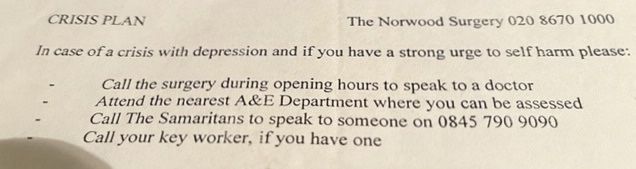
A Crisis Plan. Special features – Not worth two pennies. Highly ineffective. Not accompanied by a conversation. No detail. Not individualised. Not created in partnership with the patient. Not an alive document. Does not mention anything more than ‘self-harm’. Doesn’t tell us what ‘Crisis’ looks like. Doesn’t identify any helpful distractions, activities, friends or family. Doesn’t appear to know the patient, for example, a key fact – does this person have a key worker? Does not express any understanding or compassion.

Commonly used in developed countries.

Oops! The name of the GP surgery is visible. It doesn’t matter. It closed down years ago. We were it’s last few unlucky patients. Owner: Saagar Naresh (1994-2014).

(Resource: Safety Planning is essential to safety: https://stayingsafe.net/home)

No words.

Two years back, it could not be screened as scheduled. After a long wait, last weekend it was, at Clapham Picture house where Saagar often went with his friends. People came from Leicester, Salford, Cornwall, Cardiff and Birmingham. Some, I had only ever seen on screen. Others, when they were school kids. They brought their sisters, spouses, friends and colleagues. They stayed for hours afterwards, talking about themselves in a way they never had. They fell in love with Saagar’s big brown eyes and mischievous smile. They saw what a treasure had been carelessly lost. Everyone felt something. Many had no words but there was a profusion of overdue hugs all around. Many felt they knew him even though they had never met him. Some introductions were made to link up the leaders from various sectors of society so they could form stronger and safer networks.

That woman in the film was not just me. She spoke for the fifteen families in the UK, who are plunged into this harsh reality every day. More than 6500 every year.

That young man in the film was not just Saagar, but everyone who has ever blamed themselves for their troubles and felt shame for things that have happened to them, hiding behind their beautiful smiles. Unseen. Unheard. Each one who lost their tribe and couldn’t find a way back.

These were not just Saagar’s friends, but all those who are left behind, trying to figure out how this could happen to someone they loved. Wondering what they could have done then and what they can do now.

This film laments a future lost. It mourns silent suffering. It also illuminates a path that appears out of darkness. It also celebrates love and smiles. It also gives us permission to soften, lighten, loosen. It breaks open our hearts so we can hear the unspoken pain that lies behind the mask of another face and our own. It makes us one.

This is what it means to be human. Here, on this beautiful Earth, there is no other. Only us. Not us and ‘them’. Just us.

PS: International film awards: Eight.

‘1000 days’ is made by Me and Thee films for educational purposes. Hence it is not yet freely available on social media. It was screened in the ‘Lived experience’ section at Middlesbrough, for the Hartlepool and Stockton Safeguarding children’s Partnership and South Tees Safeguarding Children’s Partnership Conference on the 12th of July. It made a profound impact on roughly 350 attendees, motivating them to make individual and collective change so as to protect young lives and their happiness. Will keep you posted on the opportunities to watch it. Thank you for your love and support. Please do share any constructive ideas/ thoughts you may have for the film in the comments section.

What do I do with this thing?

It churns inside me all the time. This thing does not settle. It does not sit still. It burns my tummy, wets my thirsty eyes, parches my tongue and pokes its elbow into the longing in my heart. It doesn’t rest and doesn’t allow me to rest. It kisses my forehead, only to kill me with its kindness. It stays with me, no matter where I go – to the park, to work, on a bike-ride, at my desk, in the kitchen. It seeps into my words. Into the movements of my hands. Into the mirror. Into the songs, I choose. Into tea and toast. There is no getting away from it. It pervades my silences and my sleep.

I wish it had never appeared but it has. It wish it wasn’t mine but it is. The problem is, it won’t leave me alone. Not for the briefest of moments. In a Stockholm Syndrome way, I hold on to it and defend it. How I wish it wouldn’t tear me up so mercilessly.

What do I do with this thing?

Once I heard a Therapeutic Writing Coach say: Name it. Claim it. Tame it. Re-frame it. Proclaim it.

‘Re-frame it’ stayed with me. It does not mean I tell myself false pacifying stories but encourages me to see it for what it is, beyond the drama. Grief, as love that has no place to go. Longing, as the other side of the coin of love.

If I don’t transform it, I will keep transmitting it and I don’t want to do that.

(Resource: Therapist and Writing for Well-being Coach

Nigel Gibbons : http://www.nigelgibbons.co.uk/About-Me.htm)

God bless America.

Following the Sandy Hook school shootings in 2012, the Conservative commentator Anne Coulter provocatively proclaimed that “Guns don’t kill people. The mentally ill do.”

“The United States sees an average of 32 000 handgun-related deaths per year (as per this paper published in 2015), and firearms are involved in 68% of homicides, 52% of suicides, 43% of robberies, and 21% of aggravated assaults. Far from the national glare, this everyday violence has a disproportionate impact on lower-income areas and communities of color, and is widely held to be the cause of widespread anxiety disorders and traumatic stress symptoms”… the stigma linked to guns and mental illness is complex, multifaceted, and itself politicized, in as much as the decisions about which crimes US culture diagnoses as “crazy” and which it deems “sane” are driven as much by the politics and racial anxieties of particular cultural moments as by the workings of individual disturbed brains. Beneath seemingly straightforward questions of whether particular assailants meet criteria for particular mental illnesses lay ever-changing categories of race, gender, violence, and, indeed, of diagnosis itself.”

“Persons in the United States live in an era that has seen an unprecedented proliferation of gun rights and gun crimes, and the data we cite show that many gun victims are exposed to violence in ways that are accidental, incidental, relational, or environmental. Yet this expansion has gone hand in hand with a narrowing of the rhetoric through which US culture talks about the role of guns and shootings. Insanity becomes the only politically sane place to discuss gun control. Meanwhile, a host of other narratives, such as displaced male anxiety about demographic change, the mass psychology of needing so many guns in the first place, or the symptoms created by being surrounded by them, remain unspoken.”

“Mass shootings represent national awakenings and moments when seeming political or social adversaries might come together to find common ground, whether guns are allowed, regulated, or banned. Doing so, however, means recognizing that gun crimes, mental illnesses, social networks, and gun access issues are complexly interrelated, and not reducible to simple cause and effect. Ultimately, the ways our society frames these connections reveal as much about our particular cultural politics, biases, and blind spots as it does about the acts of lone, and obviously troubled, individuals.”

Ref: American Journal of Public Health. 2015 February; 105(2): 240-49.

Mental Illness, Mass Shotings and the Politics of American Firearms by Jonathan M. Metzl, MD, PhD and Kenneth T. MacLeish, PhD

PMCID: PMC4318286

PMID: 25496006

https://www.ncbi.nlm.nih.gov/pmc/articles/PMC4318286/