Othering our Ownkind.

“More than two thousand people read my post and saw my video today “ Yuval said.

‘They will see it and be moved by it. What then? What will they do?’ asked Basel.

That is the big question. What can we do? What will we do? Two young journalists from either camp came together to document the encroachment and destruction of a village called Masafer Yatta on the West Bank. They raise this question loud and clear for each of us. What can I do? The injustice of all this pushing and kicking, hurting and forcing fills me to the brim with a sense of sadness and powerlessness. My arms and legs go limp. So, thus far I’ve been running away from it. I must be a coward. What can I do? So many influential and powerful people have been quiet, watching the numbers and images get worse every day for decades.

Today, I watched No Other Land on the big screen. Live footage shot on a mobile phone over 4 years, 2019 to 2023. Running away is not possible anymore.

Harun’s mother prayed for his death. This young man was shot by a soldier while he was trying to stop his home from being demolished by the army. The bullet left him paralysed from his neck down. He was nursed in a cave as they had no house. No facilities. No transport. No freedoms. Everything around them was being bull-dozed – chicken coups, elementary schools, homes and villages. No one knew what new destruction each new day would bring. Toddlers were learning to speak, and older kids were trying to play and go to school in the middle of this madness. The respectable Mr Tony Blair graced the village with his pointless guest appearance for seven minutes.

Our world is bipolar, selectively blind. It’s okay for the politics of some nations to be tied to a faith but not for others, it’s okay for some nations to dishonour every treaty that they ever signed but not for others, it’s okay to condemn the exact same atrocities when committed by one nation and not another, it’s okay for third parties to fund and support the killing of women and children in plain sight. This is our world.

We humans have the arrogance to believe we are the smartest of all species, yet dogs don’t kill other dogs in millions every year. No other species has constructed the level of othering that humans have. We can’t see what we are doing to ourselves. We can’t see that there is no other. It’s only us in different garbs. Those of us who can see, must see. Those who can write, must write. Those who can sing, must sing. Let not our dark side win.

Arrogance, blindness and cowardice – a recipe for self-extinction.
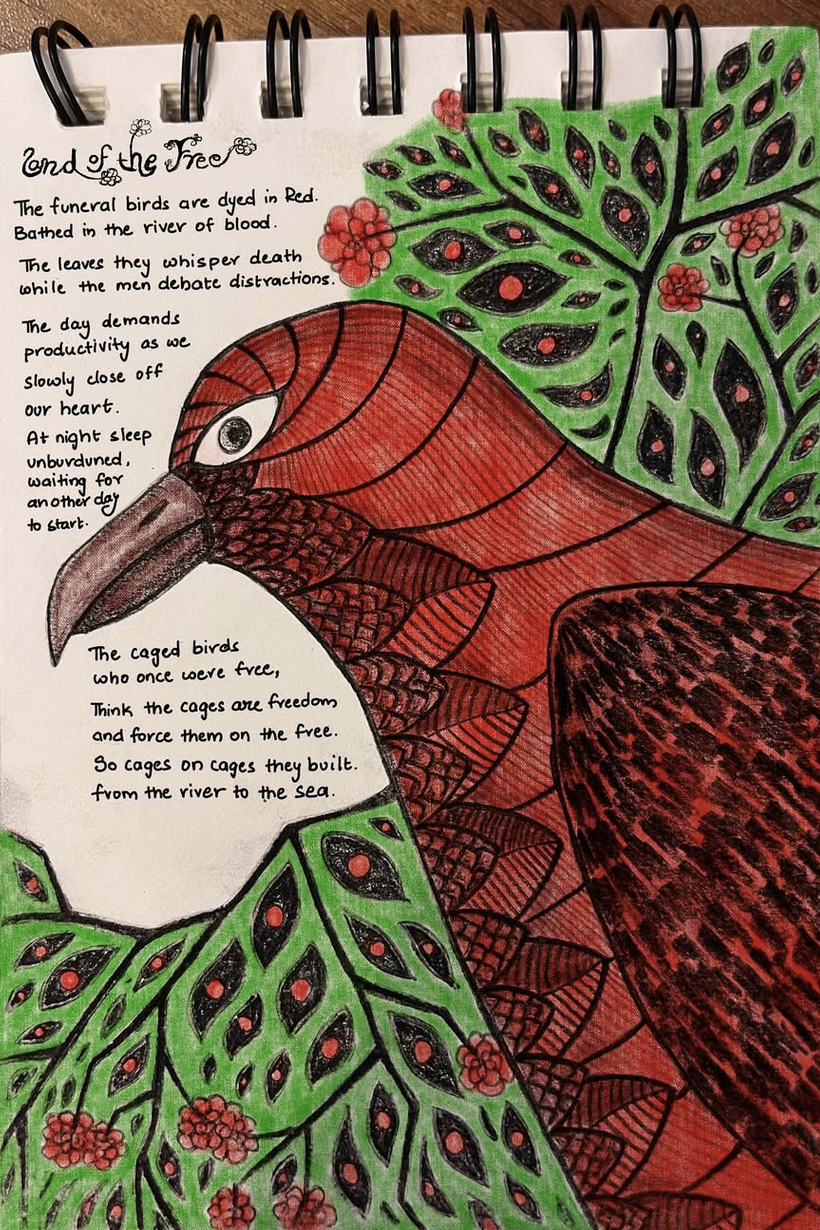
By Abdul Raheem (https://www.instagram.com/mud._.lotus)

170,000

– the number of suicides in India every year. India holds the top position in the world in very few things. This is one of them. Of these deaths, more than 40% are under the age of thirty. Both these facts possibly underestimate the problem due to poor data collection, criminalisation of suicidal attempts, inefficient registration systems, lack of medical certification of deaths and biggest of all, stigma. Every eight minutes a young Indian person dies by suicide. Year on year, the rates are rising by 4-7%.

The incidence of student suicides surpasses population growth rates. Over the last decade, the number of student suicides increased from 7,696 to 13,089.

Source: A report released on Sept 10th 2024: Student Suicides: an epidemic sweeping India.

Today, to mark World Mental Health Day, a brave young lady, Jayeta Biswas, published an article remembering her brother, Jayanta. Aside from revealing some shocking statistics, it lamented the seriously negative societal attitudes towards poor mental health and suicide in India:

“A home that was always filled with visitors when my brother was alive saw no one from his school, college, professional life or network after his departure. None of his friends, including those he had contacted in his last hours – attended his funeral, nor did they visit our house. I am certain that this is because they heard that he died by suicide.”

We have a long way to go as a society but small school initiatives such as SEHER give me hope.

No words.

Two years back, it could not be screened as scheduled. After a long wait, last weekend it was, at Clapham Picture house where Saagar often went with his friends. People came from Leicester, Salford, Cornwall, Cardiff and Birmingham. Some, I had only ever seen on screen. Others, when they were school kids. They brought their sisters, spouses, friends and colleagues. They stayed for hours afterwards, talking about themselves in a way they never had. They fell in love with Saagar’s big brown eyes and mischievous smile. They saw what a treasure had been carelessly lost. Everyone felt something. Many had no words but there was a profusion of overdue hugs all around. Many felt they knew him even though they had never met him. Some introductions were made to link up the leaders from various sectors of society so they could form stronger and safer networks.

That woman in the film was not just me. She spoke for the fifteen families in the UK, who are plunged into this harsh reality every day. More than 6500 every year.

That young man in the film was not just Saagar, but everyone who has ever blamed themselves for their troubles and felt shame for things that have happened to them, hiding behind their beautiful smiles. Unseen. Unheard. Each one who lost their tribe and couldn’t find a way back.

These were not just Saagar’s friends, but all those who are left behind, trying to figure out how this could happen to someone they loved. Wondering what they could have done then and what they can do now.

This film laments a future lost. It mourns silent suffering. It also illuminates a path that appears out of darkness. It also celebrates love and smiles. It also gives us permission to soften, lighten, loosen. It breaks open our hearts so we can hear the unspoken pain that lies behind the mask of another face and our own. It makes us one.

This is what it means to be human. Here, on this beautiful Earth, there is no other. Only us. Not us and ‘them’. Just us.

PS: International film awards: Eight.

‘1000 days’ is made by Me and Thee films for educational purposes. Hence it is not yet freely available on social media. It was screened in the ‘Lived experience’ section at Middlesbrough, for the Hartlepool and Stockton Safeguarding children’s Partnership and South Tees Safeguarding Children’s Partnership Conference on the 12th of July. It made a profound impact on roughly 350 attendees, motivating them to make individual and collective change so as to protect young lives and their happiness. Will keep you posted on the opportunities to watch it. Thank you for your love and support. Please do share any constructive ideas/ thoughts you may have for the film in the comments section.

Come home, my darling.

I still hear the key turning in the door from the outside and you stepping in. Can you believe it? I still see your face, darkened by the sun. Dressed in your cricket whites, you drag your massive cricket-bag-on-wheels behind you by your left arm.

“Did you take the sun-screen with you?” I ask.

“Yes, it’s in the bag.”

“Did you actually put it on?’

 “Mamma, I’m hungry.”

I still wait for you to join us for dinner. I cook the foods you like, especially on your birthday: spinach-paneer for mains, chocolate mousse for dessert. I wonder what you’d be doing in this realm if you were here. Job? Girl-friend? How silly! Isn’t it? I can’t help it. It’s involuntary. It’s got something to do with the heart. With longing. With missing. With love. It’s not supposed to make sense. You would have had a good old chuckle at my expense if you were here. But you are not and I am. How random is that?

I still remember the first time I felt you elbow-ing or knee-ing me from inside my tummy, as if we had an inside joke between us. I remember holding all three kilos of you in my arms for the first time. I couldn’t believe you were for real. You were all mine. Now my arms ache with emptiness. Is this real?

Do you miss me sometimes?

Happy birthday my darling.

Heaven

It will be the past

And we’ll live there together.

Not as it was to live

But as it is remembered.

It will be the past.

We’ll all go back together.

Everyone we ever loved,

And lost, and must remember.

It will be the past.

And it will last forever.

                      – A poem by Patrick Phillips, on the New York subway.

(“Ghar aa” is a Hindi phrase that means “Come home”)

A report and a film.

A report published last month by National Child Mortality Database (NCMD) identifies common characteristics of children and young people who die by suicide between 1st April 2019 and 31st March 2020. It investigates factors associated with these deaths and makes recommendations for policy makers.

Every child or young person who dies by suicide is precious. These deaths are a devastating loss for families and can impact future generations and the wider community. There is a strong need to understand what happened and why, in every case. We must ensure that we learn the lessons we need to, to stop future suicides.

Key Findings:

-Services should be aware that child suicide is not limited to certain groups; rates of suicide were similar across all areas, and regions in England, including urban and rural environments, and across deprived and affluent neighbourhoods.

(No one is immune.)

-62% of children or young people reviewed had suffered a significant personal loss in their life prior to their death, this includes bereavement and “living losses” such as loss of friendships and routine due to moving home or school or other close relationship breakdown.

(Saagar was unable to return to his life at University due to a new diagnosis of a mental illness.)

-Over one third of the children and young people reviewed had never been in contact with mental health services. This suggests that mental health needs or risks were not identified prior to the child or young person’s death.

(Saagar had been in contact with Mental Health Services but they discharged him as soon as he showed signs of improvement. They did not follow him up. His GP was unable to identify his high risk of suicide despite his Depression scores being the worse they could be for at least 4 weeks.)

-16% of children or young people reviewed had a confirmed diagnosis of a neurodevelopmental condition at the time of their death. For example, autism spectrum disorder or attention deficit hyperactivity disorder. This appears higher than found in the general population.

(Saagar did not.)

-Almost a quarter of children and young people reviewed had experienced bullying either face to face or cyber bullying. The majority of reported bullying occurred in school, highlighting the need for clear anti-bullying policies in schools.

(At his Primary school in Belfast, his peers called him ‘Catholic’. He didn’t know what it meant but he knew it was not right. This went on for more than a year before I found out. When I spoke to his class teacher about it, she denied any problem.)

The film ‘1000 days’ tells us about Saagar and what we have learnt from his life and death. I am not sure what or how much the policy makers and service providers have learnt or changed but we have learnt and changed a lot and here we talk about that. The film is presently available on-line at the Waterford Film Festival (Short Programe 6), till the 15th of November at the link below. Please take 20 minutes to watch it if you can. You will learn something too. Each one of us can make a difference.

https://waterfordfilmfestivalonline.com/programs/collection-jlvwfxb8ctq