Day 650

A brain surgeon, Paul Kalanithi got diagnosed with terminal lung cancer at the age of 36. Suddenly he found himself on the other side of the table. He wrote a ‘rattling, heartbreaking, beautiful’ book about his life as a doctor and then as a patient before he died. It is called “When breath becomes air’. In it he tactfully dissects the walls that exist between doctors and patients. Having found myself on either side of the table – first as a physician and then as the mother of a severely ill child, I can completely relate with this excerpt below.

“The reason doctors don’t give patients specific prognoses is not merely because they cannot. Certainly, if a patient’s expectations are way out of the bounds of probability – someone expecting to live to 130, say, or someone thinking his benign skin spots are signs of imminent death – doctors are entrusted to bring that person’s expectations into the realm of reasonable possibility. What patients seek is not scientific knowledge that doctors hide but existential authenticity each person must find his or her own. Getting too deeply into statistics is like trying to quench a thirst with salty water. The angst of facing mortality has no remedy in probability.”

“I had to face my mortality and try to understand what made my life worth living and I needed Emma’s (my doctor’s) help to do so. Torn between being a doctor and being a patient, delving into medical science and turning back to literature for answers, I struggled, while facing my own death to rebuild my own life – or perhaps find a new one.”

I cannot imagine what one’s options would be when diagnosed with a severe/ terminal mental illness. Saagar was unable to access his own life as he knew it and perhaps chose to find a new one.
Day 649

The entire planet is in turmoil. Disparaging images surround us.
Many hundreds of people have been injured and killed in traumatic circumstances and many hundreds of others are left with horrifying visions etched upon their retinas and burnt into their brains. The media is explicitly ugly in the details it exhibits.

It’s heartbreakingly bad news all around. The world is going crazy!!!

Today it was revealed that many atrocities are being carried out systematically against young people in detention centres for many years in the so called ‘developed nations’. At Don Dale prison in North Territory in Australia, children in detention are being abused, hooded and bound in a manner likened to Abu Ghraib and Guantánamo Bay. It is often arbitrary, indefinite and without right to appeal.Last night a television programme on Australian TV brought the shocking details out in the open in some of the most disturbing footage.

Indigenous youths make up 96% of the young prison population in the Northern Territory and only 30% of the overall population.

The lawyer representing Voller, one of the boys demanded his immediate release and said, “The impact of these years of brutalisation must be immediately measured and he needs immediate assistance.”

“The Modus Operandi  of the NT government is this: shoot the messenger, discredit the report and demonise these kids, so people out of the street think it’s OK for that to happen to these kids.” – Megan Mitchell, National Children’s commissioner.

The present time reminds me of the Second law of Thermodynamics  which describes the limits of what the universe can do. This law is about inefficiency, degeneration and decay. It defines entropy  as a measure of the amount of disorder within a system. It tells us that our actions are  inherently wasteful and that there are irreversible processes in the universe. It gives us an arrow for time and tells us that our universe has an inescapably bleak and desolate fate. Cosmologists call this the “heat death” of the universe, an inevitable consequence of the unstoppable march of entropy.


Day 642

What makes a good life?

An answer to this age-old question was attempted by a huge study at Harvard. It followed 724 men from their teenage years for a period of 75 years. Half the men were students at Harvard and the other half were disadvantaged inner city boys of Boston. They all went on to pursue various fields of work – brick-layers, teachers, solicitors and one even became the president of America. Every year, each one of them answered a paper questionnaire and was interviewed in person. Bloods tests and brain scans were performed on them and a large body of data was collected and analysed.

What did they find?

Loneliness is toxic. Loneliness kills.
The way to health and happiness is through good relationships.
Cholesterol level is not a predictor of good health but the quality of one’s social connections is.
Good relationships protect the brain too. People who have friends and relatives they can count on retain their memory for much longer than the ones that don’t.
So, while relationships can be messy, difficult and trying, they are worth leaning into, be it with family, friends or a community.

How can this be done in real terms?

  • Replacing screen time with people time?
  • Doing something new – going for a long walk, gardening, volunteering, watching a black and white film, trying a new recipe?
  • Calling an old friend you’ve been thinking of for a while?
  • Putting a grudge or mistrust aside and reaching out?
  • You know best.

“There isn’t time for bickering, apologies, heart burnings, calling to account. There’s only time for loving. An instant for that.” – Mark Twain.

Good life = Good relationships.


Day 640


dahlarexf1_1692375c

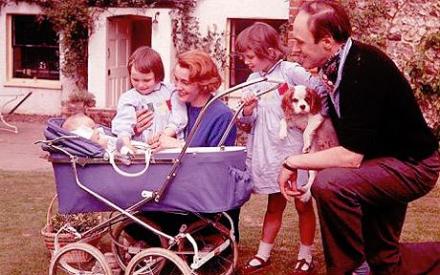
In 1960 Roald Dahl’s son Theo developed hydrocephalus (fluid collection in the brain) following a road accident. He needed repeated surgeries to drain the fluid through a thin tube (shunt) away from his brain. The problem was that the shunts repeatedly got blocked.

Dahl knew Stanley Wade, an expert in precision hydraulic engineering from their shared hobby of flying model aircrafts. In 1960 a team formed by Wade, neurosurgeon Kenneth Till and Dahl invented a new valve with a negligible risk of blockage. By the time the device was perfected, Theo had healed to the point at which it was not necessary for him. However, several thousand other children around the world benefited from the WDT valve before medical technology progressed beyond it.

His daughter Olivia died of measles at the age of seven in 1962. Her death destroyed him. Many years later he spoke of his lack of fear of death, “If Olivia can do it, so can I.”

Roald Dahl believed in taking practical steps to improve the lives of those around him. He generously gave his time and money to help seriously ill children and their families, including many he never met. Roald Dahl’s Marvellous Children’s Charity helps to make life better for seriously ill children and young people in the UK.

The charity believes that every child has the right to a more marvellous life, no matter how ill they are, or short their life may be. They focus upon helping those who have the biggest needs, and who aren’t being fully supported by anybody else. This might be because they have a serious rare condition, be living in poverty, or not have any family at all.

2016 marks 100 years since the birth of Roald Dahl, an extraordinary storyteller, a pilot, a spy, an inventor and most of all, a father.

imgres

Day 638

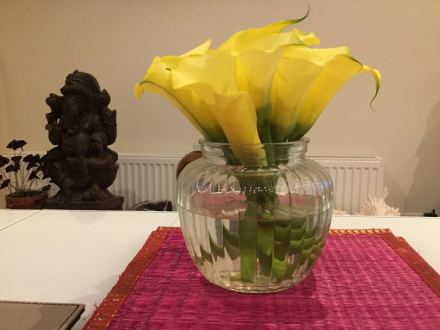
yello arum lilies


Just a routine commute back home from work.
Rucksacks on Si and me.
And a thick layer of fatigue.

The Bustimes App said 6 minutes.
The double decker arrived in 4.
We beeped in following the 14 odd people before.

They spead out on the top floor.
Each one by a window.
Just one last vacant pair of seats to go.

I slide past him to get to the window seat.
An unsaid rule that we repeat.
He sits down beside me and we happen to look down at our feet.
The sight is that of an unusual wonderfulness.
A paper bag full of sunny yellow soft beautifulness.

We look closely at multiple tapering funnels unfurl.
Many a bright green stem
Unfold into an elegant yellow curl.

I pick out of the bag as I reach.
Four bundles, a dozen each.
For us! It’s hard to believe.
Yellow arum lilies someone did leave.

Wonder what their story was.
Who were they meant for?
Where were they headed? Was someone to be wedded?

Well, they came home with us.
They seem happy enough.
Looking pretty and shining their light.
Just what Saagar would have liked.