Inheritance of fear

The past is never dead. It’s not even past.”
– William Falkner. Requiem for a Nun.

The echoes of past traumas get subconsciously played out by us in our everyday lives. Sigmund Freud called it ‘repetition compulsion’ – an attempt of the unconscious mind to replay the unresolved so that we can ‘get it right’. This mechanism drives its way through generations. Jung also noted that whatever is too difficult to process does not fade away. It gets stored in our unconscious and finds expression in other ways. He says,” When an inner situation is not made conscious, it happens outside as fate.”

Here’s an example: Jake was 19. He hadn’t slept a full night’s sleep in more than a year. He had developed dark circles around his eyes and a blank stare in them. He looked at least 10 years older. He had been a star student and a great athlete but the insomnia had left him lifeless. This thing had no explanation and none of his doctors or psychologists or naturopaths could figure it out.

It had started with Jake waking up shivering one night at 3.30 am, frightened to death. No amount of woollen clothing warmed him up.  Soon, insomnia became a daily ordeal. Despite knowing that his fear was irrational, Jake was helpless and could not relax. The ‘freezing’ feeling associated with the first episode was quite peculiar.

On exploration of Jake’s family history, this story came out: His mum’s brother, Uncle Colin,  whom he had never met had frozen to death at the age of 19. He was checking power lines in a storm in the Northwest of Canada. He struggled to hang on but eventually fell face down in a blizzard, lost consciousness and died of hypothermia. The family never spoke his name again.

Now, thirty years later, Jake was unable to slip into sleep at the same age as his Uncle. For Colin, letting go meant death. For Jake, falling asleep must have felt the same. Once Jake could see this link, he was able to free himself of it with the help of healing techniques taught by Dr Mark Wolynn, a neuroscientist with an expertise in breaking inherited family patterns.  His book “It didn’t start with you”, describes some of these practical tools.

Scientists are now able to identify bio-markers as evidence of traumas passed down from one generation to the next. Studies on Holocaust survivors and their children have revolutionised the understanding and treatment of PTSD all over the world. Be it fear, guilt, low self-esteem or anxiety, the roots of these issues may reside in the traumas of our parents, grand-parents and even great-grandparents.
 

Rascal Moon – A short story

His substantial shoulders supported a shapely head of midnight black hair – a Number 1 on the sides and a Number 4 on top. When he was born his grandmother had made him a small blue cotton pillow stuffed with black mustard seeds, for his head to assume that gorgeous shape. His skin was the colour of almonds. His wide creaseless forehead came down to a pair of perfectly symmetrical arched black brows underneath which two deep brown wells belied his 20 years. They were a cocktail of ancient wisdom of an old soul, dark torment of a lunatic and pure white innocence of a toddler. Nose, as if borrowed from the Buddha. A lazy stubble, almost deliberate. Smile, bright and generous as a Moroccan sky, giving him wings.  A shy dent in the middle of his chin. His man-child voice, lightly raspy yet gentle, had a penchant for accents. His favourite was Vietnamese. A peculiar whiff of teenage-testosterone tinged perspiration plus Lenor floated around him.

Despite his age and size, he delighted in the physicality of affection. He would douse his head in coconut oil to encourage Cleo, the family dog to lick it all off. She loved the taste of it. They rolled and tumbled on the floor like kids immersed in a game of ‘dog and head’. His ability to connect with others, be it man or beast was superhuman. In all his solid self-assuredness, all he wanted was to belong.

His drum kit was his Mecca. His passion for ‘rock’ percussion anchored him to the Earth. Strangely, this softie’s songs were – Catatonic, Heartless, Chimaira, Smoke and Mirrors, A Semblance of Life, Bleed, The Blackening. The dinner table often shook rhythmically as he sat playing imaginary drums with his fingers on his thighs underneath, carrying a faraway look in his eyes. If he wasn’t creating rhythms on the bonnet of a car, a table top, a random plate, a serving tray, a window sill or a Djembe, he was inviting them to flow into his brain through his ears and the world disappeared.

The rascal Moon turned green. Its beat was better. It thrusted its powerful yet silent, surreptitious rhythm on him. It got him like a mongoose gets a snake. His consciousness started to expand and contract with the pulse of the lunar cycle. As the tide rose, his beautiful head exploded. As it ebbed, he shrunk into nothingness. He couldn’t belong to anyone or anything. Not his shadow or his drums, his friends or his Mum, his beating heart or the air in his lungs. He couldn’t belong to his smile. He took refuge in the ritual of neatly rolling tobacco, blowing smoke out of his Velux windows. There was nothing anyone could do. All his kin watched the pendulum swing with impeccable timing.

The wretched Moon forced acknowledgment. On the brightest night that autumn, the young man typed his last message on Facebook: “Bigass mooooooon. Innit?”

                                                  ___  ___  ___

(Middle English lunatik, from Anglo-French or Late Latin; Anglo-French lunatic, from Late Latin lunaticus, from Latin luna; from the belief that mental stability fluctuated with the phases of the moon)


It’s a boy!

4th May 2018

It’s not a tranquil lake. It’s a torrential flash flood and it’s fast approaching. It’s coming towards me and I am putting up a big fight but not winning. I am being pushed towards it by the boulder of time. Another turn of the wheel. The approach is a rough zig-zag path with exhausting ups and 3G downs, jagged corners and innumerable pot-holes. It goes thud-thud-thud. My brain hits the hard inside of my skull multiple times as it comes closer and closer. Am I going to hold my breath when it happens?  Am I going to be submerged for longer than I can hold on? I don’t know how to swim and my limbs are pathetic. What am I going to do when it hits?

6th May 2018

It’s here – the 24th birthday of a man-child who didn’t reach his 21st. It’s a blessed day. A happy day. But it doesn’t feel that way. A painfully long weekend filled with his absence. A trip to the local park. An ice-lolly. Carrying his djembe around in the sun like a mad woman as if it’s my baby. Baking raspberry, pistachio and chocolate brownies. Holding back tears all day. Being with ‘it is like this’. A visitor. A long evening. A nice meal. An enormous hole. Massive nothingness – a vacuum that my love wants to get into but there is no way in or out. It’s sealed like a submarine.  Not a drop of water or a molecule of love can enter or leave. The void sits in the middle of my living room. My life. Starving my love of all expression. Suffocating me.

7th May 2018

It came and went. I lived. But I am not getting anywhere. I want to be someone I am not while accepting everything as it is. How can these two positions be compatible? It’s like being night and day at the same time. Not dusk or dawn – they are too serene. Do I have a realistic hope of ever getting there or am I delusional?

Does unconditional peace exist? Apparently, some folks have experienced it. I have too, for brief snatches of time. To have it as a native state of being – unblemished, pure and vast consciousness. It seems unachievable. But they say it’s possible. May be. Some day…

(Buddhist teachings by Ajahn Anando: ‘Knowing in the present’: https://www.amaravati.org/speakers/ajahn-anando/page/2/)


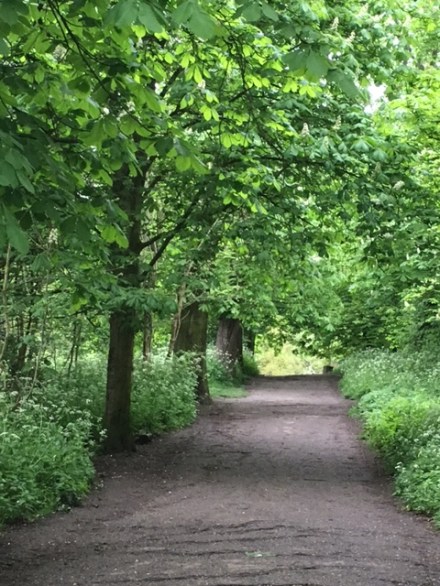
I love tree-tunnels.

IMG_6360

I love tree-tunnels and I know why. They are proof that in every separation, there is a meeting. A river separates its two shores but also links them. I once heard a story of 2 prisoners in solitary confinement. Their cells were separated by a thick wall. Over time they learnt to talk with one another by a particular pattern of tapping on this wall. The very thing that kept them apart, connected them.

Every year I seem to forget what this time of year looks like. Then I am surprised and delighted by the blossom and the fresh greenness on the trees. Even on a dull day like today, walking, looking and driving through tree-tunnels, channels light into my life. The trunks of these trees stand on either side of the road but the roots intertwine underground and the leaves meet up in the air and dance together. It feels like nature is not just giving me permission but actively encouraging me to enjoy life and look beyond what is visible. I need to give the same permission to myself. This light is mine.

Maybe this apparent separation from my darling Saagar is not at all real. Maybe this chasm is the link between me and my higher self. Maybe the greatest life lessons come to me through this gorge. Maybe this deep cleft of pain has been created for growth to take place. Maybe this fissure has appeared to make more space for love and kindness in our world. Maybe.


We all are Sakura.

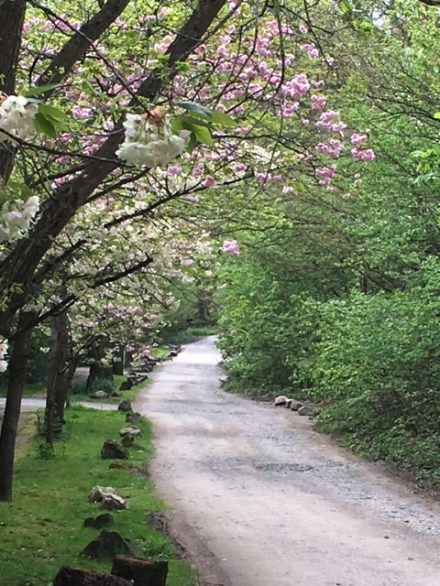
After a long, harsh and adamant winter, the hope and light of spring is here. The former is still lurking around the corner, waiting to jump back when it can. But for now, it’s hiding. Pink and white clouds of blossom hover a few feet above the ground.

IMG_6355

For centuries cherry-blossom or sakura has lived in the hearts of and ignited the spirit of the Japanese people. They wait for this time of year as the blossom signifies beauty and celebration. Its delicate pinkness stands for innocence and fragility. Families get together ceremoniously to marvel at this spring-time bloom. This occasion of watching and admiring of the blossom is called Hanami.

These feathery pink  flowers have inspired much of Japanese painting, poetry, film, music, food, textile design, ceramics and other art forms. In addition to being exquisite to look at, they carry a deep philosophical meaning. They are a timeless metaphor for human life. While this blooming season is intoxicatingly brilliant, it is tragically short. It  reminds us of the splendour and brevity of our own lives. It encourages us to appreciate our time on earth with the same joy and passion as we do the blossoms. It awakens our senses and forces us to pay attention – notice the present moment, welcome what’s to come, honour what has passed, acknowledge the transient nature of everything and hold ourselves in a stance of grace and gratitude.

The samurai embodied this combination of beauty and mortality. They appreciated the inevitability of death without fearing it. A fallen petal or blossom is said to symbolise the end of their short lives.

Sakura also indicates renewal. In Japan, this is the month in which the school, calendar and fiscal year start.  Aside from deep historical, religious and cultural significance, it also has connotations of agricultural optimism.

Beautiful, fragile and transient – that is us.