Day 832

The hospital where we went when he was ill is just down the road from where we live. It is 18 minutes by bus, 10 minutes but car on a quiet day. The Emergency department is on the left. The Mental hospital is on the right. There is a visitor’s car park in front of the Mental hospital. That is where we parked the car. That is where we waited for a couple of hours to be seen by a psychiatrist. That is where I had to make my own way that day because Saagar refused to have me in the car with him and his father. That is where he should have been when he was severely ill a few weeks later. That is where he could have been saved.

That is where I went this afternoon to watch a play called ‘Hearing Things’, a play co-produced by patients and professionals, based on insights derived from 6 weeks of workshops involving actors and people with a mental illness, offering both an opportunity for expression, transformation and co-creation. Through a cast of 3, we met people of different races and age groups. It was about challenging assumptions. It was about the empathy and personalities of patients. It was about ‘the system’ and the dynamics within it, mental well being of health care providers and role-reversal. It was about giving people a chance.

“I am off now to be mad and I don’t have to be sectioned for it”, remarked one of the participants as drama gave him the freedom to be who he is, without fear of judgment. It was about the possibility of being ‘re-assembled’. It was powerful and moving. It did not mince words. I spoke loud and clear. It was accessible, funny, clever and heart-breaking.

One young person describes his experience of drama:

“…after you do the drama you get this feeling…it feels as if whatever was bothering you went away and you feel light and can do whatever you want around you, it makes the day simpler and you can concentrate on your activities, it makes you feel better, like at the end of the day when you come home from work tired and you want to put your feet up, you don’t feel guilty relaxing as you have done a hard days work. I wanted to understand the person and put myself in their shoes.  At the end of it I felt good.  150% happy!”  

 It was about creating a new paradigm of relating to people suffering with mental illness.  It was all heart.

Ref:

http://playingon.org.uk/hearing-things-2016-2017/
Day 830

16387290_1223236211093081_7092133132352048931_n

Now, I belong to a network of mums and dads who share the same loss. We exchange stories, everyday struggles and our little achievements. Sometimes it is something as small as getting through an hour, a day. But then, fighting to get through the night, an all too familiar scenario. We know. We understand. We listen.

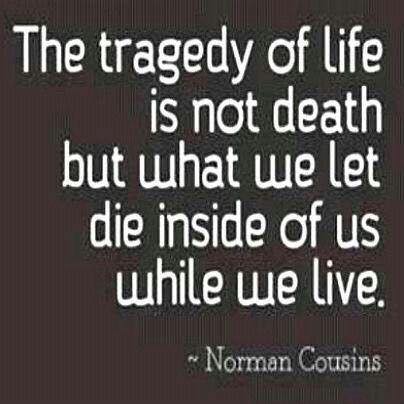
Sometimes, it is an inspirational piece of craft, a moving piece of music, a long walk or a rant. All of us desperately trying to hold on to who we were and make sense of who we now are, hanging on to the shreds of our being with all our might, seeing ourselves in each other, watching our helplessness and grief spill across the screen over and over again only to gather it all up and see it as nothing but love. All the rags weave together to form a mesh that strengthens each one of us. We recognise our reflections in each other and feel our little angels sending us collective blessings. All that is inside of us is alive even if it feels like it isn’t. It’s the purest form of love.

Day 829

Loneliness – a disturbing word, often invoking a sense of sadness and despair.

It’s not one thing. It is subjective. Imprecise.
It can be found anywhere.

When after many requests you still don’t have a sibling.
When you are born with skin colour darker or lighter than it should be.
When you are the new girl in class.
When you don’t get picked for the team.
When you sit alone at lunch time.
When you are not sure what you want and settle for what is available.
When you are stuck in a loop of cold-hearted bureaucracy.
When you are different.
When you are told ‘you should be happy’ by the one you are married to.
When you work from home and see no humans for many days.
When you feel you have to be somebody else to be successful and accepted.
When you are unable to have children.
When you have an abortion or a miscarriage.
When you have children and don’t see anyone but them all day everyday.
When your family is no longer a family.
When you have a fracture and are stuck in bed for weeks or months.
When ‘Facebook’ and ‘Instagram’  constantly offer comparisons.
When you get fired.

When you have just retired.
When a loved one suddenly disappears.
When you are blamed for a mistake you did not make.
When you get mugged.
When you are diagnosed with a serious illness.
When you are old and so easily forgotten.

Solitary confinement is one of the most severe forms of punishment because it can break your spirit. In 1951 researchers at McGill University paid a group of male graduate students to stay in small chambers equipped with only a bed for an experiment on sensory deprivation. They could leave to use the bathroom, but that’s all.  They wore goggles and earphones to limit their sense of sight and hearing, and gloves to limit their sense of touch. The plan was to observe students for six weeks, but not one lasted more than seven days. Nearly every student lost the ability “to think clearly about anything for any length of time,” while several others began to suffer hallucinations. “One man could see nothing but dogs.” A study at Harvard found that roughly a third of many solitary inmates they interviewed were “actively psychotic and/or acutely suicidal.”

In the biggest literature review into the subject of loneliness, the University of York looked at 23 studies involving 181,000 people for up to 21 years. They found that lonely people are around 30 per cent more likely to suffer a stroke or heart disease, two of the leading causes of death in Britain. More than 1 in 5 people in the UK privately admit they are ‘always or often lonely’. It is a public health problem.

I welcome the ‘Commission on Loneliness’ launched in memory of the murdered Labour MP Jo Cox, to look for practical solutions to reduce loneliness in the UK. Let’s do our bit, however small.
RIP Jo.

“Fools,” said I, “You do not know –
Silence like a cancer grows.
Hear my words that I might teach you.
Take my arms that I might reach you.
But my words like silent raindrops fell
And echoed in the wells of silence…
-Sound of Silence by ‘Simon and Garfunkel’

Ref:

http://www.telegraph.co.uk/news/2017/01/31/mps-launch-jo-coxs-commission-loneliness/
http://www.telegraph.co.uk/science/2016/04/19/loneliness-is-public-health-problem-which-raises-risk-of-stroke/


Day 826

img_0534

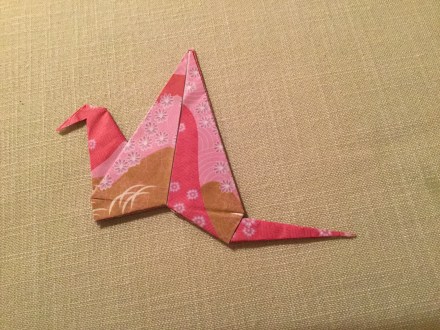
This forgotten book-mark in a book being revisited after two years is an origami crane – a symbol of healing in Japan. A school kid had given it to me at Hiroshima as a token of gratitude for helping him practise his spoken English.

Paper folding started in China in the first century and reached Japan in the 6th century. Here it was cultivated as an art of understatement. Origami suggests. It implies without announcing outright. It intimates without brashness. In Japanese folklore, a crane is fabled to live for a thousand years and is held in high esteem. It is believed that folding 1000 paper cranes brings the folder’s wishes come true.

A young girl called Sadako Sasaki survived the Hiroshima bomb when she was only two years old. Less than 10 years later she was diagnosed with leukemia, a cancer of the bone marrow. The disease progressed rapidly and the prognosis was not good. She set out to make a thousand paper cranes. She could complete 644 before she died on Oct. 25, 1955, less than a year after being diagnosed. Her classmates, family and friends made more to bring them up to 1000 and buried them with Sadako.

2013-08-20-sadakobybushcropped

Her story captured the imagination of the country and the world. Today, we recognize the crane as a symbol of peace and hope.

“She let out both the pain of our parents and her own suffering with each crane.”
“Her death gave us a big goal. Small peace is so important with compassion and delicacy it will become big like a ripple effect. She showed us how to do it. It is my, and the Sasaki family’s responsibility to tell her story to the world. I believe if you don’t create a small peace, you can’t create a bigger peace. I like to gather those good wishes and good will and spread to the world,” said Masahiro, her brother.

Peace and hope to Sadako and to us all.

Day 825

“But, you have the rest of your life in front of you.”
‘That is a terrible thing to say! That is such a terrible thing to say.’
(A conversation between Jackie Kennedy and her friend a few days after JFK’s assassination, in the film ‘Jackie’)

These days I randomly find myself standing in queue at ticket-counters at random cinema halls looking for a ticket for the next show, whatever it may be. Last week it happened to be ‘Manchester by the sea’ and today, just by chance, it was ‘Jackie’, both portrayals of death, devastation and dignity. Is this Universe’s way of letting me know that I am not alone?

Many, who have survived violent deaths of their loved ones.
Many, who have struggled to keep their legacy alive.
Many, who have shown great dignity despite housing a volcano of anger inside them.
Many, who have silently hidden and nurtured their incessantly weeping wounds.
Many, who have wished for their own death every night while staring into the darkness.
Come morning, many who have put on a ‘brave’ face.
Many, who have thought, ‘I could have saved him.’
Many, who have insisted the world witnesses the aftermath.
Many, who have held the bodies of those they love, in disbelief.
Many, who have not even had the chance to do that.

Well, I guess I am not alone.