Day 552

His bench is ready but I haven’t seen it yet. I have seen the pictures that I am sharing with you.

A delightful young man at Saagar’s old school put it together as his final ‘Design and Technology’ project. He spent a lot of time on developing the idea. He went through many of Saagar’s pictures and stories with me. He read through his memory books. He very politely consulted with me at every stage. He even had me shedding tears on his school blazer at every meeting when I hugged him.

S Bench 2

S Bench 1

S Bench 3

I love the “S” shape. It is elegant and it stands for Saagar and sadly for Suicide too – a co-relation that is established through the bench. For me it is very meaningful. I think the story will be shared widely at installation and on-goingly thereafter so that it carries a message for many other young people. The inscriptions on the bench are well chosen and well done – they also tell part of the story. That he was 20, his hobbies, his humour and his abilities are all well captured. I hope that the school will be able to use this opportunity to educate the boys about the importance of mental well being and asking for help when in difficulty. ‘Never Alone’.

The lime-green legs represent his love for the same colour. It only mentions how old Saagar was, without dates making him ageless in a strange way. It clearly conveys the vulnerability of young men.

A text arrived last night from one of Saagar’s classmates from University, “I hope you’re well. Just wanted to let you know that I’m planning on dedicating my dissertation to Saagar :-> Lots of love to you. xxx”

Creativity, expansion and growth, dedicated to Saagar. How appropriate. He continues to live and his memory continues to inspire. My beautiful boy! Love you!
 

Day 548

suicideGreatRecession03

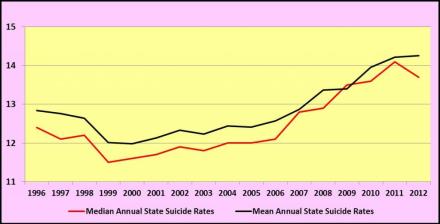
Yesterday a couple of things happened that made me think of the relationship between suicide rates and financial crises; there was a letter in the post for Saagar from Wonga offering him money and we watched “The Big Short”.

The 2008 global financial crisis affected economies around the world. It led to the deepest UK recession since World War II, with rises in unemployment, debt and home repossessions. Young people experienced particularly high levels of job losses and unemployment. In England, as in the rest of the world, the greatest rise in the incidence of suicide appeared to be in young men.

Disputes over benefits, wage cuts or demotions and reduced hours are among the other sources of distress. A range of sources of debt were identified, including loans (e.g. hire purchase and student loans), mortgage, rent arrears, gambling and debts to friends and family. Many people do not get in touch with mental health services or their GP in situations like these.

People in the ‘know’ seem to think that we all are headed towards another global financial crisis. Austerity measures and job losses are all over the news. Several studies have shown that the people most vulnerable to job loss and debt are individuals with pre-existing mental health problems or past psychiatric illness. Thus vulnerable individuals may become more vulnerable during periods of recession.

Countries with more generous unemployment benefits and more investment in active labour market programmes (e.g. job search assistance, apprenticeships, subsidised employment) experience the smallest rises in suicide during recession.

A policy focus on creating work opportunities for young people is particularly important during periods of recession. Young people are the group most likely to be made redundant and experience difficulties finding work. Negative first experiences of job seeking and the labour market may have a permanent scarring effect.

Frontline staff most likely to be in contact with individuals whose mental health is affected by economic and employment difficulties should receive training in recognising and responding to risk.


Day 543

In 2009 Thomas Joiner proposed the Interpersonal-Psychological (I-P) theory of suicidal behaviour.

Author of over 385 peer reviewed journals, Thomas Joiner has worked extensively in the field of psychology, neurobiology and suicidal behaviour.
As per the I-P theory, an individual will not die by suicide unless s/he has both, the desire and the ability to do so.
Who desires suicide?
There are 2 specific psychological states in their minds simultaneously:

  1. Perceived burdensomeness
  2. Low belongingness/social alienation.

Perceived burdensomeness:

“My death will be worth more than my life to family, friends, society, etc.” – a view that often represents a potentially fatal misperception. Studies have shown that this is a robust predictor of suicide attempt status and of current suicidal ideation, even controlling for powerful suicide-related covariates like hopelessness.

Low belongingness:

Not feeling like an integral part of a family, circle of friends, or other valued group.  As with the research base on perceived burdensomeness, there is abundant evidence that this factor is implicated in suicidal behaviour. A study by Joiner in 2008 showed that college students’ suicidal ideation peaked in the summer semester when the campus is less active. This accounted, in part, for the association between semester and suicidality.

How does one overcome the powerful instinct for self-preservation?

By developing a fearlessness of pain, which is acquired through a process of repeatedly experiencing painful events such as previous self-injury, repeated accidental injuries, numerous physical fights and occupations like physician and front-line soldier in which exposure to pain and injury, either directly or vicariously, is common.

The Interpersonal-Psychological theory is a promising one with growing evidence base. It suggests that clinicians be cognizant of their patients’ levels of belongingness, burdensomeness, and acquired capability (especially previous suicide attempts), as this knowledge may aid clinicians in the task of suicide risk assessment and of targeting ttreatments.

Day 541

“Hate drumming inside of me
Hate dying to get out.
Sinking into a pool of blackened hate.
Hate drinking me.
Hate consuming me.
Hate isolating me.

Hate me.

Hate controlling me.
Hate inspiring me.
Hate defining me.
Hate denying me.

Hate me.

Indescribable hate.
Hate scarring me.”

This poem was written by Laura Miles when she was a teenager. It described how she felt. She started self-harming when she was 13. She didn’t know why she was doing it. She didn’t know anyone else who was doing it. She didn’t even know what it was called. It was just something that she had power over, something that gave her a sense of control over this ever-changing world. It calmed her.

Laura went on to self-harm extensively throughout her teens and early twenties during which time she studied GCSEs, A levels and a BA in History. She was diagnosed with depression and developed obsessive compulsive traits which ruled her life. In May 2008, after a decade of poor mental health, she decided to end her life. This is when she read the Bible and had a significant encounter with God. That changed her perspective and started her on the road to recovery. She spent 7 months in a residential unit and learnt to manage her feelings and her life well.

She went on to complete a Master’s degree in Social work and now works protecting vulnerable teenagers. She can listen to them with empathy and give them hopes and dreams for the future. She shares her experiences and techniques she has learnt to help others get better. She understands better than anyone that self-harm in only ever a symptom and never a cause.

Day 534

Professor Guy Goodwin, the main author of the third and latest revision of the BAP Bipolar Guidelines said in his e-mail accompanying the publication:

“The third revision of the British Association of Psychopharmacology (BAP) Bipolar guideline is now available. It is substantially revised from last time to reflect changes in the available evidence, obviously, but also a changing perspective on how to weigh the evidence. It is intended to provide a counterbalance to the NICE document of 2014 which in places shows partiality (to psychological treatments) and a lack of common sense. The authors hope that the BAP revision will be useful in guiding and improving treatment of what remains a curiously neglected disorder.

 09c48df2-1880-4795-a043-562daa8a726a

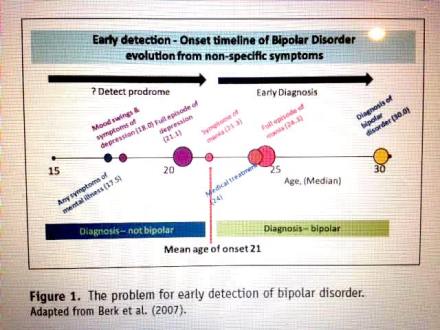
The BAP Guidelines for Bipolar Disorder is a 59 page document. The above picture is on page 20. It is a clear depiction of the evolution of the disease and elicits a ‘full episode of depression’ at the age of 20 years and a few months which was exactly the age Saagar was when he had the full episode of depression – 20 years, 5 months and 10 days. Yet he was discharged to the GP without highlighting the possibility of this happening and all the doors to access specialist services were closed behind him.

On page 23, it goes on to say – “Premature discharge to primary care can further dilute the treatment package available in the early stages of managing the illness.”

He was discharged by the Psychiatrist to the GP after 20 days of having made the diagnosis of Bipolar Disorder.

What more can I say? Poor kid!