Day 958

DSC00625

An excerpt from the Eulogy by Saagar’s uncle (my brother), Chetan:

“Two things about him come up over and over again.
The first is how much fun he was to be around. His ability to laugh. To make people laugh. And his astonishing ability to laugh at himself.
The other was how helpful he was. How he would do things he did not have to, to help other people out.
But clearly Saagar was so much more. He was so many things to so many people. And it is very difficult to capture in words the essence of what a person is. In the angst of his loss, his aunt wrote a short poem, which captures him more beautifully than I ever could, so I would like to read out now.
You..
You were more…
More than the dreams you dreamed
More than the laughs you shared
The beats you kept of the music you played
The words you learned of the tongues you spoke
The love you sought and the hearts you won
More…
More than the questions we ask, and the tears we shed
And more, much more than the demons you faced
And the battle you lost.
Hope you found your peace, and some day we find meaning…

When I think of his having moved on, I am in despair. But when I think about Saagar himself, what comes to mind is a series of memories. Knowing Saagar, they are all a lot of fun.
I fIrst met Saagar Naresh on a warm day in the summer of 1994 in Delhi. A baby was brought before me, probably 30 minutes after birth. I had no idea a human could be like that tiny, that fragile. The honour bestowed upon me was to be the very first person on this planet – after his mother, of course –  to provide him nourishment. I touched a spoon with honey briefly to his lips. That was my first meeting with Saagar Naresh.
Saagar has been a constant source of joy and pleasure ever since. The odd way in which he slept in bed as an infant.  The 2nd birthday where the birthday boy vanished, only to be found in the balcony with the new puppy, sharing a bowl of yoghurt, one spoon at a time.
I remember the 8 year old who never tired of practicing his bowling. The child who found the courage to get into a fixed wing glider for a joyride. He came out badly shaken,  but proud that that he had done it.
And the 14 year old who – once when he was visiting us – decided it would be fun to have my pet Doberman, Cleo, lick his head.  So he poured coconut oil all over his head. And Cleo was more than happy to oblige by licking it all off.
I remember the naughty 18 year old bodybuilder who put a post on his sister’s facebook page when she wasn’t looking, which said “My brothers triceps could dam a river”. And, of course, Saagar and Hugo’s mimicry of the English spoken by Indian tour guides would always have us in splits.
Saagar was great fun. I can bet that wherever he is right now, those around him are happy that he is there. Just like we have been for the past 20 years. Of course, there is regret that I will not see him soon. But there is gratitude for the time that I did have with him.
Saagar was gifted with a natural skill for languages, and along with that comes the desire to travel, which he did extensively. And because of him being far away and traveling often, there were always extended periods when we would not see each other.
Saagar has set off on another such trip now. And I think it is just a matter of time before we run into each other again. Honestly, I can’t wait for that day.
We miss you Saagar. Have a great trip.”

Day 934

IMG_0701

Rikka

The custom of placing flowers on an alter is an ancient one. In the sixth century, Ikebana was founded in Kyoto as an offering to the Goddess of Mercy. Flower arranging contests were held at the imperial court where aristocrats and monks competed with each other at festivals.

In the early 16th century people tried to give a deeper meaning to the thoughts accompanying flower arranging. They wished to arrange rather than casually placing them in a vase. An earlier attitude of passive appreciation developed into a more deeply considered approach.

Rikka is the oldest style of Ikebana. Trees symbolise mountains while grasses and flowers suggest water. A natural landscape is expressed in a single vase. Indeed, all things in nature are reflected. In Rikka it is important to know the laws of nature through harmony of trees and plants.

It is my good fortune that I have the opportunity to be very intimate with Mother Nature in this concrete jungle of London. I have a teacher who is dedicated to passing this ancient tradition on to future generations. Her school has generated a number of teachers who inspire many people like me. Arranging flowers is like meditation in motion. The right brain can express itself to the fullest. The intuitive decision making, the textures, smells and colours of materials, the elegant shapes, the spatial organisation and the movement within bring peace and satisfaction. It is creative within a set of rules. It is aesthetically appealing to the subtle sensibilities. It is a gentle experience of being one with nature.

Maybe one day beauty will save the world.


Day 924


Day 924

CHIRAG
(Central Himalayan Rural Action Group; Also means ‘lamp’)

Every time I return to India I witness immense beauty in simplicity. I feel that beauty changing me. I grew up in a simple, sweet world. Moving away from it was difficult but time moulded me. Somewhere deep within that appreciation of simplicity remains. I see it without romanticising it. It is a part of me. I feel closer to myself each time I am faced with it.

Last week I volunteered to tell a story at a primary school in a small village in the Himalayas. I sat in a circle on the floor of a well lit large classroom with a group of  sixteen 7 year olds and we chatted for about half an hour in a mixture of Hindi and English. One of them asked me if we would be singing but I wasn’t able to confirm that. It bothered me.

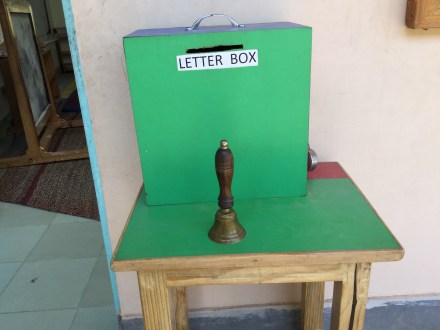
The Principal, an enthusiastic young man of 29, said they didn’t have a music teacher in the school as the charity had just about enough money to pay for teachers to cover the academic curriculum. A local musician has offered to teach music but they are waiting for funding to come along to be able to employ her.

It is Saagar’s 23rd Birthday today.
I think he would have liked for that school to have a music teacher.
Happy Birthday Darling!

“O Bud! Your life is so moving that only for a while
You blossom, for just a smile.
“In this garden, O dear,” said the bud
“Just a few are lucky to smile, even for a while.”
(Translation of an Urdu couplet by Josh Malihabadi)

IMG_0624

IMG_0625

Chirag School Newsletter 2_Autumn 2016


Day 921

Lady’s fingers

IMG_0629

Naani’s food is the best in the world. Yes. Much better than Mamma’s. That is a fact and Mamma agrees without the slightest reservation. She is happy to continue being Naani’s student forever. Naani’s chicken curry is the bestest ever and she even manages to make vegetables taste yummy!  – These lines would accurately reflect Saagar’s feelings.

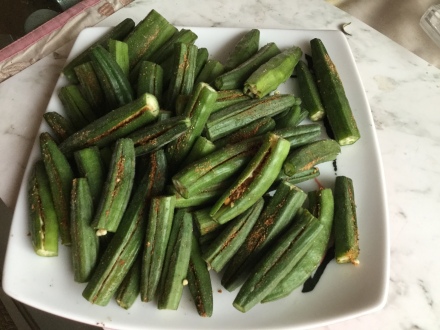
Naani is my mother. I am spending some time with my folks back home and life is largely about food.  Mangoes, ice-coffee, fried fish, momos and idlis form a fraction of a vast list that is adding further vastness to my waistline and other lines. Summer offers up only a few vegetables of which ‘bhindi’ or ‘okra’ is a big favourite in our family. The particularly yum preparation is the spicy, stuffed one. Uncooked it looks like the image above.

Here’s how , for 3-4 people:

300 grams of tender okra – cleaned, dried, topped, tailed and slit along the length.

For the stuffing:

Salt to taste
Turmeric powder – half tsp
Red chilly powder – half tsp
Coriander powder – 5 heaped tsp
Dried mango powder – 1 tsp
Garam masala – 1 tsp
Method:
Stuff the okra with the mixture of dried spices above.
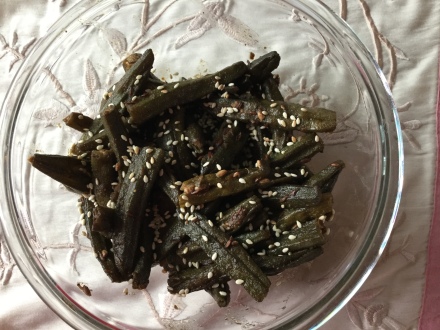
Heat 1 tablespoon of mustard oil till lightly smoking. Splutter 1 tsp of cumin seeds in it, add the stuffed okra and cook until soft. Serve hot. Garnish with roasted sesame seeds before serving.

IMG_0632

Saagar loved this dish. We often cooked it together. I prepared the okra and the spice mix and he put them together. We had it with yellow masoor daal and plain basmati rice.

Today, we made bhindi, sending him our love and blessings.
We missed him at the dinner table. A lot.

Day 914

Ding-dong – the laundryman with the ironing.
Ding-dong – the ever-smiling, podgy little cleaning lady.
Ding-dong – the air-con repair man with a helmet.
Ding-dong – the Fed-ex man with a delivery for the neighbours.
Ding-dong – one of the workmen upstairs requesting a bottle of cold drinking water and so on …

The lull of rotating fan blades. The hazy, lazy sun. The hopeful hint of an on-coming shower. The microscopic layer of fine urban dust on glass table tops. The colourful screw-tops of refrigerated water bottles. Old familiar Hindi film songs playing in the background like long lost friends. Dodgy links with the world-wide-web. The cool marble floors easing bare soles. Honey like water melons. Heavenly early mangos, semi-yellow, a wee bit raw around the stones. Heads taking respite under thin cotton scarves in multitudes of colours. Loose, airy, light, flowing, feminine garments. Childhood aromas emanating from Mum’s kitchen. Her annoyance with disobedient modern gadgetry. Dad’s concern. Their everyday household problems of retirement. Saagar’s pictures lining the walls adorned with flowers and silk. Being called by childhood names.

Specks of earth lifted off by droplets hitting parched ground. The magical heady confluence of moisture and earth teleporting my brain to a nearly buried, exotic moment from a long time ago. The awesome dance of the wind with the chime. The pure joy of the breath. The ecstacy of being.

The best things in life are not things.