Kisa Gautami

download

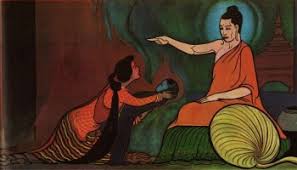
In ancient India, there lived a woman. She was happily married to a rich merchant and was the proud mother of a bubbly one year old. After a brief illness, her only son died. Her grief was unbearable. Wailing and weeping, she took her child’s lifeless remains from door to door pleading with the townspeople to bring her beautiful child back to life. No one could help her. She was destroyed.

Someone suggested she take her infant to the Buddha. She did. Through her tears and sobs she narrated her tragic story and begged Him to infuse life back into her bundle of joy. The Buddha listened with compassion and said, “Kisa Gautami, there is only one way. Bring me 5 mustard seeds from a household where no deaths have occurred.”

Her eyes lit up with hope. She hurriedly gathered up her bundle and once again, went knocking on each and every door in town. To her utter disappointment, every family had experienced death in one form or another. She realised the lesson that the Buddha had wanted her to learn. Suffering is a part of life and death is inevitable. Kisa Gautami’s eyes were now open. In the light of this knowledge, she could handle her grief. She went on to become an ardent follower of the teachings of Buddha.

Like Kisa Gautami, I have found myself at the feet of the Buddha. His teachings have brought light and lightness to my being. Along the way other divine souls have helped in unique ways.

This is the festive season for most people. Planning meals, choosing stocking fillers, selecting wrapping paper, posting greeting cards and preparing to welcome the New Year. Yay! It’s all happening. But a Saagar-shaped piece is missing. I feel for all the families who will have that vacant chair at their table this year. I hold them close to my heart. As time goes by, it does not get easier. This excerpt on the subject of ‘Pain’ from ‘The Prophet’ speaks to me. I hope it helps you too. I wish you as peaceful a time as possible.

“And a woman spoke, saying, “Tell us of Pain.”
And he said: Your pain is the breaking of the shell that encloses your understanding.
Even as the stone of the fruit must break, that its heart may stand in the sun, so must you know pain.
And could you keep your heart in wonder at the daily miracles of your life, your pain would not seem less wondrous than your joy;
And you would accept the seasons of your heart, even as you have always accepted the seasons that pass over your fields.
And you would watch with serenity through the winters of your grief.
Much of your pain is self-chosen.
It is the bitter potion by which the physician within you heals your sick self.
Therefore trust the physician, and drink his remedy in silence and tranquillity:
For his hand, though heavy and hard, is guided by the tender hand of the Unseen,
And the cup he brings, though it burn your lips, has been fashioned of the clay which the
Potter has moistened with His own sacred tears.”
― Kahlil GibranThe Prophet


It’s become a ‘thing’.

For a thousand days I wrote every day. It wasn’t a ‘thing’. That’s just what I did. I didn’t worry about who read it and why. It didn’t matter how good or bad it was. I just did it. Then I slowed down to writing roughly once a week.

Now, I think about writing. I talk about writing. I look up ‘writing’ on the internet. I consider on-line courses. I buy books on writing. I worry about writing well. I listen to podcasts of interviews with famous writers. I am on the lookout for writing tips in newspapers and magazines. I wonder what it must feel like to write properly every day. I envy those who can. What I do very little of, is write. I believe I repeat myself endlessly. I say the same things again and again. I forget things that are important. I hardly know any juicy big words. Why would anyone be interested in what I have to say? English is my second language and I can’t fully express myself in it anyway. My imagination is limited. I haven’t read enough books. I have no writing qualifications. Ms Confidence has evaporated and Mr Self Doubt has surreptitiously crept into her space in the vacant apartment of my psyche.

One ‘expert’ on you-tube suggested the way forward is to just write 3 full A4 sheets every day. She said,”… best not to think too much. Just put down on paper whatever comes to mind”. She called it a ‘brain dump’. She promised that over time it would start to make sense. It would become a story in your voice.

Maybe it’s time to go back to writing everyday. Maybe it’s time to start  my “big fat” book 🙂

PS: My favourite book on writing is ‘On Writing Well‘ by William Zinsser.


Treatment versus Care

In her entry to this year’s BMA News Writing Competition, a consultant psychiatrist relates the experience of her postpartum psychosis and explains that, although grateful for her treatment, something was missing from the care she received.

images

The Human Factor

I am a consultant psychiatrist. Two years ago, I had a taste of my own medicine.

Three sleepless nights after the birth of my daughter, I became acutely ill. I slowly realised I couldn’t sleep — something strange was happening. Within six hours, I was experiencing a kaleidoscope of symptoms — elation, fear, heightened senses, delusions. I wanted to kill myself and my daughter.

Postpartum psychosis is a medical emergency and a consultant perinatal psychiatrist was at my house within the hour. I literally ran to her ward in my socks, my mum running behind, having forgotten her shoes too.

My first night was terrifying, but the staff were fantastic. As I rode an emotional rollercoaster, they reassured me, calmed me, gave me the sedation I desperately needed. Soon, I settled into a mild mania. Though at times it was very scary, I was fascinated. I noted with curiosity how my brain behaved. I felt great love for my daughter, and beneficence for my fellow man. I enjoyed all the activities the ward had to offer.

Five weeks later I was happily home. But what goes up, must come down. Gradually, I became unsettled, filled with self-doubt. I became convinced my baby was autistic. The anxiety became intense, and I considered suicide. My consultant coaxed me into hospital again. ‘It will only be two weeks,’ she promised. ‘I think you need to start lithium.’

You cannot breastfeed on lithium. One day I was connected with my baby, the next she fed from a bottle. My heart broke as my breasts filled to burst. It was a symbolic change, from wonderful to awful. She smelled wrong, artificial. I began a tiresome regimen of sterilising, preparing and cooling bottles, when all the while my baby yelled, to my great shame. As if in protest, she vomited spectacularly after every feed.

This time, the ward seemed an unfriendly place; swelteringly hot, noisy, tedious, excessively rule-bound. The other patients seemed uninteresting and depressing. My eldest son was bewildered: he wasn’t allowed on the ward. Why wasn’t mummy coming home? He became rejecting and oppositional. My heart broke some more.

I begged for leave but developed extreme insomnia and could not get well. I remember one night getting up, sitting down, and getting up again for seven hours, unable to decide whether to wake my baby for a change. A burly nurse was recruited to force me unceremoniously to move to a room near the nurses. I was told I would be sectioned if I tried to leave. An informal patient, I was allowed out for only half an hour each day.

I told my consultant I wasn’t depressed, her ward was the problem. ‘You’re depressed’ she repeated, implacably, and brought in a second-opinion doctor. I was desperate to leave as soon as I arrived, yet those two weeks became two months.

Having a mental illness is one of the most disturbing and frightening experiences one can ever have. The rug is truly pulled out from under your feet. Suddenly you are somehow lesser, rendered powerless. I was one of the lucky ones. I knew what was happening, and was more able than most to speak up for myself. I got treated very quickly. Many don’t.

My consultant was a former colleague of mine, a peer. She was kind but paternalistic, and my care became a battle of wills. She believed her plan was faultless and that her ward was entirely beneficial. She conducted her ward rounds like job interviews and treated me like an adolescent. I watched helplessly as she pathologised my normal behaviour and denied promises to get me to comply.

We were fragile mothers, but were often shamed like naughty children for not ‘doing the right thing’, sometimes berated across the ward for all to hear by opinionated nursery nurses with little sensitivity to our mental state. Mothering a screaming baby during an intense crisis of confidence was a tortuous task, yet it was rarely considered that our babies were exacerbating the problem. Scared and disturbed women were managed by intimidating rapid response teams.

I lost trust in them, I hid symptoms. One night I nearly killed myself but never told.

I now can understand how my patients feel when they say they no longer want to go back to ‘that place’. How lack of insight guides them away from reminders of restraint, coercion, scrutiny and endless questions. How it is difficult to trust people who don’t treat you as fully human.

Despite all the positives and the expertise in my care, an important element was missing. Care needs to be more than medication, therapies and keeping people safe. Now I’ve had a taste of my own medicine, I always ask: ‘What is this like for you, what do you really need to help you get well?’

We have further information on doctors’ well-being and our doctors for doctors services

Small talk saves lives.

It’s a dry winter morning. I am in my favourite red jumper and floral denims, on my way to the therapist. I have seen him for 3 years and I remain completely unfinished. My train will arrive at this platform, Platform number 1, West Norwood Station in 4 minutes. There are only 2 tracks and only 2 platforms here. The sun is in hiding and all trains are delayed, allegedly due to bad weather. Despite 2 people ahead of me in the queue there is enough time for me to get a cappuccino with one and a half sugars from the newly-opened kiosk, the Blackbird Bakery. The pair of sweet,  smiley girls behind the counter have a way of making things work while maintaining an environment of relaxed, chatty friendliness.

A toddler in a pram doesn’t want her half-eaten kitkat anymore. She wants to feed it to the birds. Her mum takes it from her and lovingly puts it in her own mouth. She gets a quizzical look from her daughter. She beams a gentle smile back on to her baby.

Just as the train pulls up behind me, my order is ready. In the here and now, the yellowness of the foliage on the ground and on trees is bright as stippled sunshine. My drink smells like the warmth of Brazil. Grateful for no rain, I turn around and step onto the train holding my hand-warming  and heart-warming treat.

I look for a forward-facing window seat with a table. The one I find seats an unclaimed blue knitted scarf, coiled up like a snake. An overweight elderly lady sits with a smile opposite me.

‘Is this your’s?’ I ask.
The train starts to move.
‘No.’ says she.
‘How are you?’
‘I am ok’, she says in a strong Spanish accent.
‘Doing anything nice today?’
‘Going to see a friend in Victoria. We don’t talk much. We meet once a week. We go for hot-chocolate.’
‘That’s nice.’
She looks down at a picture of 3 pretty young women in her magazine.
‘I always wanted daughters but I got 2 sons and1 grandson. No girls.’
‘Boys are lovely too.’
‘Yes. But I would have liked a girl.’
I smile.
West Norwood station is well behind us by now.
Saagar, my son comes alive in my mind.
Platform 1 was where he spent his last couple of hours. That was 3 years ago. He was more than I could have dreamt of. All I wanted was him, his happiness. Nothing else.

He was there for at least two whole hours. No one spoke with him. Small talk saves lives. For every life lost on the railway, 6 are saved by those around them. Only if someone had interrupted his train of thoughts. Only if someone had trusted their instincts enough, to act. Only if someone had cared enough to ask if he was ok. Only if everyone had the basic tools of suicide prevention, just like they do for choking and drowning. Who knows?

Now, all I want is for him to come back to me.

Free on-line training for all, in Suicide prevention, launched by the Zero Suicide Alliance. 20 minutes of life-saving skills : https://www.relias.co.uk/zero-suicide-alliance/form.


Me and the Mountain

IMG_0950

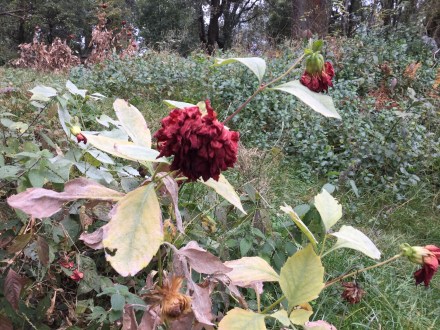
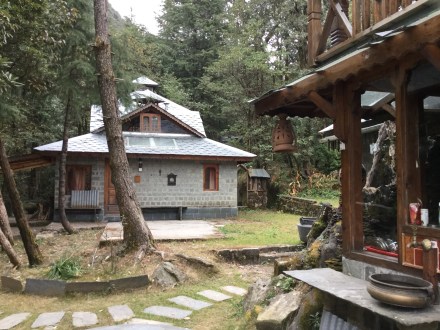
A friend’s house on a mountain has been our home for this week. A little bit of water and electricity flows through it but no phone signal or Wi-fi. It’s more than a kilometre away from the nearest motorable point. It’s made of wood and stone and surrounded by cedars, pines, oaks and rhododendrons on all sides. Every room has a fire place and all the windows are single glazed. It’s about 50 years old, quaint and basic. Since the sun went into hiding yesterday, it has been icy cold and we have been magnetised by the lone wood-burning stove. The overgrown garden around the house still has colour from clusters of wilting maroon dahlias, symbolising the past glory of the house within. Every window looks on to a landscape that could be a picture postcard.

IMG_0947

There is nothing to do but go walkies. Jacob, a neighbour, dropped by to say hello. He is certainly the most energetic 70 years old man I have ever met. An Austrian anthropologist and a tour guide by trade, he has been living on this mountain for more than 40 years. He has a lovely Austrian wife who gave birth to their 4 sons on this mountain. The sons went to the local Tibetan school and then moved on to fulfilling careers.

A Buddhist monk has been living in silence and solitude in a cave on the side of this lush green mountain for the last 15 years. The only visible indicator of his presence is an oil lamp that lights up every evening.

Tea is consumed by the gallons here. It’s milky and sweet enough to float a boat. Its calorific value is high enough to eliminate the need for food. People here have peace, time, clean air and fresh spring water – luxuries for most city dwellers. Stories are exchanged, transmitted and created over cups of tea. They keep the bush telegraph alive and kicking.

There is a distinct beauty and stillness about this mountain, called Dharamkot, in the Dhauladhar range of the Himalayas. The sharp contrast between my inner and outer landscapes is unsettling. I teeter closer to the edge of insanity than usual, feeling ill, walking the scenic slinky mountain tracks every day. Good old grief is bubbling up big time, threatening to push me over the edge. I am plummeting down the roller coaster at the speed of light and the only way seems to be down.

Since ancient times sages and sadhus have recognised and chosen the Himalayas as a seat of peace and enlightenment. The Dalai Lama’s residence and monastery are visible down the valley from this mountain. Smiling monks amble in ochre robes, lending an atmosphere of calm and serenity. The spiritual energy here is palpable. It’s doing its best to hoist me out of my slump.

I sit still, struck by the scale and magnificence of the giant Himalayas. What am I in front of these ancient icons? Insignificant. One little turn in the weather for the worse , one slight ruffle in the tectonic plates beneath me, one tiny miscalculation of a footstep on the mountain slopes, one temper tantrum of the mountain breeze is enough to make me disappear.

How big am I?
How big is my sorrow?
How many stories have these mountains witnessed?
How many more are yet to unfold?

What if the answer is to dissolve the ‘me’ in the mountain, in the basic elements that make up everything – earth, water, fire, air and ether. Be nothing and everything.