Day 825

“But, you have the rest of your life in front of you.”
‘That is a terrible thing to say! That is such a terrible thing to say.’
(A conversation between Jackie Kennedy and her friend a few days after JFK’s assassination, in the film ‘Jackie’)

These days I randomly find myself standing in queue at ticket-counters at random cinema halls looking for a ticket for the next show, whatever it may be. Last week it happened to be ‘Manchester by the sea’ and today, just by chance, it was ‘Jackie’, both portrayals of death, devastation and dignity. Is this Universe’s way of letting me know that I am not alone?

Many, who have survived violent deaths of their loved ones.
Many, who have struggled to keep their legacy alive.
Many, who have shown great dignity despite housing a volcano of anger inside them.
Many, who have silently hidden and nurtured their incessantly weeping wounds.
Many, who have wished for their own death every night while staring into the darkness.
Come morning, many who have put on a ‘brave’ face.
Many, who have thought, ‘I could have saved him.’
Many, who have insisted the world witnesses the aftermath.
Many, who have held the bodies of those they love, in disbelief.
Many, who have not even had the chance to do that.

Well, I guess I am not alone.
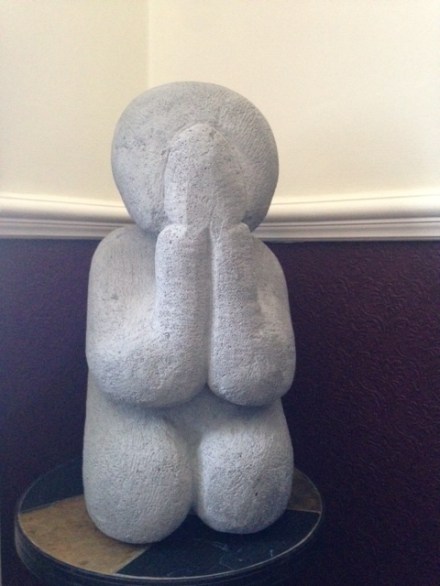
Day 815

photo

(A sculpture by Ruth M, who lived with Bipolar Disorder, expressing her depression)

In the 1940s, mental hospitals were places of isolation and confinement, probably closer to prison than hospital. Netherne, in Surrey was seen as a progressive asylum at the forefront of waves of reform and development for nearly 50 years, till the eventual closure of the British asylums. They enthusiastically adopted physical treatments, now viewed as barbaric- insulin coma therapy, electroconvulsive therapy and lobotomy, then seen as optimistic approaches to treatment.

Edward Adamson (1911-1996) was a pioneer of British Art Therapy. He encouraged and collected the paintings, drawings and sculptures by people compelled to live in Netherne Hospital between 1946 and 1981. He describes that many people who came to his first lecture there had shaved or bandaged heads, bruised faces and black eyes, following brain surgery.

Adamson started collecting art during his early visits when a man on a locked ward gave him the first of his several drawings done on toilet paper with a charred matchstick. He later met other people on the wards who would have had no personal possessions, working with whatever materials they could find to create something for themselves.

The Adamson Collection has 6,000 of these works of an estimated 100,000 when he retired. The collection is seen as unique in the history of art therapy of the reforming psychiatry of the 1950s and 60s, collected by an artist rather than a psychiatrist, with a strong representation of works by women. Above all it is a memorial to all those who suffered in the asylums and to the human need to express.

“Edward Adamson practiced art as healing before there were ever terms or labels like ‘Art Therapist’. Being with him for anyone was therapy and yet he didn’t play at clinician, but rather served so sweetly as a supreme friend, ‘there’ for those who had none other. There were for Edward no patients. I think that is why so many lost people in his care found their way back to themselves. Adamson’s was an alchemy of the highest sort.”

– Rebecca Alban Hoffberger, Founder/Director American Visionary Art Museum, 2011

13ec28aed459f20a9816caf08304393c

Ref: http://www.adamsoncollectiontrust.org/wp-content/uploads/2016/09/2-2011.-DOF-Raw-Vision-for-EAF.pdf

Day 813

Short stories have always intrigued me. Of late my attention span has become so short that those are the only kind of stories I can relate with and appreciate.

Here’s an abridged version of ‘Grief’ by one of the greatest writers of short fiction, Anton Chekov.

‘Grief’

It is twilight. Large flakes of snow are falling. A cab-driver, Iona, waits for a customer. He sits in his cab with his body bent as double as a living body can, immobilized by misery. ‘To whom shall I tell my grief?’

At last an officer arrives. Iona sets off in his cab with the officer at the back. He turns around to speak to him.
“My son…er…my son died this week, Sir.”
‘Hm. What did he die of?’
“It was a fever.”
Silence. Iona turns around again to find the officer nodding off.

As the evening progresses, Iona attempts to talk to someone three times. He tries to tell the story of his son’s death again and again. The second passenger, a high browed businessman interrupts Iona and says, ”We all must die one day.” Another man simply gets out of the sleigh. Later Iona tries to speak with a house porter but he brusquely tells him to drive on. Still later Iona offers one of his fellow drivers a drink but the young man promptly falls asleep. Just as the young man has been thirsty for water, Iona thirsts for speech. There is so much he needs to share.

“One must tell it slowly and carefully; how his son fell ill, how he suffered, what he said before he died, how he died. One must describe every detail of the funeral and the journey to the hospital to fetch the defunct’s clothes. His daughter Anisya remained in the village – one must talk about her too. Was it nothing he had to tell? Surely the listener would gasp and sigh and sympathise with him?”

Finally at the end of the working day, Iona returns to the stables. He starts to speak to his horse, “Now let’s say you had a foal, you were that foal’s mother and suddenly, let’s say that foal went away and left you to live after him. It would be sad. Wouldn’t it?”

The mare munches hay and breathes on her master’s hands. She doesn’t close her eyes, nor walks away, nor interrupts with her own wisdom on the matter. And it’s enough. Iona tells her everything.

At the risk of repeating myself, I tell the story I need to tell:

(Special thanks to Diane Morrow and her book: One Year of Writing and Healing)

Day 804

This time of the year is difficult for many families. Financial pressures, obligatory socialising with people whose affections may not be entirely genuine, a perceived time for evaluating various aspects of one’s life, overindulgence, having to revert back to traditional gender roles, the need for things to be just so…

Many women fear the festive period. Not a year goes by when there isn’t a seasonal rise in incidents of domestic violence reported to the police. Humberside Police Force reports that calls rose from 38% in the rest of the year to 54% in December 2015.

“For too many children across Ireland, being home at Christmas, is not a place of safety, warmth and happiness. It’s a place of fear, loneliness, pain and neglect,” said the ISPCC (Irish Society for the Prevention of Cruelty to Children). On Christmas day more than 1000 calls were received by their 60 strong staff on Childline service from children reporting distress due to domestic violence and/or alcohol abuse.

Pangs of loneliness are more acutely felt by the elderly and floating populace at this time of the year. Age UK works steadily on reducing loneliness in the elderly, 1.2 million of whom suffer from it on a chronic basis. Their objective is : ‘No one should have no one on Christmas’.

For those of us who have recently lost a dear one, their physical absence is more visibly, painfully and deeply felt than other times. That one less present, that one less seat on the dinner table, that one less name on the card, that one less beaming smile, that one less hug …

Ref: http://www.newstatesman.com/politics/welfare/2015/12/it-s-hardest-time-year-why-domestic-violence-spikes-over-christmas

https://www.rt.com/news/371953-child-abuse-helpline-ireland/