Breakable

images

A long time ago, on a Sunday morning at a village fete I saw a beautiful black-clay handmade earthenware pot. I wanted it. He said that we shouldn’t as it might break. We brought it home. A long time ago, it decorated our home for a long time.

He said if something is breakable, there is a real chance it will break, no matter how much we feel it ‘should’ not. Each time we looked at it our hearts warmed like the insides of fur mittens. He said nature had its own laws of demolition. That was a long time ago.

Another day, we brought another sweet fragile thing home. It was delicate as a little bird. It claimed all our love, our time and our sleep. It cooed and cackled and played silly games. It decorated our home for a long time. Each time we looked at it our eyes sparkled like north stars and our hearts overflowed like rivers breaking  banks. He said the cement of our love would keep us all intact and together. Forever.

We forgot that this thing was breakable. And we were breakable too. He said even if we moved across continents and oceans everything would be alright. He said even if we had nothing we would be okay. He said nothing would break. That was a long time ago.

Now the black-clay handmade earthenware pot from a long time ago sits in the centre of our living room, on a glass top coffee table, looking pretty. It’s breakable.

(Anaphora: https://www.merriam-webster.com/dictionary/anaphora)

Inheritance of fear

The past is never dead. It’s not even past.”
– William Falkner. Requiem for a Nun.

The echoes of past traumas get subconsciously played out by us in our everyday lives. Sigmund Freud called it ‘repetition compulsion’ – an attempt of the unconscious mind to replay the unresolved so that we can ‘get it right’. This mechanism drives its way through generations. Jung also noted that whatever is too difficult to process does not fade away. It gets stored in our unconscious and finds expression in other ways. He says,” When an inner situation is not made conscious, it happens outside as fate.”

Here’s an example: Jake was 19. He hadn’t slept a full night’s sleep in more than a year. He had developed dark circles around his eyes and a blank stare in them. He looked at least 10 years older. He had been a star student and a great athlete but the insomnia had left him lifeless. This thing had no explanation and none of his doctors or psychologists or naturopaths could figure it out.

It had started with Jake waking up shivering one night at 3.30 am, frightened to death. No amount of woollen clothing warmed him up.  Soon, insomnia became a daily ordeal. Despite knowing that his fear was irrational, Jake was helpless and could not relax. The ‘freezing’ feeling associated with the first episode was quite peculiar.

On exploration of Jake’s family history, this story came out: His mum’s brother, Uncle Colin,  whom he had never met had frozen to death at the age of 19. He was checking power lines in a storm in the Northwest of Canada. He struggled to hang on but eventually fell face down in a blizzard, lost consciousness and died of hypothermia. The family never spoke his name again.

Now, thirty years later, Jake was unable to slip into sleep at the same age as his Uncle. For Colin, letting go meant death. For Jake, falling asleep must have felt the same. Once Jake could see this link, he was able to free himself of it with the help of healing techniques taught by Dr Mark Wolynn, a neuroscientist with an expertise in breaking inherited family patterns.  His book “It didn’t start with you”, describes some of these practical tools.

Scientists are now able to identify bio-markers as evidence of traumas passed down from one generation to the next. Studies on Holocaust survivors and their children have revolutionised the understanding and treatment of PTSD all over the world. Be it fear, guilt, low self-esteem or anxiety, the roots of these issues may reside in the traumas of our parents, grand-parents and even great-grandparents.


Old people’s radio station

Screen Shot 2018-02-25 at 19.33.32

During his holidays, Saagar and his friends would be subjected to Woman’s hour on BBC Radio 4 second hand, as their mothers listened. They would later have amusing/interesting discussions about breast feeding, female education and employment challenges. This station was pre-set on the car-radio and at home. It was designated as the ‘old people’s’ radio-station by him. Invariably, ‘Gardener’s question time’ would come on while we were in the car together, travelling over the weekend. It was quaint by its sheer irrelevance to us as we could barely keep our 4 nameless indoor plants alive.  Our urban pre-occupations meant we didn’t have a gardening vocabulary.

‘Just a minute’ was our all-time favourite – a panel of funny people asked to speak for one whole minute on a given topic without repetition, hesitation or deviation. The seemingly innocent topics often held great potential for hilarity, for example, billiards, the best thing about cats, how I spread a little happiness, keeping a straight face, my love of the absurd, garages and such. The correct and incorrect challenges posed by the panellists generated tremendous amount of laughter. Our attempts at giving each other topics resulted in great amusement.

On Thursday evening I was asked if I’d like to be a guest on Woman’s hour to talk about Saagar. It was unbelievable. It made me smile and cry at the same time. What a paradox! Of course I’d love to be on Woman’s hour. Under these circumstances? Meeting Jenni Murray was an honour. She was down to earth and professional, looking just as I imagined,  in her trademark glasses sitting just above the tip of her nose.I told her she had my dream job. She said Joan Baez had been in the studio the day before, sitting at the same chair as me. How cool! Oops! Saagar prohibited me from saying ‘cool’ as he thought it sounded all wrong coming from me. I wonder how he would feel about this interview if he knew. Maybe he does.

Despite making notes and preparing as well as I could, I was a bit flummoxed by some of the questions. I didn’t say everything I wanted to. I hope there will be other opportunities. This conversation must grow until everyone is a part of it in a meaningful and constructive way. In a way that saves lives.

A recording of the interview with brilliant and committed Mr Ged Flynn, the CEO of PAPYRUS and I:

Every day my love is new.

All those years ago, when we were kids, we attended medical school together. The Batch of 1983 had its 3rd re-union at Cochin, the capital of Kerala in South India over the last 3 days. I travelled from snow-bound Wiltshire to lush green tropics. Many of my classmates came together from all over the globe. Some brought their families. Others brought videos of their kids doing this and that. I brought memories. We shared stories of our teachers and colleagues from our time as adolescents and young doctors at our alma mater. We felt close to each other, reminiscing our naivety, vulnerability and innocence. Nostalgia of our ‘good old days’ of simplicity, like silk threads knitted us close.

We went sari shopping. My friend chose a pale blue sari with a gold border. Her 15 year old daughter commented, “it’s as bland as playing tennis without a net.” It was exactly the kind of thing Saagar would say. He would also take great pleasure in imitating the way I say, “So pretty. No?”. Aaaaaaaaargh!!!

Looking back:

2014: Saagar went.
2015: Longing
2016: Longing
2017: Longing

If I told my plight to a river, it would stop flowing. If I told it to a tree it would shed all its leaves. I burn in this fire of longing, again and again, every day. I have become a boat of compassion filled with the gold of nothing, riding the waves in search of my beloved. I weather the tides of sorrow and happiness while my longing lives in me. I find my beloved in my longing. There is no destination no more.

An ancient parable goes like this: Once a forest caught fire and all the birds and animals of that forest started to leave. There was a bright little parrot who decided to stay. The tree that housed it said, ”You have wings. Go. Fly away.”
“I ate your fruit, I soiled your leaves, I played from branch to branch. You burn and I fly away? You love but once.”
The utterly foolish parrot goes and plunges herself in a nearby lake, comes back and flaps her wings over the blazing forest fire. Two drops of water fall. She goes back into the lake and come back with another couple of drops of water and sprinkles them over the humungous fire. The other fleeing birds and animals start scoffing and laughing at her.
“What do you think you are doing?”, they say.
The parrot turns around and says “I am doing what I can.”
Just then the Gods pass by and see this bird. They take the form of an eagle and watch her closely. They are incredible moved to see her do what needed to be done, be in the here and now and her passionate endeavours to quench the fire in and around her. The Gods wept and the clouds burst into a heavy down pour of milk.

Everyday my love is new.
I wish you the same.

“Whatever happens in your life, no matter how troubling things might seem, do not enter the neighbourhood of despair. Even when all doors remain closed, God will open-up a new path only for you. Be thankful when all is well. A Sufi is thankful not only for what he has been given but also for all that has been denied.” – From ‘Forty rules of love’ by Elif Shafak.

Kisa Gautami

download

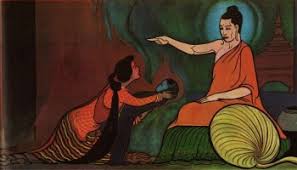
In ancient India, there lived a woman. She was happily married to a rich merchant and was the proud mother of a bubbly one year old. After a brief illness, her only son died. Her grief was unbearable. Wailing and weeping, she took her child’s lifeless remains from door to door pleading with the townspeople to bring her beautiful child back to life. No one could help her. She was destroyed.

Someone suggested she take her infant to the Buddha. She did. Through her tears and sobs she narrated her tragic story and begged Him to infuse life back into her bundle of joy. The Buddha listened with compassion and said, “Kisa Gautami, there is only one way. Bring me 5 mustard seeds from a household where no deaths have occurred.”

Her eyes lit up with hope. She hurriedly gathered up her bundle and once again, went knocking on each and every door in town. To her utter disappointment, every family had experienced death in one form or another. She realised the lesson that the Buddha had wanted her to learn. Suffering is a part of life and death is inevitable. Kisa Gautami’s eyes were now open. In the light of this knowledge, she could handle her grief. She went on to become an ardent follower of the teachings of Buddha.

Like Kisa Gautami, I have found myself at the feet of the Buddha. His teachings have brought light and lightness to my being. Along the way other divine souls have helped in unique ways.

This is the festive season for most people. Planning meals, choosing stocking fillers, selecting wrapping paper, posting greeting cards and preparing to welcome the New Year. Yay! It’s all happening. But a Saagar-shaped piece is missing. I feel for all the families who will have that vacant chair at their table this year. I hold them close to my heart. As time goes by, it does not get easier. This excerpt on the subject of ‘Pain’ from ‘The Prophet’ speaks to me. I hope it helps you too. I wish you as peaceful a time as possible.

“And a woman spoke, saying, “Tell us of Pain.”
And he said: Your pain is the breaking of the shell that encloses your understanding.
Even as the stone of the fruit must break, that its heart may stand in the sun, so must you know pain.
And could you keep your heart in wonder at the daily miracles of your life, your pain would not seem less wondrous than your joy;
And you would accept the seasons of your heart, even as you have always accepted the seasons that pass over your fields.
And you would watch with serenity through the winters of your grief.
Much of your pain is self-chosen.
It is the bitter potion by which the physician within you heals your sick self.
Therefore trust the physician, and drink his remedy in silence and tranquillity:
For his hand, though heavy and hard, is guided by the tender hand of the Unseen,
And the cup he brings, though it burn your lips, has been fashioned of the clay which the
Potter has moistened with His own sacred tears.”
― Kahlil GibranThe Prophet