New things.

They opened her sister’s tummy and took out a thing that looked like a red chili. Their mother was very worried, but the doctor said ‘all went well’. She was so relieved, she brought her a blue silk purse embroidered with beads and sequins. She had managed to buy a nearly new one for pennies at the village market from a heap of random goods piled up on the roadside.

New things never happened to Amita. She was the fifth of six kids. One girl. 3 boys. Her. One more boy. Most of her childhood was spent in boy’s clothes. When she was seven, she could finally wear her sister’s tattered old frocks. All she wanted was something new.

Amita started complaining of tummy aches that were so strong she had to miss school. She hardly ate anything and became scrawnier every week. She looked sallow. Her parents took her from one doctor to the next. They were exasperated. Finally, the fifth doctor said they would have to open her tummy and look inside. Amita’s dream was coming true. She smiled inwardly. Her operation was scheduled for Monday.

On Sunday night, in her hospital bed she remembered when her aunt had come to visit from Bangalore, she had brought one plastic doll for the girls to share. Its golden hair was pulled back in a tight ponytail. Her head was round with two very round brown eyes. When you lay her on her back, her eyelids closed over. Thick long black lashes touched her pink cheeks. On standing her up, the lids mechanically snapped open. Her elder sister claimed the doll all for herself. When no one was looking, Amita would hold the doll like a baby, rock it from side to side and stroke its cheeks.

On Monday morning, she was super-excited. As she was going off to sleep, the blue silk purse embroidered with beads and sequins danced in front of her eyes.

When she woke up, Amita had a huge red gash right down the middle of her tummy. It was so painful that she could hardly breathe but Amita didn’t care. She waited for her mum. When the visiting hour arrived, her mum brought her a gift – a red silk purse embroidered with beads and sequins. It was even more beautiful than the blue one. Amita felt victorious. She had a new thing, all for herself.  She could hardly wait to show it to the smiley nurse who routinely looked after her.

That night, Amita slept peacefully in her hospital bed, clutching on to her silk purse.

The next morning, the smiley nurse came in with a thermometer and placed the tip of it under Amita’s tongue with a smile. She then started writing her notes. Just then, Amita pulled out the purse from under her pillow and held it up for her to see, her eyes popping out but unable to speak.

“Oh! For me? How kind! Thank you.” said the nurse and received the purse with both her lovely hands.

                                                ****    ****    ****

Resource: This story is inspired by an anecdote from the book “Nonviolent Communication. A language of Life.‘ by Marshall B. Rosenberg. PhD. In Chapter 4, he addresses the heavy cost of unexpressed feelings about unmet needs.


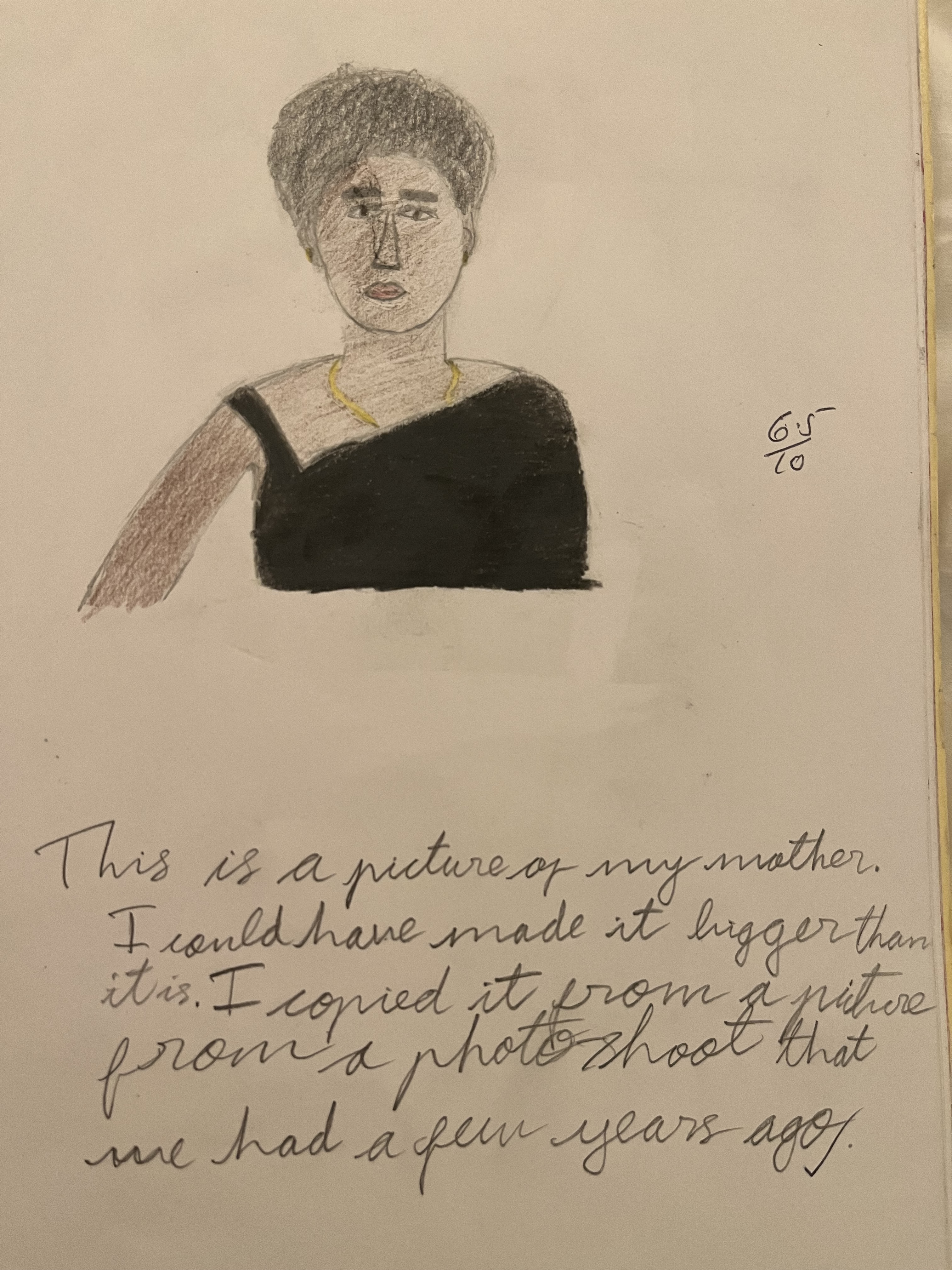
The day is the day.

(Credit:: Saagar Naresh. Age 12. Art Homework.)

It’s an ordinary day that starts as the sun peeps from somewhere behind the horizon and ends as it vanishes somewhere behind another at different times for different people on the globe scattered all over these continents everywhere. It is not a singular day as it claims to be.

It’s not my enemy and yet it circles around each year as a reminder of what happened as if I need reminding. It’s not my enemy even though it feels like one. It’s just another day, innocent and ignorant, asking me to sit down. Have another cup of tea.

It was nameless and inconspicuous until it arrived hiding a deep darkness within its light wearing the face of a sacred place and a robe of expansion and growth and holding a promise of transformation before I knew what that meant, unlocking the path to an invisible destination.

This endless path covered in thorns and nettles with no alternative or detour must be trodden with bare feet. It is essential they bleed.

To my desperate open eyes the destination remains invisible. When I let them close I glean a faint ray of hope.

Comings and goings.

As usual, I sit here at my table by the window of my study, admiring the autumnal trees standing in the park across the road, looking for inspiration to write. They have been my encouraging companions for years. The difference is that today might be the last time I write sitting here.

Early autumn has cycled back again. The fullness of the moon has synchronized with the one eleven years ago. The comings and goings of the seasons, of the world carry on as usual. Moving away from this home to live elsewhere was unthinkable at one time. But now, the heart has settled. It knows things it did not before. It carries a treasure of love and memories. Saagar lives in this heart now. He cannot be left behind. He is with me everywhere.

This, our home is ‘under offer’ now. A young couple wants to buy it for the same reasons we did twenty years ago. A quiet street. A diverse neighborhood. A garden. Parks and good schools nearby. Last few days of packing up have been intense. Things that have surfaced from deep recesses – a handheld Nintendo Gameboy carefully wrapped in its purple case, a proper Canon camera, one black sock with TUESDAY on it in yellow bunched together with another with SATURDAY printed on it in green.

I know not to trust my memory. It often fails me. It misremembers things, puts them in the wrong order. Omits some entirely. It plays tricks, causes confusion. Forgets what I want to hold on to and remembers what I’d rather forget. Luckily, the job of the heart does not include remembering but feeling – how it feels to sit here looking out the window and then at a blank page, to fold a much-loved photo in silk and cover it in more soft clothing, to look at an empty room and see it filled with light, to know it’s okay. I can trust this thing in the center of my chest. It’s all okay.

Bad mother.

She had been admitted to a separate room in the Birth Center because of her special circumstances. The thing was written all over her notes.

“Congratulations Vicky! You have a beautiful baby boy. Do you have other kids?” the doctor’s voice boomed from behind the drapes covering Vicky’s legs. She was grieving her first born, Oliver. Only six weeks prior, his brain tumour had ended his sweet little life. He was three. The doctor should’ve known but he didn’t. Did he not read her notes? Did no one tell him?

She kept quiet and so did her midwife, who knew. She let go of Vicky’s hand and walked south to whisper something in the doctor’s ear. His question remained suspended on top of her head like a heavy cold fog.

Vicky lay there, admonishing herself for the time Oliver had asked her for a cuddle. She was so tired, she was unable to stand up. The last few weeks of her second pregnancy and the last few weeks of Oliver’s life had mercilessly clashed and she was trapped in the middle. She wished for more strength. She wished Oliver had been home to receive his little brother. His sweet round face with blue google eyes danced in front of her eyes. The new baby had been cleaned and weighed. He lay in the cot while she danced with Oliver in her dreams.

Back in her room, the midwife fished out a smiley portrait of Oliver and set it on Vicky’s bedside table so she could see his face. Susan, her friend from the Lamaze classes came with a bunch of red roses. In those days that was allowed. “You have the perfect replacement.” she leaned down to kiss Vicky on the cheek, holding her own belly with her right hand.

Forty-five years later, Vicky still says “Bad mother” to herself for not having given Oliver more cuddles, especially the one he had asked for. She has not forgotten his smile or his suffering. She still believes her doctor was callous. She wishes Susan had not said what she said.

The kindness of that nameless midwife still brings a smile to her face and a tear to her eye.

*** *** ***

(On Unresolved parental grief , research says that parents who have not worked through their grief are at increased risk of long-term mental and physical illnesses. Core helps parents grieve and grow together.)

Everywhere.

A year or so after Saagar, one Saturday morning we were driving on the M4 to see Simon’s mum. As we tuned into BBC Radio 4, my ears were assaulted by the prefix, ’committed’. Neither the BBC, nor the psychiatrists knew better. They hadn’t learnt that crimes are ‘committed’. Not suicides. Suicides came from a desire to end insufferable emotional pain. Either these people didn’t know or they didn’t care enough to modify the words that habitually barfed out of their mouths. That prefix is so firmly embedded in the English language that it thoughtlessly rolls off our tongues. Suicide was a crime in the UK before 1961. It is still a ‘sin’ according to some good men and women of God. Hence, the default prefix, “committed”. That has to change. Like people who sadly die of cancer, people die of Depression and Schizophrenia and the like. They do not “commit” a crime.
Part of me was grateful they were talking about it, even if their language was wrong. I tried not to get too put off by that. I had not heard so many conversations about it before. Had something changed or had I not been listening all this time?
My mind could no longer handle long complicated, rambling books. It forgot names, lost plot lines and wandered off, out the window within minutes. Short and gentle texts, it could deal with but nothing that puts too much cognitive load. I asked a helpful librarian to recommend a couple of small books. She pulled out ‘The sense of an Ending’ by Julian Barnes and ‘The French Exit’ by Patrick deWitt. Both the stories had suicide at the center of it. I have read many books but couldn’t remember this theme arising so often.
I joined a short-story writing course at the Himalayan Writing Retreat. The award-winning author, Kritika Pandey, our teacher asked us to read ‘Why I decide to kill myself and other jokes’ by Douglas Glover beforehand. My heart pounded right through those sixteen pages. I was asked to pay attention to the technical details – the elliptical way in which the word ‘blue’ appears at periodic intervals, the sub-plot involving the dogs, the side-story of Hugo’s mum, the symbolism of the car – all of these were lost on me. I was inside the protagonist’s head, feeling her dread, her quandary and her hopelessness. It was in my face again.
The e-mail from the V&A was advertising an Alexander McQueen exhibition.
The film on TV tonight was ‘The Hours’.
The book that fell off the shelf and broke its spine today was ‘The First Forty-Nine stories’ by Earnest Hemingway.
This blasted thing that came out of nowhere, is now, everywhere.
Had my eyes and ears been shut for all these years?

Or, I wonder if, like many others I was not aware of my belief – this kind of thing only happens to others?

PS: The author, Earnest Hemingway and the fashion designer Alexander McQueen, both ended their own lives. ‘The Hours’ is a film based on a book by Michael Cunnigham with Virginia Woolf’s suicide at the center of it.