Two suitcases, three homes.

Diwali at home with Mum and Dad – after ages!

Nineteen months passed before I could travel again. The uncertainty in the air for all this time meant no one knew when they would see their close family that lived in far-off countries. The news relayed the horrendousness of the situation in India and the 6700 kilometers between them and me made me feel utterly powerless. I would have flown to India at least thrice in this time but I waited for it to become possible.

Then, it did. Si booked my tickets and I felt like I was flying already but coming up to the date of travel, the extra layer of bureaucracy turned me into a tight knot of nerves. This test, that certificate, the other QR code, the timing of this, the reference number of that, one on-line form to be filled on the way out and another on the way back and so on and so forth. I had 2 close friends on speed dial, one in India and the other, a frequent flyer in the UK.

Yet, in the run up to the date of departure, my antacid consumption seriously shot up. In my awful dreams, the faceless uniforms looked at my paper work and shook their heads from side to side. They sent me back home from the airport. They told me I would have to quarantine at the other end in a seedy hotel for 10 days. That would eat up more than half my holiday. I woke up in a bath of sweat.

My two suitcases were mostly packed with chocolates, cheeses, cheese-crackers, sheep’s wool, woolly jumpers, bamboo socks and other such goodies for my folks. I got on the plane at Heathrow and landed at New Delhi safely, utterly grateful to be united with all my loved ones back home. How much I take for granted!

I immersed myself in the everyday life back home- boiling milk, making chapattis, creating rangolis at Diwali, indiscriminately consuming sweets dripping in desi ghee, singing, praying, chatting and overeating at every meal. I set aside my concerns about pending jobs, deadlines for writing assignments, hacked e-mail accounts, consciously locked them away in a clanking steel Godrej cup-board.  

Yes, there was pollution and poverty. There was religious and political bigotry. There was the Right and the Left and the Middle, the Farmer’s protest, the choked Press and the Covid dictats. There was my mind, noticing that Saagar was not physically present in the room. His cousins were messing about, grandma was cooking his favourite chicken curry, Olivia Rodrigo was singing ‘Jealousy Jealousy’ on the Bose speaker, his uncles and aunts were drinking beer and chomping on roasted, salted cashew nuts, talking about the joys of driving on the new highways network and the high price of petrol. We were celebrating our togetherness but he was not here.

In that thought, he became present to me. His essence appeared in the room, as me, my presence, my noticing, my love and my longing. It was subtle, only perceptible at a certain frequency that in now accessible to me. This nameless, formless realm that makes itself known when I pay attention. My real home. Its doors always open.

Before I knew it was time to come home. My two suitcases filled with silk and cotton fabrics, saris ‘borrowed’ from my mother, home-made carrot halwa, cashews and almonds and proper Darjeeling tea.

I am back home from back home now. Rested and reconnected. Refreshed and reassured.

All is well. All is well.
A report and a film.

A report published last month by National Child Mortality Database (NCMD) identifies common characteristics of children and young people who die by suicide between 1st April 2019 and 31st March 2020. It investigates factors associated with these deaths and makes recommendations for policy makers.

Every child or young person who dies by suicide is precious. These deaths are a devastating loss for families and can impact future generations and the wider community. There is a strong need to understand what happened and why, in every case. We must ensure that we learn the lessons we need to, to stop future suicides.

Key Findings:

-Services should be aware that child suicide is not limited to certain groups; rates of suicide were similar across all areas, and regions in England, including urban and rural environments, and across deprived and affluent neighbourhoods.

(No one is immune.)

-62% of children or young people reviewed had suffered a significant personal loss in their life prior to their death, this includes bereavement and “living losses” such as loss of friendships and routine due to moving home or school or other close relationship breakdown.

(Saagar was unable to return to his life at University due to a new diagnosis of a mental illness.)

-Over one third of the children and young people reviewed had never been in contact with mental health services. This suggests that mental health needs or risks were not identified prior to the child or young person’s death.

(Saagar had been in contact with Mental Health Services but they discharged him as soon as he showed signs of improvement. They did not follow him up. His GP was unable to identify his high risk of suicide despite his Depression scores being the worse they could be for at least 4 weeks.)

-16% of children or young people reviewed had a confirmed diagnosis of a neurodevelopmental condition at the time of their death. For example, autism spectrum disorder or attention deficit hyperactivity disorder. This appears higher than found in the general population.

(Saagar did not.)

-Almost a quarter of children and young people reviewed had experienced bullying either face to face or cyber bullying. The majority of reported bullying occurred in school, highlighting the need for clear anti-bullying policies in schools.

(At his Primary school in Belfast, his peers called him ‘Catholic’. He didn’t know what it meant but he knew it was not right. This went on for more than a year before I found out. When I spoke to his class teacher about it, she denied any problem.)

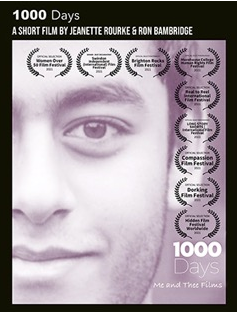
The film ‘1000 days’ tells us about Saagar and what we have learnt from his life and death. I am not sure what or how much the policy makers and service providers have learnt or changed but we have learnt and changed a lot and here we talk about that. The film is presently available on-line at the Waterford Film Festival (Short Programe 6), till the 15th of November at the link below. Please take 20 minutes to watch it if you can. You will learn something too. Each one of us can make a difference.

https://waterfordfilmfestivalonline.com/programs/collection-jlvwfxb8ctq

Not ‘them’ and ‘us’. Just ‘us’.

It has been a dream to be face-to-face, talking about Saagar with the Psychiatric community. In the past 7 years that has not really happened. On Wednesday, the 15th of September, I got as up close as possible with an entire department of roughly 100 psychiatrists and Therapists at differing levels of experience and practice. They were in New York and I was here, in London. The Grand Round was organised by a colleague, Prof Mike Myers, who gave it the title:

‘Losing a Son to Suicide: How One Mother is Opening Hearts and Minds Around the World’

After a cordial ‘meet and greet’, the film ‘1000 days’ was screened. It was followed by complete silence. Same as the previous time it was screened. And the time before. Each time the audience was left speechless.

After a long minute I gently stepped in with the assurance that this was a normal response. I invited questions and comments. I thanked them for the work they do and acknowledged how difficult it is for the profession to deal with such losses. I shared my hope that the film will deepen their insights into the human element of such deaths and the value of forging partnerships with bereaved families.

What followed was a fulsome, creative and holistic exchange of ideas.

“What led you to make this film and share your life in this way?” one young Resident asked me.

“I could only work with what I had and do what was in front of me. When I could write, I wrote. When I could speak, I spoke. When I could learn, I learnt. From the moment I heard the news of Saagar’s death, my only intention was that this must stop. No one should have to suffer the way Saagar did or the way I and his friends do. This film came about because it’s time we recognize that these lives are worth talking about, that the desire to end one’s suffering is a normal human desire and that we all have a role to play.”

Winner – BEST DOCUMENTARY – Swindon Independent International Film Festival
Winner – Brighton Rocks Film Festival – Spirit Award
Winner – Compassion Film Festival Colorado – Reflections of Love People’s Choice Award
Nominee – Morehouse College Human Rights Festival Atlanta (winners yet to be announced) 
Semi Finalist – Gold Coast International Film Festival – New York 
Nominee – Long Story Shorts International Film Festival 

Upcoming festivals where the film can be watched starting 23rd September 2021. Tickets available now.

‘1000 Days’  
Morehouse College Human Rights Film Festival – fosters ongoing discussions about human rights and social and political issues.
September 23 – 25 https://morehousehumanrightsfilmfestival.com/2021-film-guide/

‘1000 Days’ at Women Over Fifty Film Festival:
WOFFF is an inclusive, international film festival celebrating women over 50 in front of, and behind the camera.
25 Sept – 2 Oct – tickets on sale
https://wofff21.eventive.org/films/61379c142c09f100b90ae7c4

Comments:

”Bringing people closer and keeping them deeply connected despite social isolation.”

“Keeping the silk threads of human bonds as strong as ever.”

Now, they are pink.

The day after he died, our door-bell went berserk. This time the same young woman from the local florist, who had been here thrice already, stood at the door again. She had arrived with yet another bouquet of pure white lilies and roses. She stood just outside our front-door with tears rolling down her cheeks. Had this stranger accessed her own sadness or was she feeling mine? I thanked her and tried to console her, wordlessly holding her hands in mine, not believing any of that was happening.

Our eyes met through the fresh white flowers and films of salt water. She didn’t know me or the young man who had died and I didn’t even know her name. But we were flowing in the same river of humanity. Of loss.

For weeks, every room in our house reeked of the sickly-sweet stink of white lilies. I used to like that fragrance before all this but now it screamed ‘DEATH’. It crept into every empty space, crevice and corner. It sneaked under tables and inside locked cup-boards. It suffused my clothes and hair and got into my body like poison.

All these years later, that smell can still hit like an axe on top of my head when I walk past an innocent flower shop.

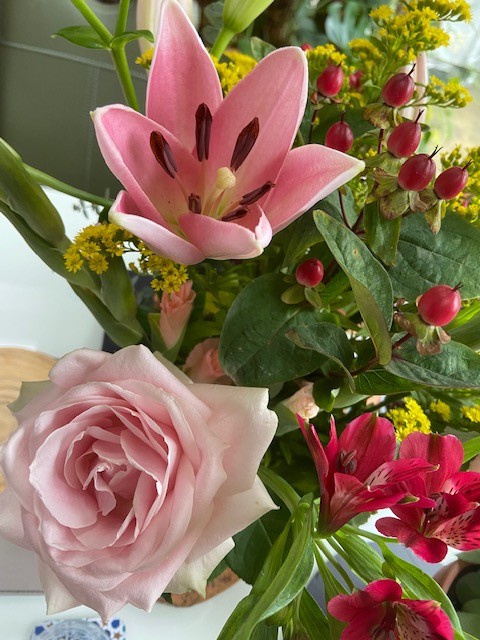
On my birthday last week, a bunch of Freddie’s flowers arrived unexpectedly. I thought I had cancelled that delivery but it seems I hadn’t. Roses, lilies and gladioli – but this time, they are a pretty pretty pink. Six days on, they are open and smiling and guess what … no heart-breaking fragrance.

Our long-distance relationship is working. Thank you, sweetheart.

One moment on a Friday morning.

Time is a scaffolding. Not the real thing. A construct. A transactional entity. An illusion. A convenience. A cage.

The Time is always Now.

Right now I hear Si pottering in the kitchen downstairs.

Michael, his friend is waiting in his car outside the front door. The engine is whirring, parked slightly to the left of the middle of the road with just enough space for passing cars to slide past.

My second cup of tea is waiting. Steaming.

The sunshine had penetrated many curtains to reach the park across the road.

The wind is gently encouraging the trees to wake up and dance.

The indoor plants watered this morning are feeling fresh. A large green Poinsettia (from last Christmas) on my left and a pink orchid on my right.

The ‘to-do’ list is staring at me from the far side of my table, feeling left-out. My Mind is pulling hard at me, trying to get me out of writing, into ‘doing stuff’. I am watching it. It looks like a toddler yanking at her Mum’s dupatta pleading for attention.

Black and green bins are lined up in tidy rows on the pavement along both sides of our street, waiting to be emptied. Five years ago, when the bin-collection day changed from Tuesday to Friday, I immediately thought I must tell Saagar. Then I remembered. Now, I think of him when I see the bins. I recall us putting the bins out together. In the Now. I feel that memory become a twinge in my chest. Sometimes, it becomes a cloud in both my eyes.

Now, I hold him in my heart on Fridays and every other day. He lives in me. Speaks through me. Sees the world and keeps me calm.

The neighbour’s son’s school bus stops at the same spot every day. He boards it wearing his yellow anorak every day. He sits at the same seat every day – by the window on the left, second row from behind.

The world goes on and I go on with it, carrying you in me. Loving you. Keeping you alive.