Breakable

images

A long time ago, on a Sunday morning at a village fete I saw a beautiful black-clay handmade earthenware pot. I wanted it. He said that we shouldn’t as it might break. We brought it home. A long time ago, it decorated our home for a long time.

He said if something is breakable, there is a real chance it will break, no matter how much we feel it ‘should’ not. Each time we looked at it our hearts warmed like the insides of fur mittens. He said nature had its own laws of demolition. That was a long time ago.

Another day, we brought another sweet fragile thing home. It was delicate as a little bird. It claimed all our love, our time and our sleep. It cooed and cackled and played silly games. It decorated our home for a long time. Each time we looked at it our eyes sparkled like north stars and our hearts overflowed like rivers breaking  banks. He said the cement of our love would keep us all intact and together. Forever.

We forgot that this thing was breakable. And we were breakable too. He said even if we moved across continents and oceans everything would be alright. He said even if we had nothing we would be okay. He said nothing would break. That was a long time ago.

Now the black-clay handmade earthenware pot from a long time ago sits in the centre of our living room, on a glass top coffee table, looking pretty. It’s breakable.

(Anaphora: https://www.merriam-webster.com/dictionary/anaphora)
Looking up – a true story.

At the age of 51, he was finally consumed by the very thing he loved to consume. He died peacefully in his sleep. Pat, his wife was sad but knew it was inevitable. She carried on.

9 months later her son Kevin went on a Summer camp. He was 15. The camp site had been shut all winter. 2 days before the start date, the camp site had been checked by officials and declared safe. The lads arrived with great memories of the previous year and masses of energy and excitement. They started with a race. With a big smile on his face, Mark flew to the finish line ahead of everyone else and was instantly charred.

Pat’s family wanted to take care of her. They moved her from her family home in Surrey, to a house closer to her brother’s, in Essex.  Pat went quiet. She silently and diligently pulled the shafts of her hair out from their roots one by one till she created white little clearings on her scalp. She scratched those clearings with such vigour that they turned into raw, red, weeping craters. She would empty the kettle before plugging it into the mains. She wore her clothes back to front, inside-out. She stood by the window for hours, waiting. She drove down the motorway in the opposite direction. Her family couldn’t help her. They thought she needed to be moved to an Institution for the insane.

A doctor in the Isle of Mann was well-known for his abilities in this field. Pat’s sister-in-law asked him if he would make an exception and help Pat even though she did not live on the Isle. He kindly agreed. He saw her. He unpicked her heart. He unwrapped the wounds in it. It was an excruciating process. She felt he was cruel, forcing her into the darkness of her soul with a torch, untangling the tight knots in her mind, wading through whirlpools of turbulence within.

After 5 weeks he invited her to live in his family home. He encouraged her to walk down the street. The first few times he went with her. Thereafter she walked alone, with her eyes fixated on her shoes. He suggested she try looking up and tell him what she saw. “Blossoms on trees, the church spire, white fluffy clouds, birds, light…”

By the time the hair-dresser had finished with her, she was ready to go home.

(If you or anyone you care for needs support after loosing a child to suicide or addiction: The Compassionate Friends : Supportive weekend retreat for bereaved parents: 6-8th July 2018: https://www.tcf.org.uk/content/events/91-supportive-weekend-retreat-for-parents-bereaved-by-suicide-addiction-or-substance-use/)


Inheritance of fear

The past is never dead. It’s not even past.”
– William Falkner. Requiem for a Nun.

The echoes of past traumas get subconsciously played out by us in our everyday lives. Sigmund Freud called it ‘repetition compulsion’ – an attempt of the unconscious mind to replay the unresolved so that we can ‘get it right’. This mechanism drives its way through generations. Jung also noted that whatever is too difficult to process does not fade away. It gets stored in our unconscious and finds expression in other ways. He says,” When an inner situation is not made conscious, it happens outside as fate.”

Here’s an example: Jake was 19. He hadn’t slept a full night’s sleep in more than a year. He had developed dark circles around his eyes and a blank stare in them. He looked at least 10 years older. He had been a star student and a great athlete but the insomnia had left him lifeless. This thing had no explanation and none of his doctors or psychologists or naturopaths could figure it out.

It had started with Jake waking up shivering one night at 3.30 am, frightened to death. No amount of woollen clothing warmed him up.  Soon, insomnia became a daily ordeal. Despite knowing that his fear was irrational, Jake was helpless and could not relax. The ‘freezing’ feeling associated with the first episode was quite peculiar.

On exploration of Jake’s family history, this story came out: His mum’s brother, Uncle Colin,  whom he had never met had frozen to death at the age of 19. He was checking power lines in a storm in the Northwest of Canada. He struggled to hang on but eventually fell face down in a blizzard, lost consciousness and died of hypothermia. The family never spoke his name again.

Now, thirty years later, Jake was unable to slip into sleep at the same age as his Uncle. For Colin, letting go meant death. For Jake, falling asleep must have felt the same. Once Jake could see this link, he was able to free himself of it with the help of healing techniques taught by Dr Mark Wolynn, a neuroscientist with an expertise in breaking inherited family patterns.  His book “It didn’t start with you”, describes some of these practical tools.

Scientists are now able to identify bio-markers as evidence of traumas passed down from one generation to the next. Studies on Holocaust survivors and their children have revolutionised the understanding and treatment of PTSD all over the world. Be it fear, guilt, low self-esteem or anxiety, the roots of these issues may reside in the traumas of our parents, grand-parents and even great-grandparents.


It’s a boy!

4th May 2018

It’s not a tranquil lake. It’s a torrential flash flood and it’s fast approaching. It’s coming towards me and I am putting up a big fight but not winning. I am being pushed towards it by the boulder of time. Another turn of the wheel. The approach is a rough zig-zag path with exhausting ups and 3G downs, jagged corners and innumerable pot-holes. It goes thud-thud-thud. My brain hits the hard inside of my skull multiple times as it comes closer and closer. Am I going to hold my breath when it happens?  Am I going to be submerged for longer than I can hold on? I don’t know how to swim and my limbs are pathetic. What am I going to do when it hits?

6th May 2018

It’s here – the 24th birthday of a man-child who didn’t reach his 21st. It’s a blessed day. A happy day. But it doesn’t feel that way. A painfully long weekend filled with his absence. A trip to the local park. An ice-lolly. Carrying his djembe around in the sun like a mad woman as if it’s my baby. Baking raspberry, pistachio and chocolate brownies. Holding back tears all day. Being with ‘it is like this’. A visitor. A long evening. A nice meal. An enormous hole. Massive nothingness – a vacuum that my love wants to get into but there is no way in or out. It’s sealed like a submarine.  Not a drop of water or a molecule of love can enter or leave. The void sits in the middle of my living room. My life. Starving my love of all expression. Suffocating me.

7th May 2018

It came and went. I lived. But I am not getting anywhere. I want to be someone I am not while accepting everything as it is. How can these two positions be compatible? It’s like being night and day at the same time. Not dusk or dawn – they are too serene. Do I have a realistic hope of ever getting there or am I delusional?

Does unconditional peace exist? Apparently, some folks have experienced it. I have too, for brief snatches of time. To have it as a native state of being – unblemished, pure and vast consciousness. It seems unachievable. But they say it’s possible. May be. Some day…

(Buddhist teachings by Ajahn Anando: ‘Knowing in the present’: https://www.amaravati.org/speakers/ajahn-anando/page/2/)


Project Eighty-four and more

180326102147-01-london-suicide-statues-restricted-exlarge-169

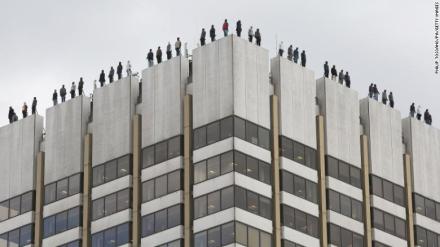
84 life-size statues of men were seen standing at the edge of tall buildings in central London in late March representing the same number of men lost to suicide every week in the UK – a hard hitting visual project aiming to bring this tragic loss out into the open from behind closed doors.

Common threads emerged from articles published in April:

“Students more likely to kill themselves” in the Times: Researchers from a Hong Kong University analysed the ONS figures and found that the number of university students in Britain increased by 5 per cent between 2012 and 2016. The total number of suicides among students increased by 32 per cent, from 139 to 183 deaths. A think tank said that a law banning universities from contacting the friends and family of students who are struggling should be revisited.

The number of first year university students reporting mental health problems in UK Universities has risen five fold in 10 years. A combination of increasing awareness of mental health issues, a lowering of the taboo previously attached to mental health services, mounting debts, homesickness, loneliness and a greater sense of anxiety about the future may be some of the reasons for it. Some vice-chancellors still think that mental well being is not the business of universities and it’s just about developing the mind. But developing minds means nothing unless students settle down well in their new environment and be ready to learn.

According to recent ONS statistics on loneliness, people between 16-24 are at the epicentre of the loneliness epidemic in the UK. More so than the elderly. Women were found to be lonelier than men. Other variables were renting a home rather than owning one, being single or widowed, having poor health and feeling disconnected from the local community.

In an article entitled “Doctors knew my son was suicidal. I should have been told before he died” in the Guardian, I raise this question yet again: Is confidentiality more important than helping someone at risk to stay alive? Is it correct for a father to be informed by doctors after the death of his son,”Now that he is dead I can tell you that this was not his first attempt”?

Is it?