Day 997

Moving home

The experts on the gardening programme  on the radio said that repotting is traumatic for plants. I had never thought about that before. Should it be any different for children and families moving house?

By virtue of my dad’s job, we moved more or less every 2 years. Some of the places we lived in are not easy to find on the map of India. I completed 12 years of schooling in 8 different schools in India. It was normal to be the new girl in class. We went to schools that catered to families that moved frequently. So, often there would be other new kids in class too. It was heart-breaking to leave friends just when our friendships were deepening. As time went on, it became a part of life and although it was sad, I could handle it much better. That was partially because I altered the quality of my relationships. I didn’t allow them to get too deep. I protected myself by holding back a bit of me for myself. That bit would always be safe. I didn’t know I was doing it then but I see it now.

The cycle repeated itself with Saagar. The difference was that he travelled outside India to places where he would be the only coloured kid in class, where they spoke a different language in a peculiar accent, where he had no close friends or extended family, where it was normal for people to live all their lives in one place and be buried in the cemetery two streets away from their primary school.

Grief can come in intangible forms – loss of trust, loss of innocence, loss of safety, loss of childhood, loss of control and loss of faith.  A 2010 study of 7,000 American adults found that the more times a person had moved house in childhood, the more likely they were to report lower life satisfaction and well-being, irrespective of their age, gender and education.

Reasons, timing and location matter. The good news is that something can be done about it.
Day 993

Ruth

churchhealing

Broken glass

“You are well enough to safely go home now”, said the panel.
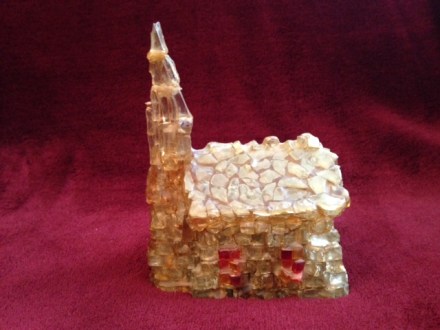
“But I can’t! I need one more day to complete my church!”, said Di, who was being treated at Bexley hospital for Postnatal Depression in 1966. She had a brilliant occupational therapist who took them to the swimming pool, organised hair-dressing days and helped patients to make things. Di made a church with bits of shattered wind-screen glass, put together with resin but the spire wasn’t on yet. This beautifully tactile piece of art was named ‘Faith’ by Ruth, her daughter.

Ruth

Ruth was a talented young lawyer. She was an actor and singer. She was kind, generous and gorgeous! She travelled extensively. She was diagnosed with Bipolar Disorder in her late 20s. She coped well with the help of health services, her friends and family but tragically lost her battle at the age of 47.

Di is in her second year of missing Ruth terribly. She has created the most beautiful garden in her memory. Some of the plants there are from Ruth’s house. Her mediterranean wall is stunning.

Mediterraneanwall

Being bereaved by suicide is a huge risk factor for suicide. Around 125 youth suicides a year occur soon after the person involved has experienced a bereavement. One in four (25%) of under-20s and 28% of 20 to 24-year-olds had lost a relative, partner, friend or acquaintance around a year or more beforehand. In 11% of suicides among under-20s, the person who those involved had lost had also taken their own life.

In a recent inquiry, bereavement was found to be an important theme in many deaths, said Prof Louis Appleby, the director.

People who have been bereaved need greater support to reduce the risk of them killing themselves. Agencies who are meant to help are not good at recognising this risk and need to improve.

This morning I caught up with Di over a cup of tea. We both believe that if Saagar and Ruth have met each other wherever they are, they must get on famously. The link below is a conversation with Di. She talks about her insights on mental health services over 5 decades. Thanks a lot Di!

Day 990

stock-photo-mans-coat-hanging-on-a-handle-of-a-vintage-door-84244456

The Hook

Couldn’t believe that Saagar was gone on Day 1 or Day 10 or Day 100 … and soon it will be Day 1000. Still, life goes on. Still struggle with it. A lot!

Everything has changed – the world, me, my relationship with the world. I have been walking, sometimes crawling, up a steep learning mountain. Still am. Sometimes flattened by it. Many of you have been walking with me, keeping me fun, encouraging and comforting company. We have spent a lot of time together and there is so much more to do, share and learn.

This blog has been the hook on which I have hung my days. It has kept me from irretrievably crashing on the floor and getting decimated. It had held me together. It has been an ever-present friend, always willing to listen and receive, the stage on which I have shown Saagar off and poured my love for him, a rubbish bin into which I have chucked my pain, anger and regrets.

Coming up to Day 1000, I am filled with anticipation as I know it is time to loosen my grip, to place a little more faith in life and ride my bike with ‘no-hands’ for a bit. I feel the time is right. It is with trepidation that I make this proposal to myself that after Day 1000 I shall post a blog every Thursday. Or will it be Day 1001?

“You who walk, your footprints
 are the road and nothing else
 There is no road, Walker.
You made the road by walking.
By walking you made the road
And when you look backward
you see
 the path that you will never step on again.
Walker, there is no road,
Only wind-trails in the sea.”

– By Antonio Machado (PROVERBIOS Y CANTARES – XXIX)


Day 989

Accidental findings

The_ACE_Pyramid

In the mid 80s, Dr Vincent Felitti ran an Obesity clinic in America. Many people enrolled and hundreds of pounds were shed by them. But he found that the drop-out rate from his programme was as high as 50% despite good results. He did not understand this and went back to look closely at patient notes.

“I had assumed that people who were 400, 500, 600 pounds would be getting heavier and heavier year after year. In two thousand people, I did not see it once. When they gained weight, it was abrupt and then they stabilized. If they lost weight, they regained all of it or more over a very short time.”

The turning point in Felitti’s quest came by accident. He was running through yet another series of questions with yet another obesity program. How much did you weigh when you were born…when you were in first grade…when you were in high school…when you first became sexually active…

One female patient replied – “Forty pounds” and broke down in floods of tears, “I was four years old.” He found similar common themes emerging from various stories and went on researching this subject for the next 25 years.

The obese people that Felitti was interviewing were 100, 200, 300, 400 overweight, but they didn’t see their weight as a problem. To them, eating was a fix, a solution like IV drug user calls a dose a “fix”.

Eating made them feel better. Eating soothed their anxiety, fear, anger or depression – it worked like alcohol or tobacco or methamphetamines. Not eating increased their anxiety, depression, and fear to levels that were intolerable. For many people, just being obese solved a problem. In the case of the woman who’d been raped, she felt as if she were invisible to men.

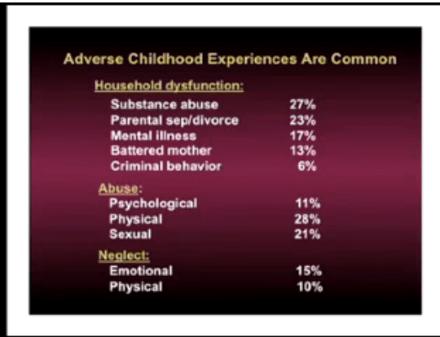
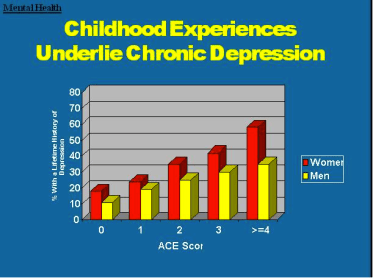
Felitti went on to further explore the  impact of childhood trauma on people and coined the term – ACE, Adverse Chilhood Experience. He found a strong co-relation between the number of ACEs and early death.

aceslist

acedepression

Film: https://www.youtube.com/watch?v=v3A_HexLxDY


Day 982

images

Many years ago in India it was traditional to keep the best nibbles like almonds and cashews stored away, for guests, often under lock and key. I understand the same practise was common throughout the middle east and in many house-holds in Europe. Although in Europe it translated to the best whiskey and brandy.

Many of these traditions have their roots in the honoured position of a guest. In Hindu belief system, God can arrive at our doorstep in any form and hence it was imperative to treat all guests, friends or strangers with great respect.

This attitude is not limited just to things. It sometimes transfers to people. While there is nothing wrong with honouring others, it does not have to be at the cost of dishonouring ourselves or those closest to us. Things may be in limited supply but love and respect are not. It’s not unusual to see people treat their friends in the best possible way and their spouses and children in the worst. Everyone else’s mistakes are easily forgiven but slightest mistakes of close family members are made to look far worse than they are.

I have learnt to honour myself and those close to me as much as a guest. Said ‘God’  resides in me and my dear ones too. Besides,  I love almonds.